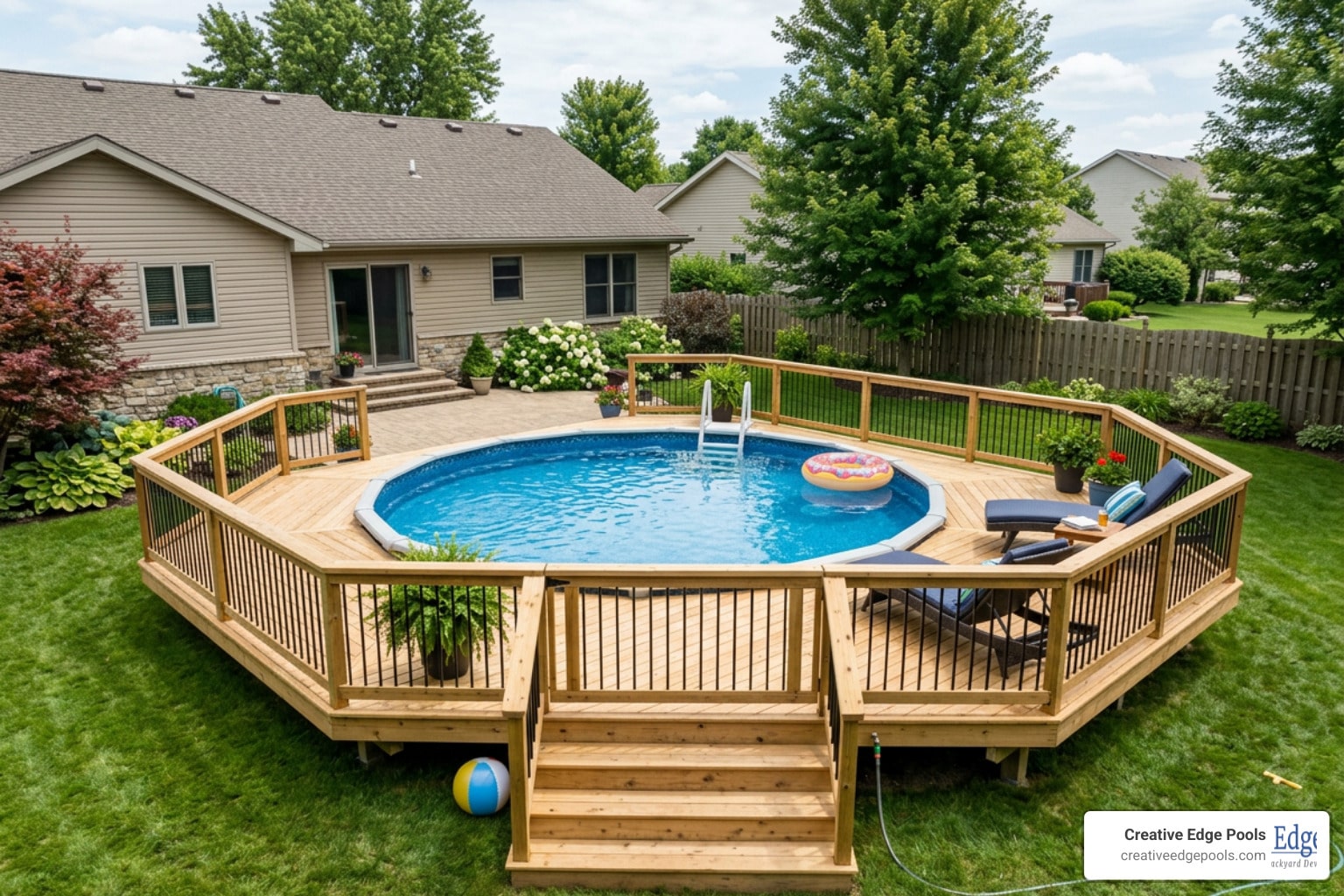
What Is a Floating Deck Around an Above Ground Pool — and Is It Right for You?
A floating deck around an above ground pool is one of the smartest upgrades you can make to a backyard in Massachusetts or New Hampshire. Instead of a deck bolted to your house or anchored with deep concrete footings, a floating deck is a freestanding platform that sits on precast pier blocks or ground-level anchors — completely independent of any structure.
Here’s what you need to know at a glance:
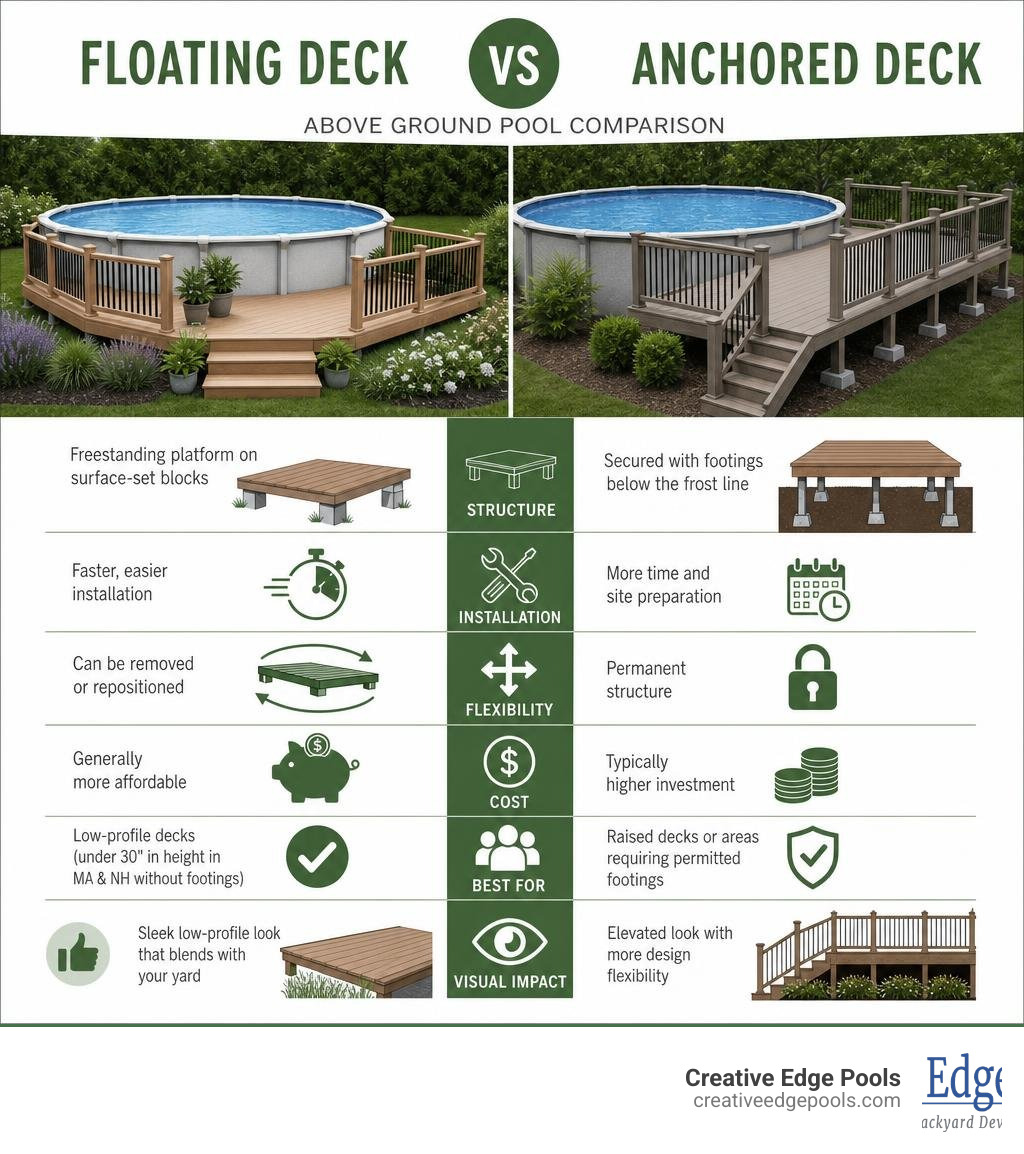
- What it is: A freestanding deck platform built around your above ground pool, supported by surface-set or shallow pier footings rather than deep concrete
- Why homeowners choose it: Easier and faster to build, handles New England’s freeze-thaw cycles better in many situations, and doesn’t require breaking into your home’s foundation
- Best for: Above ground pools where a full wrap-around or partial deck is desired without the cost and complexity of poured concrete footings
- Key limitation: Local codes in MA and NH often restrict floating (non-footed) decks to structures under 30 inches in height — taller builds typically require permitted footings
- Typical cost range: Industry averages for above ground pool decks run from $3,000 to $25,000+ depending on size, materials, and complexity (these are publicly sourced averages, not Creative Edge Pools pricing)
The appeal is real. An above ground pool on its own can feel temporary and out of place. Add a well-designed floating deck, and suddenly that backyard in Andover, Wilmington, or Hampton, NH looks like a planned outdoor living space — not just a pool dropped on a lawn.
But “floating deck” means different things to different people, and making the wrong choice for your soil type, pool height, or local zoning rules can create headaches down the road.
This guide breaks it all down — materials, design, code requirements, costs, and when to call a professional.
Explore more about floating deck around above ground pool:
Why Build a Floating Deck Around Above Ground Pool Systems?
When planning a pool surround, structural engineering is your most important consideration. A floating deck around an above ground pool relies on a freestanding foundation. This means the deck is completely self-supporting and does not attach to either your home’s ledger board or the pool structure itself.
By keeping the deck freestanding, you avoid breaking the waterproof envelope of your home’s siding. Traditional decks attached via ledger boards require flawless flashing and sealing to prevent long-term rot and water damage. A freestanding design completely bypasses this vulnerability.
Furthermore, above-ground pools are not engineered to carry lateral loads or the weight of a deck. Attaching joists directly to the pool wall can warp the frame, puncture the liner, or cause a catastrophic structural failure. A floating deck stands on its own feet, protecting your investment.
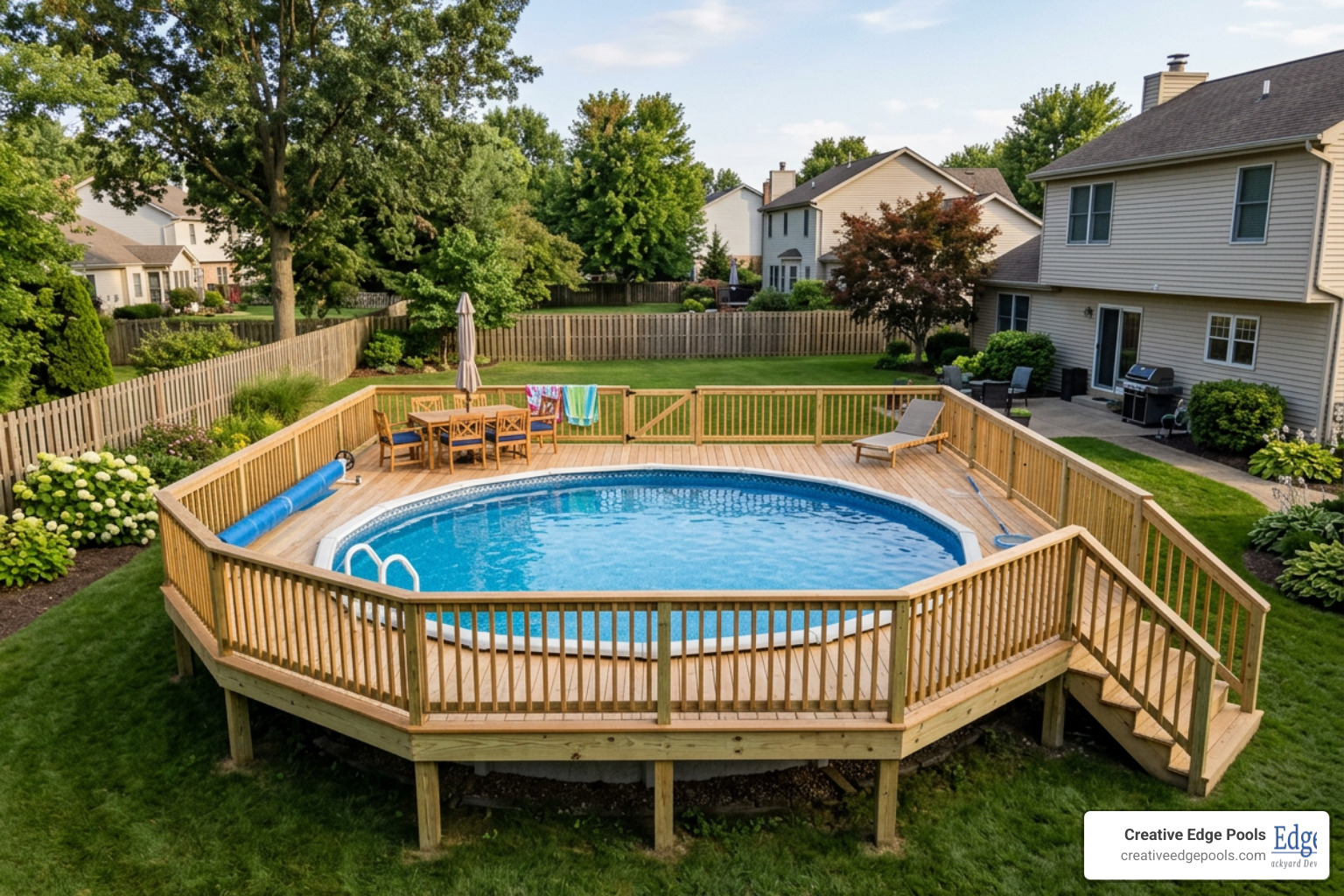
To learn more about various layout styles and structural approaches, check out our Pool Decking Complete Guide 2026.
Structural Benefits: Frost Heave and Ground Movement in New England
New England’s climate presents unique challenges for outdoor construction. In places like Andover, MA and Hampton, NH, the winter freeze-thaw cycles cause significant ground movement. Clay soils and moisture-heavy ground expand when frozen, pushing upward with immense force—a phenomenon known as frost heave.
Traditional decks rely on concrete footings poured below the local frost line (typically 42 to 48 inches deep in Massachusetts and New Hampshire) to remain stationary. However, if a footing is not poured perfectly, or if clay soil grips the concrete pier, frost can still lift the structure unevenly.
A floating deck handles this movement differently. Because it sits on the surface using precast concrete blocks or specialized deck anchors, the entire structure is designed to rise and fall uniformly with the soil. During a hard winter freeze, a floating deck may rise about 1/2 inch to an inch (and up to several inches in dense clay soils) and then settle back down naturally in the spring.
As detailed in the Above Ground Pool With Deck: Complete Design & Installation Guide (2026), allowing the deck to ride the seasonal wave prevents the structural warping, cracking, and fastener shearing that occurs when one part of a deck is anchored deep in the ground while another part shifts.
Designing a Floating Deck Around Above Ground Pool Layouts
Designing a deck that harmonizes with a circular, oval, or rectangular above-ground pool requires careful planning of heights and clearances. The top of the deck should sit flush with or slightly below the pool coping (the top edge of the pool wall). This creates a seamless, high-end look and prevents tripping hazards.
When positioning the deck framing, you must leave a clearance gap between the deck and the pool. We recommend maintaining a 1/2-inch to 3/4-inch gap between the deck boards and the pool coping. This gap ensures that as the ground shifts during seasonal changes, the moving deck will not crush or scrape the pool wall.
Additionally, we recommend running the deck boards slightly beneath the pool rails rather than butting them directly against the side. This clever design detail ensures that when the pool liner eventually needs to be replaced, the pool technician can access the top rails without needing to cut or dismantle your beautiful deck.
For more inspiration on blending your pool deck with your yard’s natural topography, explore our Backyard Above Ground Pool Landscape Ideas.
Materials and Engineering for a High-End Floating Pool Deck
Because a pool deck is constantly exposed to splashing water, chlorinated or saltwater pool chemicals, and bare feet, material selection is critical. The framing must be structurally sound, while the surface must resist moisture, rot, and splintering.
| Material Type | Splinter Resistance | Maintenance Required | Lifespan | Slip Resistance |
|---|---|---|---|---|
| Pressure-Treated Lumber | Low (can splinter over time) | High (annual sealing/staining) | 10–15 Years | Moderate |
| Composite Decking | Excellent (barefoot friendly) | Low (periodic washing) | 25–30 Years | High (textured finishes) |
| Tropical Hardwood (Ipe) | High (very dense) | Moderate (oil to keep color) | 30–50+ Years | High |
While pressure-treated wood remains a popular choice for framing due to its cost-efficiency, composite decking and tropical hardwoods are highly recommended for the surface. Composite decking resists warping, fading, and moisture absorption, making it an exceptional long-term investment for wet environments.
To see how these materials fit into a broader backyard aesthetic, check out our guide on Pool Landscaping Ideas.
Key Components of a Floating Deck Around Above Ground Pool Projects
A floating deck relies on a system of specialized components working together to distribute weight and maintain lateral stability without deep foundations:
- Precast Concrete Piers (such as Dek-Bloks): These 12x12x8-inch concrete blocks sit directly on a prepared gravel base. They feature molded slots to hold 2×6 or 2×8 joists and a center recess for 4×4 vertical support posts.
- Sub-Base Preparation: To prevent uneven settling, the sod must be removed under each pier. We recommend excavating a shallow area, laying down geotextile fabric, and compacting a 3-inch layer of crushed stone or gravel to create a stable, draining foundation.
- Joist Framing and Lateral Bracing: Because above-ground pools sit 3 to 6 feet above the ground, any deck built to meet the pool rim will have tall support posts. To prevent swaying or “racking,” diagonal cross-bracing is absolutely essential between the posts.
- Joist Tape: Applying protective joist tape to the top of all framing members prevents water from trapping between the deck boards and joists, significantly extending the life of the wood.
For a classic look at traditional framing layouts, you can review structural concepts in the Popular Mechanics Pool Deck Plans.
Professional Installation vs. DIY: Code Compliance and Safety
While a simple ground-level platform deck is a common DIY weekend project, building a raised deck around an above-ground pool is a highly complex structural undertaking. In Massachusetts and New Hampshire, safety regulations and building codes are strictly enforced to protect homeowners and guests.
Under the International Residential Code (specifically IRC R507), decks that are more than 30 inches above the adjacent grade require detailed structural plans, specific load-bearing capacities (usually 40 lbs per square foot live load), and engineered guardrails. Furthermore, the International Swimming Pool and Spa Code (ISPSC) dictates that pool decks must have secure barriers at least 48 inches high with self-closing, self-latching gates that swing outward away from the water.
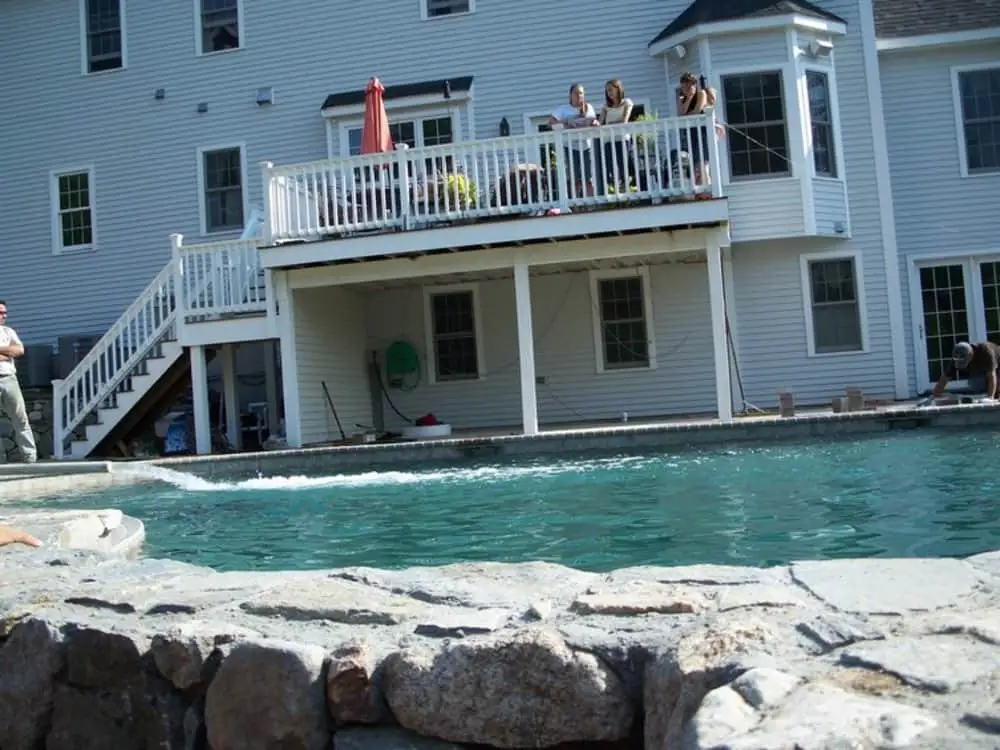
In towns like Wilmington, MA and Exeter, NH, local building inspectors often restrict the use of floating pier blocks for any deck that sits higher than 30 inches off the ground. For these taller structures, building codes frequently mandate poured concrete footings extending below the frost line to guarantee structural safety and wind-uplift resistance.
Navigating these permits, setback requirements (often 5 to 10 feet from property lines), and electrical bonding codes requires professional expertise. Hiring an experienced contractor ensures your deck is fully compliant, safe, and built to last. Learn more about professional structural additions on our Hardscaping Near Me page.
Cost Analysis and Long-Term Value
An integrated pool-and-deck environment completely changes how you use your backyard. Beyond the immediate lifestyle benefits, homes with beautifully integrated pool-and-deck setups sell for 5-10% more than comparable properties with standalone, un-decked above-ground pools. A well-constructed deck turns a temporary fixture into an attractive, permanent-looking estate feature.
Understanding the Investment and Pricing Realities
When budgeting for your backyard transformation, it is helpful to look at general market trends. Based on publicly available internet data, the average cost to build a standard deck around an above-ground pool typically ranges from $3,000 to $12,000.
However, because custom site conditions, premium materials, and professional labor rates vary widely throughout Massachusetts and New Hampshire, realistic project costs for a high-quality, professionally built deck usually fall into a much broader range:
- Estimated Custom Project Range: $10,000 to $60,000+ (This wide range reflects industry averages for professional custom design, site excavation, premium composite or hardwood materials, structural bracing, and code-compliant safety railings. Please note that these are average costs sourced from public online data and do not represent the actual pricing of Creative Edge Pools.)
Investing in premium materials like composite decking or tropical hardwoods will push your initial material costs higher, but it dramatically reduces your annual maintenance costs and ensures your deck remains beautiful for decades.
Frequently Asked Questions About Floating Pool Decks
Do floating decks require building permits in Massachusetts and New Hampshire?
Yes. In almost all jurisdictions throughout MA and NH, any deck built around a swimming pool requires a building permit. Even though a deck is “floating” on the ground, it acts as a pool access platform and must comply with strict safety barrier codes, height restrictions, and zoning setback regulations. Always consult your local building department before starting construction.
How does a floating deck handle winter freeze-thaw cycles?
A properly constructed floating deck handles the freeze-thaw cycle by shifting uniformly. Because it is not anchored to a fixed point in the ground, the entire platform rises slightly when the moisture in the soil freezes and expands, then settles back down as the ground thaws. Using a compacted gravel base beneath your pier blocks ensures this movement is even and prevents individual posts from sinking.
Can a floating deck damage the walls of an above-ground pool?
A floating deck will only damage a pool if it is built incorrectly. To prevent damage, the deck must be entirely freestanding and never attached to the pool frame. Additionally, leaving a 1/2-inch to 3/4-inch clearance gap between the deck boards and the pool coping ensures that when the deck shifts during winter frost heaves, it will not press against or damage the pool walls.
Conclusion
A custom deck is the ultimate way to elevate your above-ground pool, turning a simple swimming area into a luxurious backyard oasis. Whether you are looking to build a partial sun deck or a complete wrap-around entertainment space, ensuring structural integrity, code compliance, and beautiful material integration is key.
At Creative Edge Pools, we are a family-owned business with over 100 years of combined industry experience. We specialize in bringing homeowner visions to life throughout Eastern Massachusetts and Southern New Hampshire. From custom gunite designs and pool installations to comprehensive backyard development, masonry, and hardscaping, we focus on quality craftsmanship and exceptional service.
Ready to transform your backyard? Visit our contact page to request an estimate. You can also explore our custom hardscaping solutions on our Creative Edge Pools Hardscaping Services page.