
Why Getting a Deck Around an Oval Above Ground Pool Right Matters More Than You Think
Planning a deck around an oval above ground pool is one of the most impactful upgrades you can make to your backyard — but it’s also easy to get wrong.
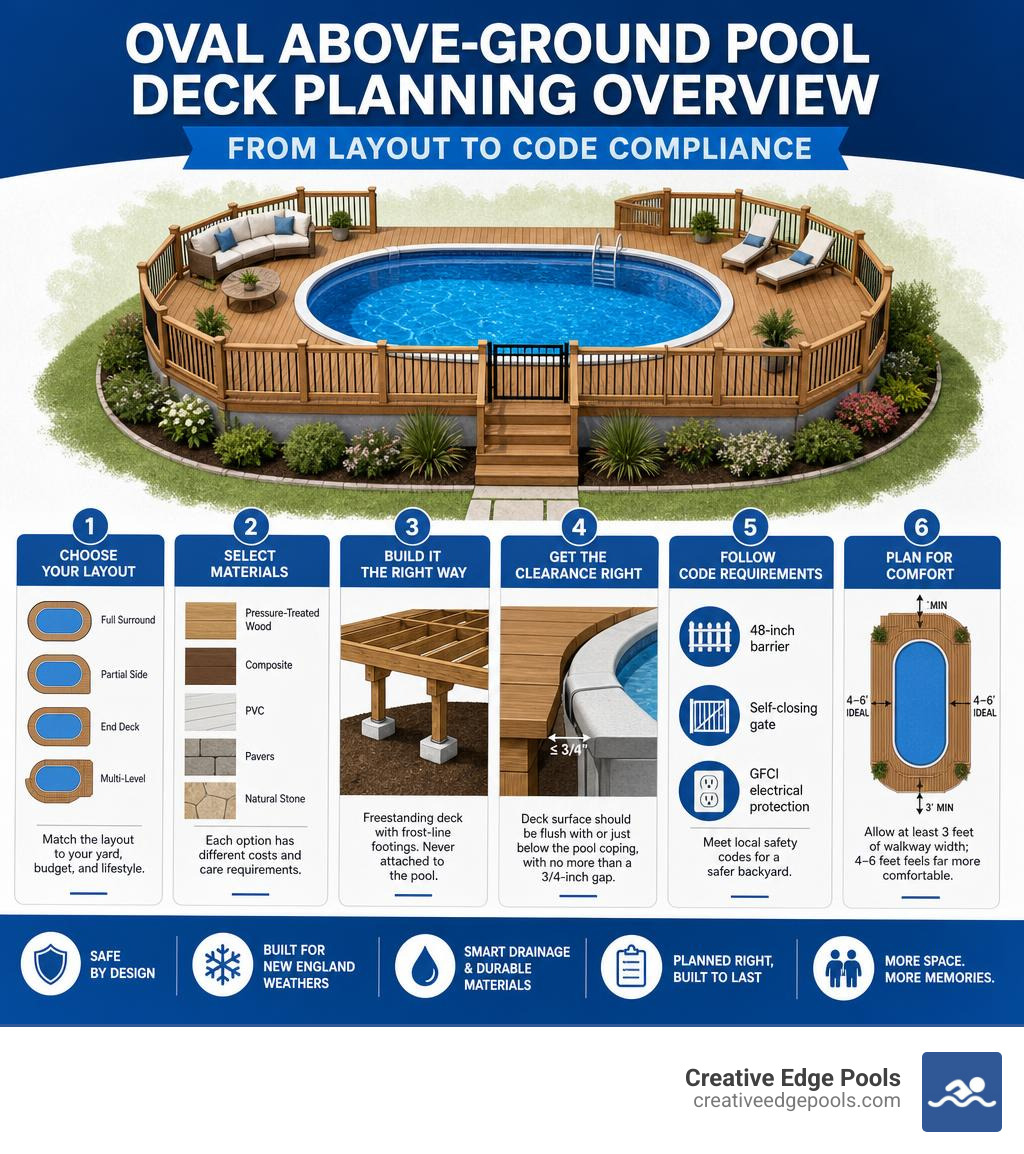
Quick answer: What goes into a deck around an oval above ground pool?
- Layout: Choose full-surround, partial side, end, or multi-level based on your yard and budget
- Materials: Pressure-treated wood, composite, PVC, pavers, or natural stone
- Structure: Must be freestanding with frost-line footings; never attached to the pool itself
- Clearance: Deck surface should sit flush with or just below the pool coping, with no more than a 3/4-inch gap
- Code: Most jurisdictions require a 48-inch barrier, self-closing gate, and GFCI electrical protection
- Size: Allow at least 3 feet of walkway width; 4–6 feet feels far more comfortable for everyday use
Oval pools have flowing curves that make deck planning more complex than a simple rectangular layout. The framing, the way boards meet the pool edge, the placement of stairs and gates — all of it must account for that curve.
Get it right, and you have a backyard that your family actually uses. Get it wrong, and you’re looking at safety hazards, code violations, or a deck that makes liner replacement a nightmare.
Homeowners across Portsmouth, NH, Dover, NH, Wilmington, MA, and Andover, MA are increasingly investing in professionally designed pool decks — and the difference between a thoughtful build and a rushed one shows up fast, especially through a Massachusetts or New Hampshire winter.
This guide covers everything: layouts, materials, structural rules, safety codes, features, and the mistakes that shorten a deck’s life. Whether you’re in the early planning phase or ready to build, you’ll find clear, professional guidance here.
Best Layouts for a deck around oval above ground pool
The best layout for a deck around oval above ground pool depends on how you want to use the space, how your yard is shaped, and how much structure the site can support.
In Massachusetts and New Hampshire, we also have to think about frost, snow loads, drainage, grades, and local permitting. A deck that looks perfect in July can become a problem by February if the framing, footings, and water movement were treated as afterthoughts.
The most popular oval above-ground pool deck layouts include:
- Full-surround decks
- Partial side decks
- End decks
- Wraparound lounge platforms
- Multi-level decks
- Pool-to-patio transitions
- Modular or phased expansion decks
- Sun decks with a larger lounge bay
For homes in Newburyport, MA, Portsmouth, NH, Wilmington, MA, and nearby communities, we often look at how the pool deck can connect visually to the rest of the backyard instead of feeling like a separate island.
Full-Surround Oval Decks
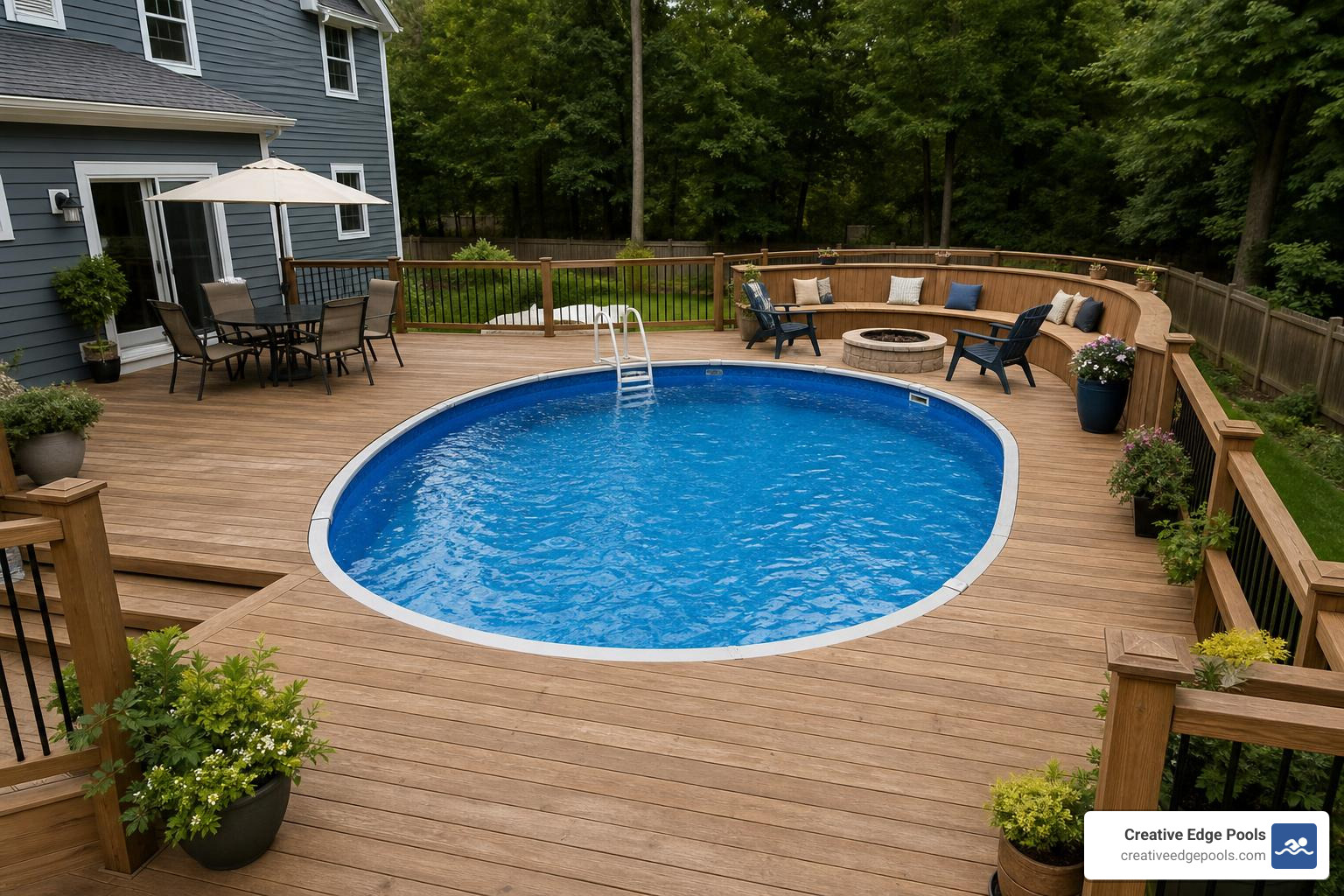
A full-surround oval deck creates 360-degree access around the pool. It is the most finished-looking option and usually gives the strongest “built-in backyard resort” feel.
A well-planned full-surround design can include:
- A continuous walking path around the pool
- Curved fascia that follows the oval shape
- Integrated railings and gates
- Multiple entry and exit points
- Furniture zones on one or both long sides
- Service clearance for cleaning and maintenance
- A larger lounge area at one end
The tradeoff is footprint and budget. Full-surround decks require more framing, more surface material, more railing, and more careful work around the pool curve. If the boards are poorly scribed or the frame fights the shape of the pool, the finished deck can look awkward.
When done right, a full-surround oval deck is ideal for families who want easy access, better traffic flow, and a polished pool area that feels intentional from every angle.
Partial Side Decks and End Decks
Partial decks are often the smartest choice when you want safe access without building a large structure around the entire pool.
A partial side deck usually runs along one long side of the oval. An end deck is placed at one rounded end. Both can work beautifully when designed with the right stairs, gates, railings, and equipment access.
Benefits include:
- Better budget control
- Simpler straight-run framing
- Smaller footprint
- Easier access than a ladder alone
- More manageable permitting in some cases
- Easier equipment access
- Good option for phased expansion
For example, a compact raised deck can provide enough room for entry, supervision, and a couple of chairs without taking over the whole yard. If you are reviewing basic layout concepts, this sample compact pool deck plan shows how a smaller platform can still create usable space beside an above-ground pool. Use any sample plan only as a high-level planning reference; final design, permitting, excavation, footings, structural framing, and pool-area safety details should be handled by qualified professionals.
Partial decks are also helpful when you want to preserve lawn, keep a septic area clear, or leave room for future hardscaping.
Multi-Level and Tiered Oval Pool Decks
Multi-level decks are especially useful on sloped yards, which are common throughout Massachusetts and New Hampshire. Instead of fighting the grade, the deck can step with it.
A tiered design may include:
- A lower patio or paver area
- An upper swim platform aligned with the pool coping
- Steps with low-voltage lighting
- Retaining walls where grade changes are significant
- A transition from the house deck to the pool deck
- A separate lounging or dining level away from splash zones
This type of design takes more planning, but it can make an above-ground pool feel more integrated into the landscape. On some sloped lots, the pool can even appear partially recessed from one side.
Drainage is critical. Water should move away from the pool structure, away from footings, and away from the house. If the pool deck connects to a larger patio plan, we recommend thinking about the full outdoor living space at once. Our guide to A Comprehensive Guide To Poolside Patio Installation is a helpful next step when you are connecting a deck, patio, and landscape plan.
How to Size a deck around oval above ground pool for Lounging and Access
A pool deck that is too narrow technically works, but it feels like walking around a restaurant table while everyone is carrying a beach towel. Not ideal.
Use these sizing guidelines:
| Area | Recommended Size | Why It Matters |
|---|---|---|
| Minimum walkway | 3 feet wide | Basic passing and access |
| Comfortable walking zone | 4 to 6 feet wide | Better for families, towels, and pool gear |
| Lounge bay | 8 to 12 feet deep | Room for chaise lounges and side tables |
| Stair landing | At least as wide as stairs | Safer entry and exit |
| Gate swing area | Clear full swing path | Prevents code and usability issues |
| Furniture circulation | 30 to 36 inches around pieces | Keeps the deck from feeling cramped |
If you want chaise lounges, a dining platform, or a Poolside Table, plan those zones before framing starts. Furniture always takes more space than people expect. So do kids, floats, coolers, towels, and that one inflatable flamingo that somehow becomes a family member.
Materials, Costs, and Premium-versus-Budget Decisions
Deck material affects everything: comfort under bare feet, maintenance, appearance, slip resistance, durability, and long-term cost.
Around oval above-ground pools in MA and NH, materials must handle:
- Freeze-thaw cycles
- Snow and ice
- UV exposure
- Chlorinated or saltwater splash
- Moisture under and around the deck
- Barefoot traffic
- Seasonal cleaning and winterization
Important pricing note: all cost ranges below are broad industry averages based on publicly available online data. They are not Creative Edge Pools pricing, estimates, or guarantees. Actual project cost depends on site access, engineering, permits, demolition, excavation, drainage, materials, railings, stairs, lighting, pool installation or renovation scope, hardscaping, masonry, and custom features. Because online average pricing can understate real-world variability, the planning ranges below intentionally use wide bands that start at roughly 2x commonly cited average costs and extend to at least 5x or more where site conditions and premium scope require it.
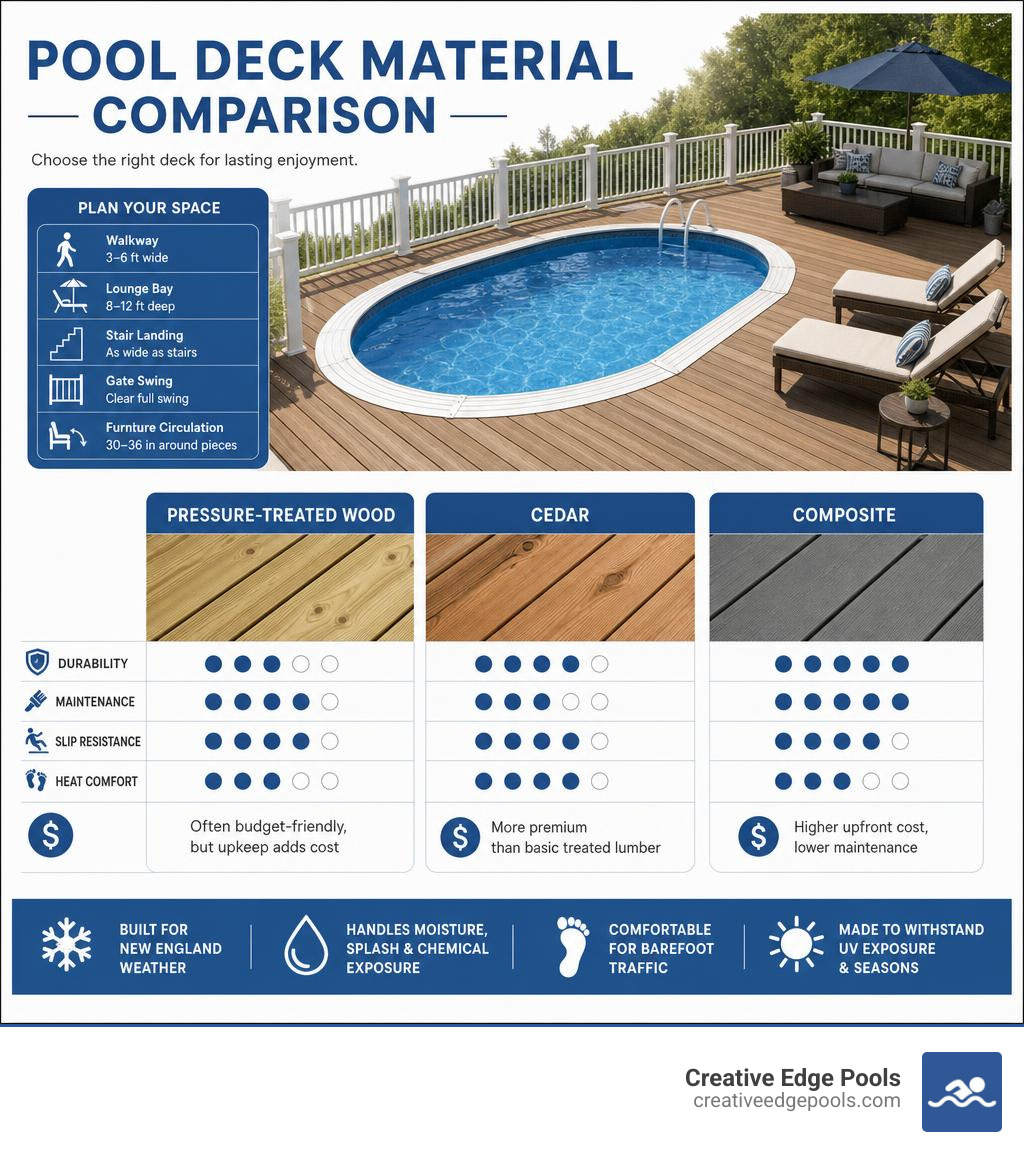
| Material | Durability | Maintenance | Slip Resistance | Heat Comfort | Broad Industry-Average Cost Context |
|---|---|---|---|---|---|
| Pressure-treated wood | Moderate with care | High | Good when textured | Moderate | Often budget-friendly, but upkeep adds cost |
| Cedar | Moderate to good | Medium to high | Good | Comfortable | More premium than basic treated lumber |
| Composite | High, often 25+ years | Low | Good if textured | Varies by color | Higher upfront cost, lower maintenance |
| PVC | High | Low | Good if textured | Varies | Premium low-maintenance option |
| Pavers | High | Medium | Good | Good | Flexible for patios and transitions |
| Brick | High | Medium | Good with proper texture | Good | Classic look, strong hardscape option |
| Stamped concrete | High if installed well | Medium | Needs non-slip sealer | Can get warm | Decorative and versatile |
| Natural stone | High | Medium | Excellent with right stone | Varies; travertine stays cooler | Premium finish with strong visual appeal |
Pressure-Treated Wood, Cedar, Composite, and PVC
Pressure-treated lumber is common because it is accessible and budget-conscious. With proper sealing and care, it can perform well, but pool environments are hard on wood. Water, chemicals, and sun accelerate wear.
For wood deck systems, we look for:
- Ground-contact-rated structural lumber where required
- Joist tape on framing to reduce moisture damage
- Stainless steel or coated fasteners rated for treated lumber
- Slip-conscious board orientation and texture
- Regular inspection for soft spots, splinters, and loose fasteners
Cedar has natural oils that help resist insects and decay, but still needs maintenance. Composite decking is popular because it resists splintering, warping, and frequent sealing, often lasting 25 years or more. PVC decking is another low-maintenance option containing no wood fiber, making it highly moisture-resistant. Darker composite and PVC boards can get hot in direct sun; lighter colors are usually better for bare feet.
Pavers, Brick, Concrete, and Natural Stone Around Oval Pools
Hardscape materials can be excellent around oval pools, especially when the raised deck transitions into a lower patio.
Popular options include:
- Brick in running bond or herringbone patterns
- Interlocking pavers that adapt well to curves
- Stamped concrete with non-slip additives
- Exposed aggregate concrete for texture
- Travertine for a cooler, elegant surface
- Bluestone or natural stone for a premium Massachusetts and New Hampshire look
Brick and pavers are useful when working with oval shapes because their modular units follow curves naturally. If you love traditional masonry character, our page on Brick Pool Decks offers more design direction. Concrete also works well but needs proper base preparation, control joints, drainage slope, and a slip-resistant finish to prevent slick surfaces.
Budget-Friendly vs Premium Deck Solutions
A budget-friendly deck means putting money where it matters most: structure, safety, drainage, and code compliance.
Budget-conscious strategies include:
- Building a partial raised deck instead of a full surround
- Using a straight side platform to reduce curved framing
- Planning future expansion during the first build
- Choosing durable but cost-conscious materials
- Connecting to a ground-level patio later
Premium solutions may include full custom wraparound decking, composite or PVC surfaces, natural stone patios, integrated lighting, built-in seating, multi-level platforms, excavation, drainage improvements, masonry transitions, pool additions, pool renovation work, or coordinated hardscaping.
Based on broad public online industry data, and adjusted into wider planning bands to reflect industry variability, smaller professionally built pool deck projects may fall broadly around $12,000 to $75,000 or more depending on size, site conditions, and material choices. Larger full custom decks with hardscaping, lighting, railings, drainage work, excavation, masonry, and multi-level features can range broadly from $30,000 to $250,000 or more.
These are not Creative Edge Pools rates, estimates, or guarantees, but wide planning ranges sourced from public online industry averages to help homeowners understand why a quick estimate rarely tells the full story.
Planning, Engineering, and Code-Compliant Construction
A safe deck starts before the first post hole is dug.
The pool should be installed first, then the deck should be measured and designed around the actual pool. Above-ground pool wall heights commonly include 48 inches, 52 inches, and 54 inches. Even small differences can affect deck height, stair layout, railing placement, and how boards meet the top rail.
In Portsmouth, NH, Dover, NH, Wilmington, MA, Andover, MA, and surrounding towns, local permitting requirements can vary. We always recommend confirming requirements before construction begins.
Where a deck around oval above ground pool Should Meet the Coping
The deck surface should typically sit flush with or slightly below the pool coping or top rail. This creates safer entry and exit while reducing trip hazards.
Key details include:
- Keep the gap between decking and pool edge no more than 3/4 inch where required by local code or manufacturer guidance
- Do not fasten the deck to the pool wall
- Allow for pool movement and deck movement
- Scribe curved boards to the actual pool shape
- Use removable boards or access planning for future liner replacement
- Avoid burying the top rail in a way that prevents service
Avoid making everything tight and permanent. While it looks tidy on day one, it can create major headaches when the liner needs replacement. A good deck respects both the pool and future maintenance.
Structural Rules You Should Not Ignore
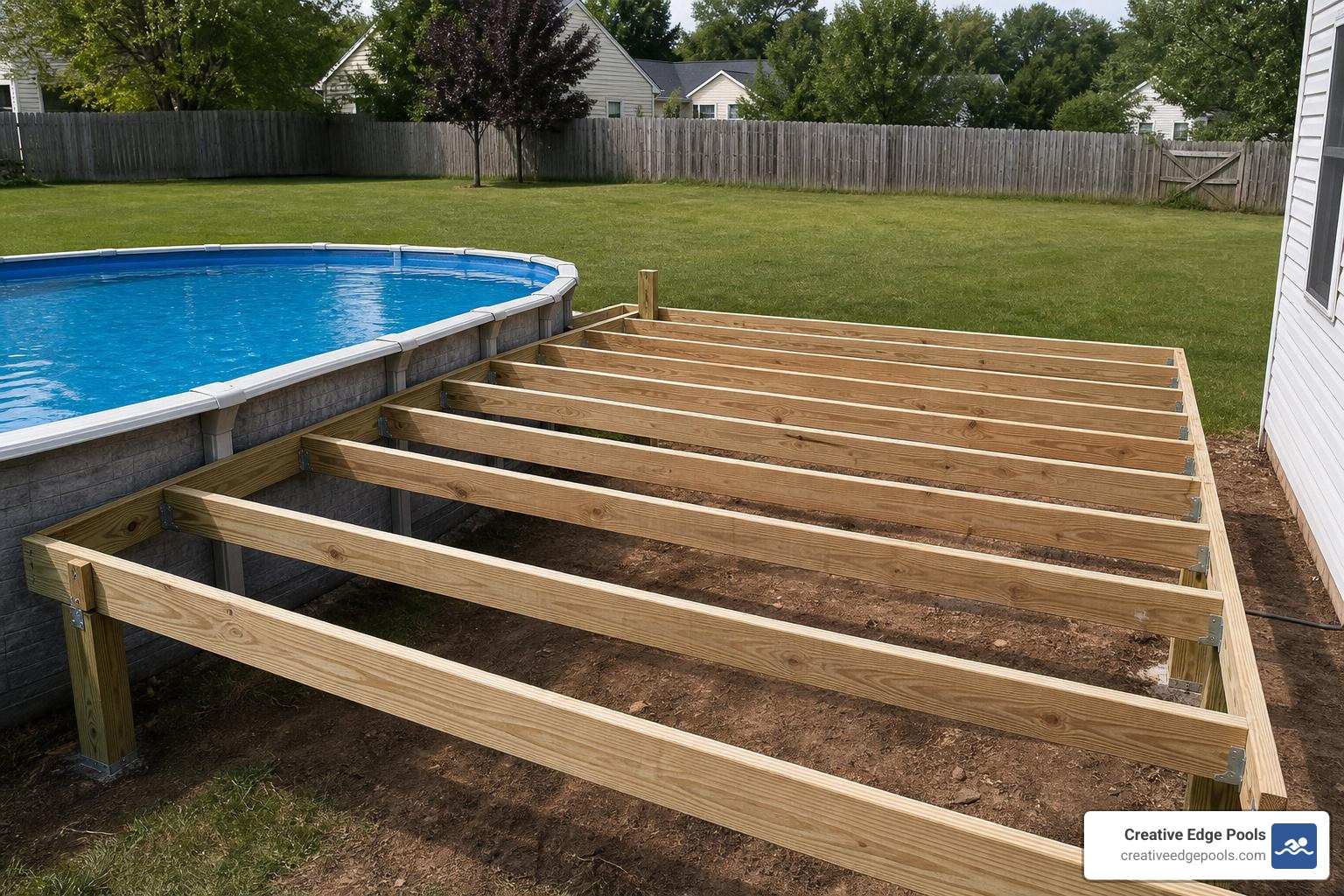
An above-ground pool deck must be a freestanding structure. The pool wall is not designed to carry deck loads, people loads, snow loads, or hot tub loads.
Structural priorities include:
- Independent posts and beams
- Concrete footings below local frost depth
- Proper load paths from decking to joists, beams, posts, and footings
- Cross bracing for lateral stability
- Ground-contact-rated lumber where framing is near grade
- Correct fasteners and connectors
- Snow load consideration for Massachusetts and New Hampshire winters
- Settlement separation from the pool structure
- Engineering for hot tubs or heavy features
Sloped yards need extra care because each post location has its own grade elevation. If a deck is high above grade, lateral bracing becomes even more important.
For more general framing concepts, this overview of above-ground deck planning basics explains several important planning considerations. Treat any general overview as informational only; elevated pool decks, pool additions, excavation, footings, electrical safety, and code-compliant barriers should be designed and installed by experienced professionals.
Permits, Barriers, Railings, Gates, and Electrical Safety
Pool decks are not just “backyard platforms.” They are part of a pool environment, which means safety codes matter.
Common requirements include:
- Local building permits
- Pool barrier compliance
- 48-inch minimum pool barrier in many jurisdictions
- Self-closing, self-latching gates
- Gates that swing outward away from the pool
- Latches mounted high enough to reduce child access
- Guardrails where deck height requires them
- 36-inch guard height in many residential deck situations
- Baluster spacing that prevents a 4-inch sphere from passing through
- Anti-climb barrier design
- GFCI protection for pool-area electrical components
Electrical work must follow applicable code, including NEC Article 680. In many cases, at least one GFCI-protected receptacle is required within 6 to 20 feet from the water, depending on local code versions.
Pool equipment placement also matters. Pumps, filters, and heaters must remain accessible. Hiding equipment under the deck may look clean, but it makes service difficult and can create ventilation problems.
Features, Landscaping, Maintenance, and Mistakes to Avoid
The best oval pool decks do more than provide access. They create zones: swim, sit, shade, dine, dry off, supervise, and relax.
But every feature adds weight, wiring, drainage, or maintenance considerations. That does not mean you should avoid features. It means they should be planned from the start.
Seating, Shade, Lighting, and Entertainment Zones
High-impact oval pool deck features include:
- Built-in benches that follow the curve of the pool
- A wider lounge bay on one long side
- A dining platform set away from splash zones
- Pergolas or shade sails for sun control
- Heavy-duty umbrellas with proper bases
- Recessed low-voltage LED deck lights
- Stair lighting for nighttime safety
- String lighting placed away from water and code-restricted zones
- Storage benches for towels and pool gear
- Privacy screens or planting beds
Low-voltage deck and step lights improve safety and define the pool’s curve after sunset. Grilling zones should be separated from the immediate swim path to keep smoke, heat, and food traffic away from wet feet.
Hot Tubs, Water Features, and Hardscaping Additions
Hot tubs and spas require serious structural planning. A filled spa is extremely heavy and should never be placed on a standard pool deck without engineering. It needs an independent load path, often a dedicated concrete pad or engineered framing system.
Popular additions include:
- A lower patio beside the raised pool deck
- Engineered spa pad
- Masonry transitions between deck and yard
- Retaining walls on sloped sites
- Waterfall accents
- Bar or table zones
- Outdoor shower areas
- Seating walls
For inspiration, explore our ideas for Backyard Pool Waterfall Ideas and In Water Table And Bar Stools. If your project includes patios, walls, steps, or masonry transitions, our Hardscaping Services can help bring the full space together.
As a family-owned company with over 100 years of combined experience, we look at these projects as full backyard environments, not isolated pool parts.
Landscaping Around an Oval Above-Ground Pool Deck
Landscaping softens the height of an above-ground pool and helps the deck feel like it belongs in the yard.
Good poolside landscaping choices include:
- Ornamental grasses
- Dwarf shrubs
- Low-debris evergreens
- Stone borders
- Drainage beds
- Mulch kept away from splash-heavy areas
- Privacy plantings
- Layered lighting
- Ground-level patio connections
Keep plantings at least 3 feet from the pool edge to reduce debris, protect the pool wall, and allow maintenance access. Avoid messy trees, thorny shrubs, or plants that attract heavy bees right beside the swim area.
For more ideas, see Backyard Above Ground Pool Landscape Ideas and Landscaping Around Swimming Pools.
Maintenance and Common Mistakes
A pool deck should be inspected at least once a year, ideally before swim season.
Maintenance tasks include:
- Check for soft spots in wood
- Tighten loose fasteners
- Inspect railings and gates
- Clean composite or PVC surfaces
- Reseal wood as needed
- Refresh paver joint sand when necessary
- Reseal stamped concrete every few years
- Watch for drainage problems
- Clear leaves and debris from gaps
- Store pool chemicals away from the deck, ideally at least 10 feet from deck and pool areas in a separate ventilated structure
- Winterize the pool and protect deck surfaces from trapped moisture
Mistakes that shorten pool deck life include:
- Attaching the deck directly to the pool
- Using undersized footings
- Ignoring frost depth
- Skipping lateral bracing
- Building too tight to service the liner
- Hiding equipment where it cannot be reached
- Choosing slippery finishes
- Forgetting drainage slope
- Using non-rated fasteners near treated lumber
- Placing heavy hot tubs on unengineered framing
- Making the deck too narrow for real use
- Skipping permits or inspections
The biggest shortcut is thinking of the deck as “just a platform.” Around a pool, it is structure, safety system, access point, and outdoor living space all at once.
Frequently Asked Questions About Oval Above-Ground Pool Decks
What is the best design for an oval above-ground pool deck?
The best design depends on your yard, budget, slope, and how you plan to use the pool.
For many homeowners, a partial side deck is the most practical starting point. It improves safety, replaces a basic ladder, and creates a small sitting area without the cost of a full surround.
A full-surround deck is best when you want 360-degree access, a premium look, and multiple furniture zones.
An end deck works well when yard space is limited or when the pool sits close to a patio.
A multi-level layout is often best for sloped yards, especially when connecting the pool to a house deck, paver patio, or retaining wall system.
If you plan to expand later, design for it from the start to make future additions much easier.
Can a deck be attached directly to an above-ground pool?
No. A deck should not be attached directly to an above-ground pool.
The pool wall is not engineered to support deck loads. The deck must stand on its own posts, beams, and footings to protect the pool wall and allow for movement. A freestanding design also makes future liner replacement and pool service much easier.
For safety and code reasons, we strongly recommend professional design and construction for any elevated pool deck, especially in MA and NH where frost and snow loads are real design factors.
How much does an oval above-ground pool deck cost in 2026?
In 2026, oval above-ground pool deck costs vary widely. All prices mentioned here are average-cost planning ranges sourced from publicly available internet data and are not the actual prices, estimates, or guarantees of Creative Edge Pools.
Public online industry averages often discuss smaller pool decks in the several-thousand-dollar range, but real projects in Massachusetts and New Hampshire can vary much more due to labor, frost-depth footings, permits, railings, site access, demolition, excavation, drainage, lighting, hardscaping, masonry, and material selection. To account for industry variability, the ranges below intentionally begin at roughly 2x commonly cited online averages and extend to at least 5x or more for larger or more complex scopes.
As broad planning ranges from publicly available online data, not Creative Edge Pools pricing:
- Smaller professional deck projects may fall broadly around $12,000 to $75,000 or more
- Larger custom full-surround or multi-level projects may range broadly from $30,000 to $250,000 or more
- Premium additions such as hardscaping, retaining walls, pool additions, pool renovation work, hot tub pads, lighting, excavation, masonry, and drainage systems can increase total project cost significantly
The only reliable way to understand cost is to evaluate the actual site, layout, materials, code requirements, and desired features.
Conclusion
A deck around oval above ground pool should never be rushed. The curve of the pool, the height of the wall, the footing depth, the railing layout, the gate swing, the drainage, and the future maintenance access all matter.
When the design is thoughtful, the result is safer, stronger, and much more enjoyable. You get easier access, better lounging space, improved backyard flow, and a pool area that feels finished instead of improvised.
At Creative Edge Pools, we design, install, renovate, and develop full backyard environments throughout Eastern Massachusetts and Southern New Hampshire. From Dover, NH to Andover, MA and Newburyport, MA, we help homeowners bring pool and outdoor living visions to life with a design-first approach backed by over 100 years of combined experience. Our work can support pool installation, pool renovation, pool removal planning, pool additions, excavation, hardscaping, masonry, patios, retaining walls, and pool-area transitions.
If you are planning a pool deck, patio, hardscape, or full backyard transformation, we would be happy to talk through your options. Explore a pool area hardscaping consultation or use the quote form button here: Request a Quote today.
