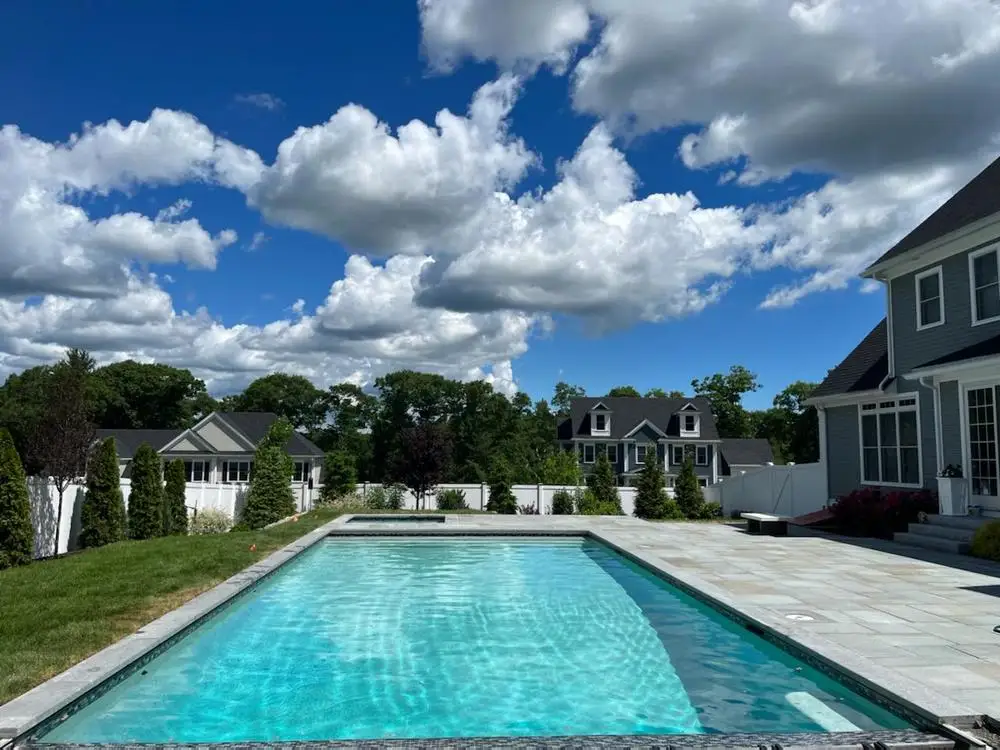
What Does a Small Backyard Pool Actually Cost?
The average cost of a small swimming pool installed in New England typically falls somewhere between $90,000 and $225,000 for a complete, turnkey project — including excavation, the pool shell, equipment, decking, fencing, and permits.
Important: All prices referenced in this article are average costs sourced from publicly available online data. They do not reflect the actual rates or quotes of Creative Edge Pools.
Here’s a quick snapshot of what homeowners in Eastern Massachusetts and Southern New Hampshire typically invest, based on industry averages:
| Pool Type | Installed Cost Range (Industry Average) |
|---|---|
| Small Gunite/Concrete Pool | $90,000 – $225,000+ |
| Small Fiberglass Pool | $65,000 – $150,000 |
| Small Vinyl Liner Pool | $55,000 – $120,000 |
| Plunge Pool / Spool | $75,000 – $175,000 |
Note: Ranges reflect full project costs including site prep, equipment, and basic decking.
So you’ve got a compact backyard in Andover, Hampton, or somewhere in between — and you’re wondering if an inground pool is even possible. The short answer? Yes, and it can be stunning.
Small pools are one of the fastest-growing trends in backyard design right now. Homeowners across Eastern MA and Southern NH are discovering that a well-designed plunge pool or cocktail pool can deliver everything a full-size pool offers — relaxation, entertainment, exercise, and real property value — without needing a half-acre lot.
But “small pool” doesn’t mean “small investment.” The excavation crew, the permits, the plumbing, the electrical work — most of those costs stay roughly the same whether you’re building a 10×20 pool or a 20×40 pool. That’s the part most homeowners don’t see coming.
This guide breaks down exactly what you should budget for, what drives costs up (or down), and what a realistic project looks like here in New England.
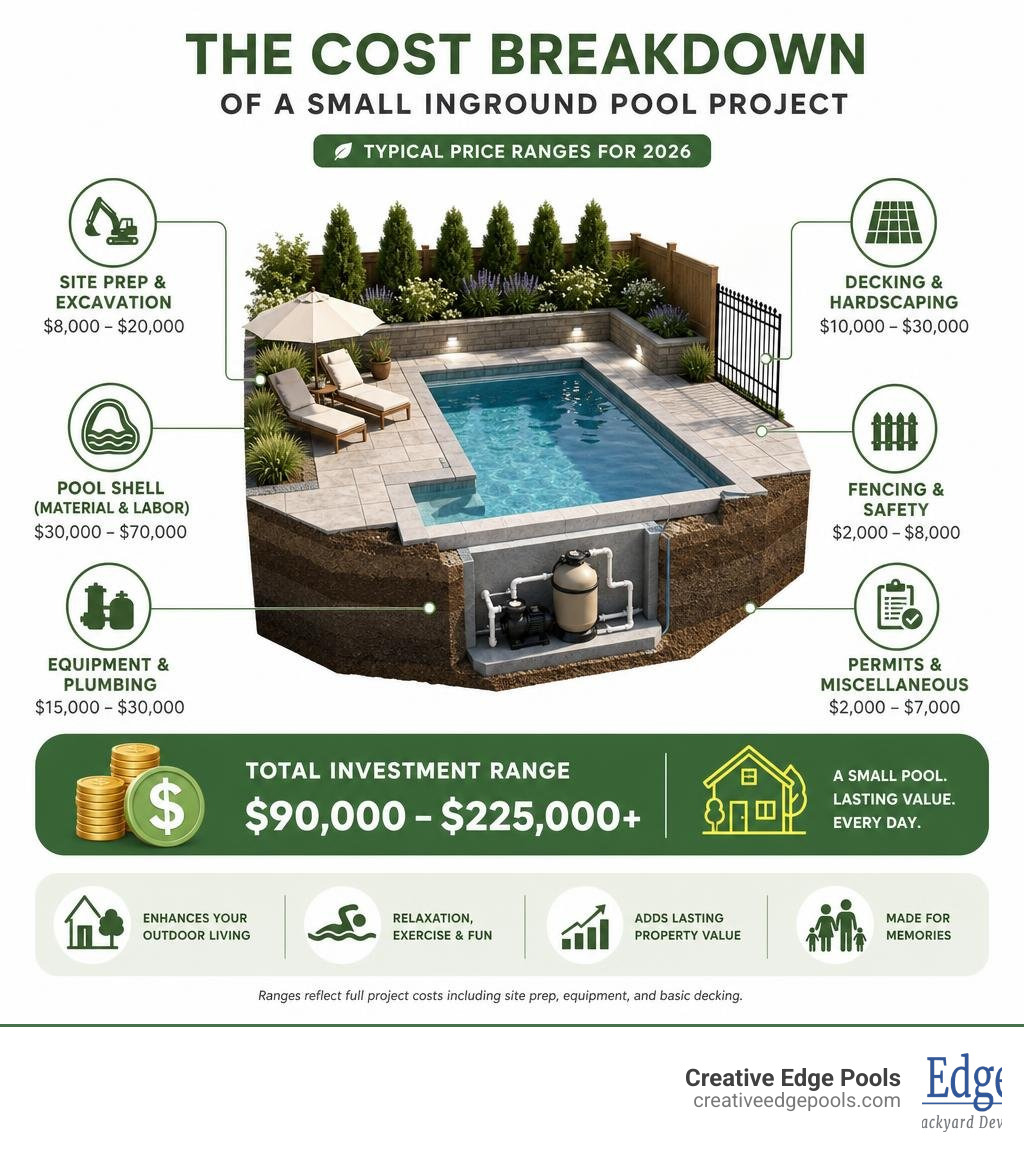
Average cost of a small swimming pool terms to know:
Understanding the Average Cost of a Small Swimming Pool
When diving into the planning process, the first question on every homeowner’s mind is: What is the average cost of a small swimming pool?
If you search the internet, you might find articles claiming a national average swimming pool installation cost of around $45,000. However, those broad figures can be incredibly misleading, especially for homeowners in New England.
To give you a realistic picture of the industry, we must look at a much wider price range that accounts for local variables. According to general online data and resources like How Much Does Swimming Pool Installation Cost? (2026 Guide) | CostWhale, a realistic industry average for a small inground pool project spans from a low end of $90,000 (which is roughly two times the basic national average) to a high end of $225,000+ (which is five times the basic average). This massive range exists because no two yards—and no two pool designs—are exactly alike.
Why does a small pool cost so much more than a standard internet search suggests? Because pool construction is heavy civil engineering in your backyard. Whether we are building a compact 10×20 plunge pool in Andover, MA or a custom cocktail pool near Hampton, NH, the foundational steps of the project do not scale down linearly with the size of the water footprint.
The heavy machinery required for excavation must still be mobilized. The engineering plans must still be drawn and approved. The plumbing, filtration systems, high-efficiency heaters, and electrical panels require the exact same specialized trade labor. Furthermore, New England’s unique geological conditions—ranging from dense clay to solid granite ledge—and strict municipal building codes mean that site preparation alone can represent a significant portion of your budget.
When evaluating the Cost for Inground Swimming Pool projects, it is helpful to look at the three primary pool materials:
- Vinyl Liner Pools: Often the lowest upfront cost, but they require ongoing liner replacements every 5 to 15 years, which can quickly add up over time.
- Fiberglass Pools: Prefabricated shells delivered to your home. While they install quickly, they are limited by highway shipping regulations (typically capped at 16 feet wide) and cannot be customized to fit irregular yard shapes.
- Gunite (Concrete) Pools: The gold standard for durability and complete architectural freedom. Because gunite is pneumatically applied concrete built entirely on-site, it can be styled into any shape, depth, or configuration to perfectly complement your home’s landscape.
Small Gunite Pool Designs: Plunge Pools, Cocktail Pools, and Spools
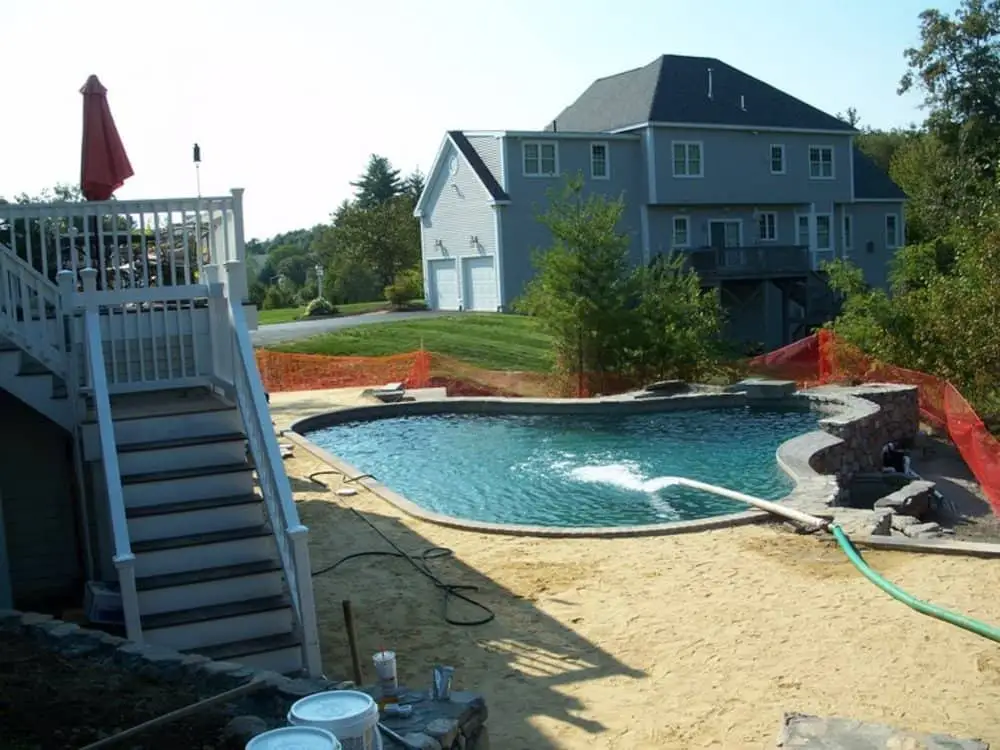
For homeowners with compact backyards, custom gunite is unmatched. It allows us to design a tiny oasis that fits snugly between property setbacks, historical structures, and existing patios without sacrificing luxury.
When designing a small gunite pool, our clients generally choose from three popular compact configurations:
| Design Type | Typical Dimensions | Key Benefits | Best For |
|---|---|---|---|
| Plunge Pool | 8′ x 12′ to 10′ x 20′ | Deep water profile, compact footprint, great for cooling off or water aerobics | Small yards, active individuals, modern aesthetics |
| Cocktail Pool | 10′ x 10′ to 12′ x 16′ | Shallow water, integrated bench seating, social layout, highly energy-efficient | Entertaining, lounging, low-maintenance relaxation |
| Spool (Spa-Pool) | 8′ x 8′ to 10′ x 14′ | Hybrid design, powerful therapy jets, rapid heating, year-round usability | Multi-season use, hydrotherapy, ultimate space-saving |
Custom Gunite Plunge Pools
A plunge pool is designed primarily for wading, lounging, and light exercise. Unlike shallow wading pools, custom gunite plunge pools often feature deeper water profiles (typically 4 to 6 feet deep) within a compact footprint. This depth provides a buoyant, refreshing escape during hot summer days.
Because they are constructed from steel-reinforced concrete, gunite plunge pools offer unparalleled longevity and New England climate resilience. Whether you are dealing with the harsh winter freeze-thaw cycles in Portsmouth, NH or the sandy soils of Wilmington, MA, a properly engineered gunite shell will stand the test of time. To learn more about the engineering and structural costs of these builds, check out our detailed guide on How Much Does a Gunite Pool Cost?.
Cocktail Pools: The Perfect Entertainment Hub
If your dream backyard looks more like a social lounge than an athletic club, a cocktail pool might be your perfect match. These pools are typically shallower (around 3 to 4 feet deep) and emphasize seating over swimming space.
With built-in wrap-around benches, tanning ledges, and flat-bottom designs, cocktail pools act as giant, refreshing couches for you and your guests. Because they hold a smaller volume of water, they are incredibly efficient to heat. On cool autumn evenings in Exeter, NH, you can quickly bring a cocktail pool up to a comfortable temperature without watching your utility bill skyrocket.
Spools: The Best of Pools and Spas Combined
Can’t decide between an inground pool and a hot tub? A “spool”—or spa-pool hybrid—gives you the best of both worlds. These ultra-compact installations feature powerful therapy jets, comfortable ergonomic seating, and high-performance heating systems.
In the heat of July, your spool functions as a cool, relaxing splash pool. In the freezing depths of January in Tewksbury, MA, it transforms into a steaming, luxurious outdoor spa. This year-round versatility makes the spool one of the most practical and high-value investments for New England homeowners.
Key Cost Drivers for Small Inground Pools in New England
When budgeting for your small pool, it is essential to understand that the physical pool shell is only one part of the financial equation. Several regional and environmental variables will shape your final construction costs.
- Site Preparation and Excavation: Before we can build, we have to dig. In New England, excavation is rarely a simple “dirt-only” affair. Our crews frequently encounter dense glacial till, heavy clay, high water tables, and solid granite ledge. If we hit solid rock during excavation, specialized pneumatic hammers or blasting equipment may be required, which can add thousands of dollars to the site preparation budget.
- Backyard Access Limitations: Small yards often come with tight access points. If we cannot fit standard-sized excavators and concrete trucks between your home and your neighbor’s property line, we must use specialized compact equipment. This smaller machinery takes longer to move earth and apply gunite, which directly impacts labor costs.
- Permits and Local Regulations: Municipalities in Eastern Massachusetts and Southern New Hampshire have strict zoning bylaws. You must account for property line setbacks (often requiring the pool to sit 10 to 30 feet away from your property boundary), environmental conservation zones, septic system clearances, and utility easements. Navigating these requirements requires professional engineering plans and permit filings.
- Electrical Infrastructure: A modern pool requires significant electrical power to run filtration pumps, heaters, salt chlorine generators, and lighting. Many older New England homes only have 100-amp or 150-amp electrical service. To safely support a pool system, you may need to budget for a utility service upgrade to 200 amps.
Because of the sheer complexity of excavation, structural steel engineering, high-voltage electrical plumbing, and shotcrete application, we strongly advise against any DIY pool installation. Cutting corners on structural engineering can lead to catastrophic shell failures, shifting soils, and expensive property damage.
Always work with an experienced, licensed professional to ensure your project is built safely and to local building codes. For a deeper dive into local installation variables, read our article on How Much Do Inground Pools Cost in Massachusetts?.
Hidden and Additional Costs Beyond the Base Quote
When comparing quotes from pool builders, the “base price” can be highly deceptive. A complete backyard transformation requires several additional elements that are often excluded from a basic pool shell estimate.
- Decking and Hardscaping: Your pool needs a beautiful frame. Whether you prefer the classic elegance of natural stone masonry, the clean lines of concrete pavers, or a custom patio, hardscaping is a major component of your project. For a cohesive, luxurious feel, plan to budget for surrounding patio space that accommodates lounge chairs, dining sets, or an outdoor kitchen.
- Safety Fencing: In both Massachusetts and New Hampshire, state building codes mandate a continuous safety barrier (typically a minimum of 48 inches high) surrounding any residential swimming pool. This fencing must feature self-closing, self-latching gates. Depending on the linear footage and material (such as ornamental aluminum, vinyl, or custom wood), safety fencing can add several thousand dollars to your bottom line.
- Water Features and Masonry: To elevate a small pool into a true luxury retreat, many homeowners add custom water features. Sheer descent waterfalls, bubbling fountains, or stone spillways not only look beautiful but also provide soothing ambient sound to mask neighborhood noise.
- Heating and Winterization Equipment: Given our short New England summers, a high-quality heating system (either a natural gas heater, propane heater, or an energy-efficient electric heat pump) is practically mandatory. Additionally, you will need a durable safety cover to protect your pool during our harsh winter months.
If you are looking to maximize your backyard’s luxury and utility, combining your pool with an integrated hot tub is a highly popular option. To see how these features interact financially, explore our breakdown of the Average Cost of Inground Pool with Hot Tub.
Frequently Asked Questions about Small Pool Costs
What is the smallest inground pool you can build?
While we can technically build a custom gunite pool as small as a bathtub, the practical limit for a functional plunge pool or spool is typically around 8′ x 8′ or 6′ x 10′.
When planning your space, municipal zoning laws dictate “setbacks”—the mandatory minimum distance your pool must sit from your home, property lines, septic tanks, and wetlands. In tight suburban lots, these setbacks will ultimately define the maximum footprint of your pool.
Does a small pool require the same fencing as a large pool?
Yes. From a safety and legal perspective, water is water. State and local building codes make no distinction between a massive 20×40 rectangular pool and a tiny 8×10 plunge pool.
Any body of water deeper than 24 inches must be fully enclosed by an approved safety barrier to prevent unauthorized access and protect children and pets.
How much does it cost to maintain a small pool annually?
One of the greatest benefits of a small pool is its lower ongoing operating cost. Because they hold less water, they require fewer chemicals, less filtration runtime, and significantly less energy to heat.
On average, you can expect to spend between $1,000 and $2,500 annually on chemicals, electricity, heating fuel, and professional opening and closing services. While routine skimming and chemical testing can be managed by the homeowner, we highly recommend hiring professional pool technicians for seasonal winterization to protect your plumbing and equipment from freezing damage.
Conclusion
Building a small pool is not about settling for less—it is about designing a highly tailored, luxurious oasis that perfectly fits your property and your lifestyle. By choosing a custom gunite design, you gain complete control over the shape, depth, features, and lasting durability of your pool, ensuring it stands up to New England’s demanding climate for decades to come.
At Creative Edge Pools, we are a family-owned business with over 100 years of combined experience in pool design, installation, and complete backyard development. From custom masonry and heavy excavation to advanced pool plumbing and automation, we specialize in bringing your unique backyard vision to life across Eastern Massachusetts and Southern New Hampshire.
Ready to transform your compact backyard into a stunning private resort? Contact our expert team today to schedule your design consultation.
- Get a Custom Quote: Request a Consultation Today
- Explore Pricing Details: Learn more about budgeting for your project by reading our comprehensive guide on Inground Pool Cost.