
Pool House Perfection: Your Guide to a Waterside Retreat
Starting a pool house construction project can transform your backyard into the ultimate outdoor living space. It’s more than just a shed; it’s a flexible retreat that brings comfort, convenience, and style right to your poolside.
Here’s a quick look at why building a pool house is a game-changer for your home:
- Convenience: Provides a dedicated space for changing, showering, and using the restroom without tracking wet footprints into your main house.
- Storage: Keeps pool equipment, toys, and chemicals organized and out of sight.
- Entertainment: Creates a perfect hub for hosting, complete with potential kitchenettes, bars, and lounge areas.
- Increased Home Value: A well-designed pool house can significantly boost your property’s appeal and resale value.
- Guest Accommodations: Larger designs can even serve as a private guest suite for visitors.
Many homeowners in Eastern Massachusetts and Southern New Hampshire dream of enhancing their outdoor space. A pool house makes your backyard oasis even more enjoyable.
Imagine relaxing by your pool, knowing everything you need is just steps away. From a simple changing room to a luxurious guest house, the possibilities are endless. This guide will walk you through everything you need to know to construct your dream waterside retreat, ensuring a perfect blend of indoor comfort and outdoor leisure.
Building a pool house is an exciting project. It adds significant functionality and elegance to any home with a pool. Costs can vary widely based on size, features, and materials. Based on internet data from April 2026, a basic pool shed might start around $1,000 to $1,500. More equipped, prefabricated options often begin at $26,000. For a custom-built pool house, you could expect costs anywhere from $15,000 to over $240,000, with many projects averaging around $72,000.
Easy pool house construction word list:
Planning Your Pool House Construction: Size, Style, and Location
Planning is the most critical phase of any pool house construction project. Before we break ground, we need to look at your backyard as a holistic environment. A pool house isn’t just a standalone building; it’s an extension of your home’s architecture and your pool’s design. At Creative Edge Pools, we focus on Landscape and Pool Design Near Me to ensure your new structure doesn’t just “sit” in the yard but belongs there.
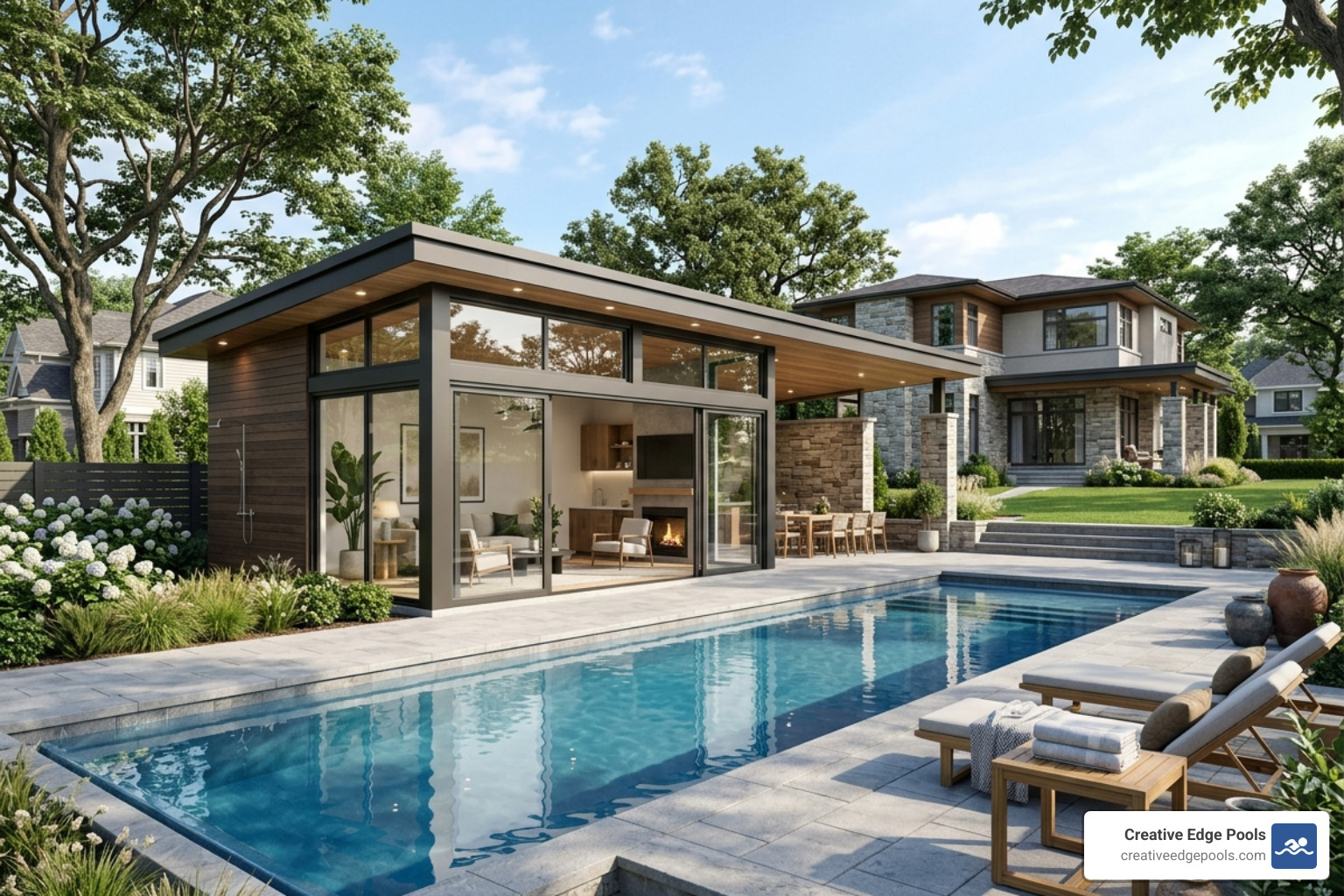
When evaluating your site, we consider several factors:
- Property Lines and Setbacks: Every town, from Andover, MA to Nashua, NH, has specific zoning laws. We must ensure the structure is the legal distance from your property lines and the pool itself.
- Sun Orientation: Do you want a shaded retreat to escape the July heat, or a sun-drenched deck for afternoon cocktails? Positioning the building to catch or block the sun changes the entire experience.
- Wind Protection: A well-placed pool house can act as a windbreak, keeping your Pool and Spa area warmer and more comfortable during those breezy New England evenings.
- Architectural Harmony: We aim to match rooflines, siding, and trim with your existing residence to create a seamless transition between the main house and the retreat.
Custom vs. Prefab Pool House Construction
One of the first decisions you’ll face is whether to go with a prefabricated kit or a custom-built structure. Prefab kits have come a long way and offer a faster timeline, while custom builds provide unlimited flexibility and structural integrity tailored to your specific needs.
| Feature | Prefab Pool House | Custom-Built Pool House |
|---|---|---|
| Average Cost (Internet Data) | $5,000 – $25,000+ | $72,000 – $240,000+ |
| Timeline | 1–3 days assembly | 3 months – 1 year |
| Durability | Moderate (standard materials) | High (engineered for New England) |
| Customization | Limited to catalog options | Fully bespoke to your vision |
| ROI | 5% – 10% | 5% – 55% (if used as ADU) |
Choosing the Right Size for Your Needs
Size is a major cost driver. Most pool houses range from 200 to 1,200 square feet. If you just need a place to store Landscaping Rocks Around Pool equipment and a small changing area, a structure under 150 square feet might suffice. However, if you’re envisioning a guest suite with a bedroom and bathroom, you’ll likely need 400 square feet or more. We recommend mapping out your “must-have” zones—changing, lounging, and storage—to determine the ideal footprint.
Essential Features for a Functional Waterside Retreat
The interior of your pool house should be as well-thought-out as the exterior. The goal is to create a space that balances beauty with the rugged functionality required near water.
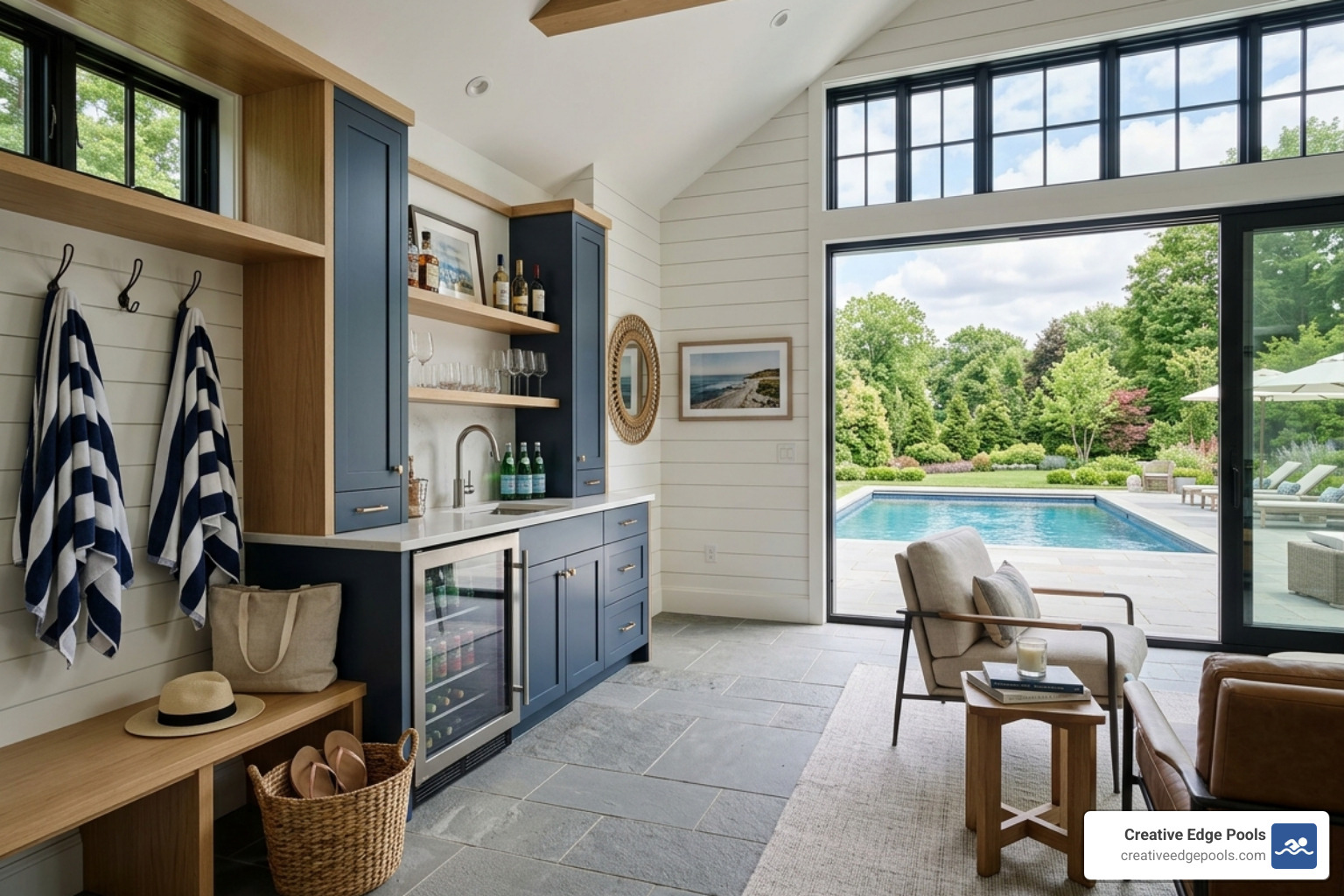
Essential features often include:
- Changing Rooms: Private spaces with hooks and benches so guests don’t have to change in the main house.
- Full or Half Bathrooms: A bathroom is perhaps the most requested feature in pool house construction. It keeps “wet traffic” out of your home’s hallways.
- Kitchenette or Refreshment Center: Including a small fridge, sink, and microwave allows you to serve drinks and snacks without constant trips to the kitchen.
- Towel Storage and Laundry Niche: Built-in cabinetry for fresh towels and a small washer/dryer stack can make post-pool cleanup a breeze.
- Hardscape Integration: We often use Pool Hardscapes to connect the pool house to the pool deck, ensuring a non-slip, beautiful transition.
Integrating an Outdoor Shower and Bar
To truly elevate the resort feel, consider adding an outdoor shower. Based on internet data, these can cost anywhere from $1,000 for a basic setup to $8,000 for a luxury stone-enclosed station. They are perfect for rinsing off chlorine before heading inside.
A poolside bar is another favorite. By adding a serving window and an overhang, your pool house becomes the social hub of the neighborhood. We can integrate Hardscaping Masonry into the bar base to match your pool’s stone features, creating a cohesive look.
Smart Storage and Utility Solutions
Don’t forget the “workhorse” side of the building. A dedicated mechanical closet is the best place to house your pool pump, filter, and heater, protecting them from the elements and dampening noise. We also recommend secure storage for pool chemicals and a “toy garage” for those bulky floats and noodles.
Materials and Durability for the New England Climate
In places like Salem, NH or Concord, MA, we deal with extreme temperature swings and high humidity. Choosing the right materials for pool house construction is the difference between a structure that lasts decades and one that rots in five years.
According to Pool House Construction: Costs, Materials, Plans, and More | Fox Blocks, Insulated Concrete Forms (ICFs) are an excellent choice for durability and energy efficiency. Other popular materials include:
- Fiber-Cement Siding: Resistant to rot, fire, and insects—ideal for the moist environment near a pool.
- Vinyl Siding: A cost-effective, low-maintenance option ranging from $1 to $8 per square foot.
- Bluestone and Natural Stone: Perfect for flooring and accents, bluestone is a staple of New England Pool Area Hardscaping.
- Corrosion-Resistant Hardware: We use stainless steel or galvanized hardware to prevent rust caused by pool chemicals and humidity.
Interior Finishes for High-Humidity Areas
The inside of a pool house is a high-moisture zone. We recommend:
- Beadboard Ceilings: Offers a classic coastal look while allowing for better moisture management than standard drywall.
- Waterproof Drywall (Greenboard): Essential for any walls that aren’t tiled.
- Non-Slip Flooring: Porcelain tile or textured stone is a must for safety.
- Ventilation: High-quality exhaust fans and strategic window placement prevent mold and mildew.
Exterior Aesthetics and Integration
Your pool house should look like it was built at the same time as your home. We pay close attention to roofline alignment and masonry accents. Using Hardscaping Service professionals to install matching stone veneers or brickwork ensures your backyard investment looks premium from every angle.
Navigating Permits and the Build Process
Before we can pour the first yard of concrete, we have to handle the paperwork. In many Massachusetts and New Hampshire towns, structures over 120–200 square feet require a building permit. If you’re adding plumbing or electricity, the requirements become even more stringent.
According to How Much Does It Cost to Build a Pool House? [2025 Data] | Angi, permits can cost anywhere from $400 to $2,000 depending on your location and the complexity of the project. We also need to account for:
- Zoning Laws: Ensuring we don’t build over an easement or too close to a septic tank.
- Electrical Bonding: All metal components near the pool must be bonded to prevent electrical hazards.
- Utility Trenching: Running water, sewer, and power lines from the main house to the new structure.
Step-by-Step Pool House Construction Timeline
- Site Preparation: Clearing the area, grading the land, and managing drainage.
- Foundation: Pouring a concrete slab or installing a frost-protected pier system ($5–$16 per sq. ft.).
- Framing: Building the “bones” of the structure ($4–$16 per sq. ft.).
- Roofing and Siding: Making the building weather-tight.
- Rough-in Utilities: Installing the plumbing and electrical “innards” before the walls go up.
- Interior Finishing: Drywall, painting, flooring, and cabinetry.
- Landscaping: Integrating the building with Landscaping Around Pools to soften the edges.
Managing Utilities: Water, Power, and Wi-Fi
Modern pool houses are tech-heavy. We often install subpanels to handle the load of heaters, AC units, and high-end lighting. We also recommend extending your home’s Wi-Fi or installing a dedicated outdoor access point for smart home automation and integrated audio systems. If you’re building in a cold climate like Manchester, NH, winterization valves are non-negotiable to prevent pipes from bursting in January.
Budgeting for Your Backyard Investment
A pool house is a significant investment that pays dividends in both lifestyle and property value. When budgeting, it’s important to look beyond the “shell” of the building.
Understanding the Cost Drivers
Average costs based on internet data for pool house projects in April 2026 typically range from $1,500 for basic storage sheds to over $750,000 for luxury custom estates. What causes such a wide range?
- Plumbing: Adding a bathroom can increase costs by $8,000 to $15,000 due to trenching and fixture costs.
- Material Quality: Choosing premium stone veneer over vinyl siding can add 30% or more to the exterior budget.
- Labor Rates: Skilled trades—electricians, plumbers, and Hardscaping Masonry experts—typically account for 40% to 60% of the total budget.
- HVAC: If you want to use the space year-round, adding heating and cooling will add several thousand dollars to the tally.
Increasing Home Value and Resale Appeal
Is a pool house worth it? Real estate experts suggest a well-integrated pool house can boost home value by 5% to 8%. If the structure is built as an Accessory Dwelling Unit (ADU) with a kitchen and sleeping area, the ROI can be as high as 55%. Beyond the numbers, it creates a “resort” feel that makes your home stand out in competitive markets like Lexington or Newton, MA.
Frequently Asked Questions about Pool House Construction
Do I need a permit for a small pool house?
In many New England townships, a shed under 120–200 square feet might not require a building permit if it doesn’t have utilities. However, the moment you add a light switch or a sink, you almost certainly need permits for electrical and plumbing work. Always check with your local building department in cities like Haverhill or Nashua before starting.
How long does the construction process take?
A prefab unit can be “delivered and dropped” in a single day, though site prep takes longer. For a custom pool house construction project, the timeline is usually 3 to 6 months, but can extend to a year if you are coordinating it with a new Gunite Pool with Spa installation.
Can a pool house be used as a guest house?
Absolutely! This is a popular option for homeowners who want to host family without overcrowding the main house. To do this, you’ll need to meet ADU requirements, which include proper insulation, a full bathroom, and often a kitchenette. It’s a great way to add functional living square footage to your property.
Conclusion
Creating the perfect waterside retreat requires a blend of vision, expert craftsmanship, and careful planning. Whether you want a simple spot to store your Poolside Landscaping Plants tools or a luxury pavilion for summer soirées, the right construction approach makes all the difference.
Creative Edge Pools, a company specializing in gunite pool installations, pool renovations, and custom pool design in Massachusetts and New Hampshire, is here to help you navigate every step. As a family-owned business with over 100 years of combined experience, we understand the unique challenges of the New England climate and the specific desires of local homeowners. From initial Landscape and Pool Design Near Me to the final stone laid on your Pool Hardscapes, we are dedicated to bringing your vision to life.
Ready to start your journey toward pool house construction perfection? Let’s build something extraordinary together.
