Your Pool Could Be Costing You More Than You Think
Energy efficient pool systems are the single biggest opportunity most homeowners have to cut their backyard operating costs — often by hundreds of dollars every year.
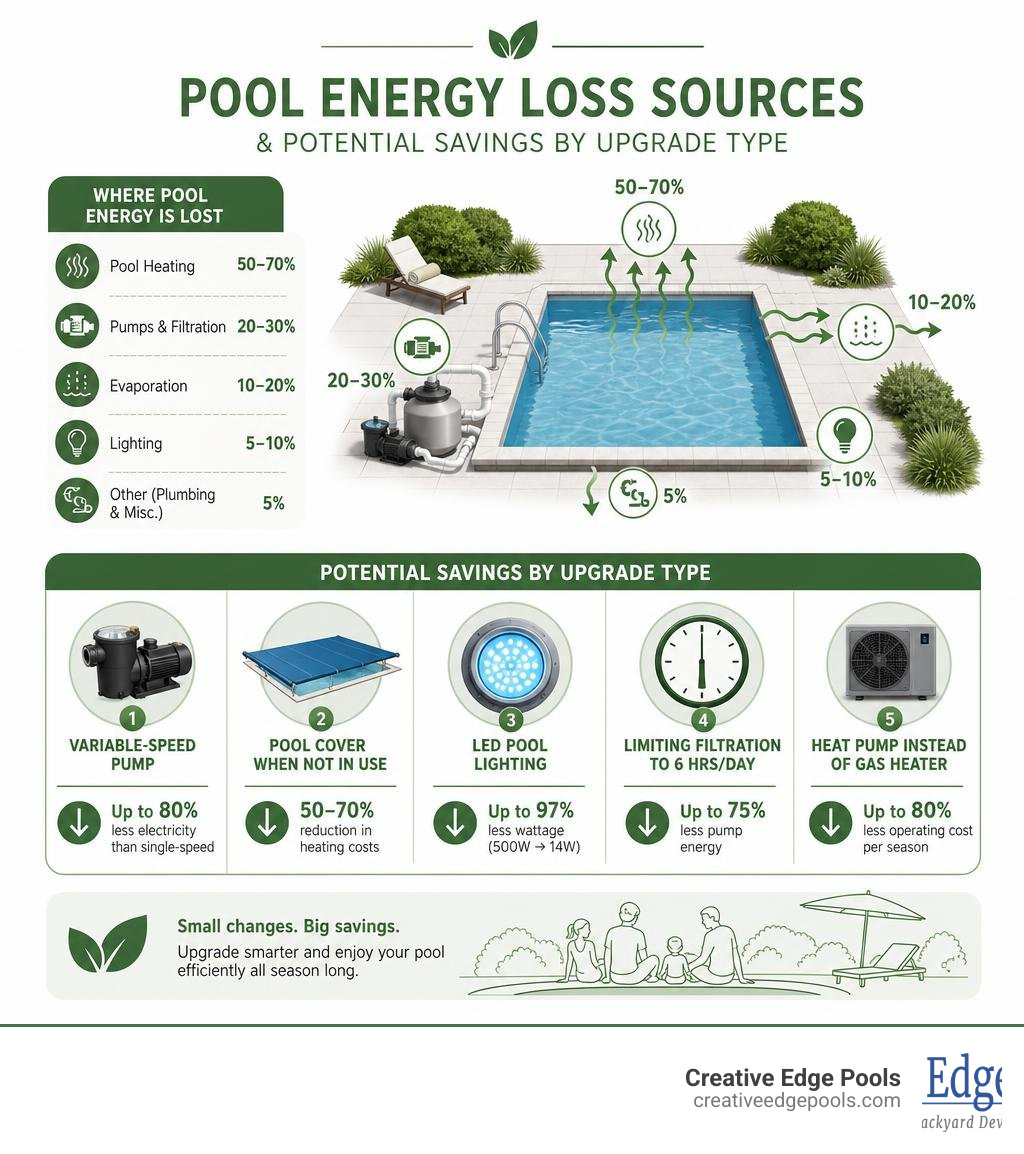
Here’s a quick summary of the most impactful upgrades:
| Upgrade | Potential Energy Savings |
|---|---|
| Variable-speed pump | Up to 80% less electricity than single-speed |
| Pool cover when not in use | 50–70% reduction in heating costs |
| LED pool lighting | Up to 97% less wattage (500W → 14W) |
| Limiting filtration to 6 hrs/day | Up to 75% less pump energy |
| Heat pump instead of gas heater | Up to 80% less operating cost per season |
Most homeowners don’t realize it, but the pool pump alone can be the second-largest electricity user in the entire home — costing up to $310 a year just to run. Across America, more than 8.5 million residential pools are installed, and the vast majority of them are running on outdated, inefficient equipment.
For homeowners in towns like Andover, Exeter, Hampton, and Reading, where pools are a genuine investment in family lifestyle, that wasted energy adds up fast — season after season.
The good news? Modern pool technology has come a long way. Smarter pumps, better heaters, and simple operational habits can slash your pool’s energy bill dramatically — without sacrificing clean water, warm temperatures, or the backyard experience you built it for.
This guide walks you through every major component of an energy-efficient pool system, from pumps and filters to heaters, covers, and smart automation — so you can make informed decisions about your next upgrade.
Designing Energy Efficient Pool Systems: The Core Components
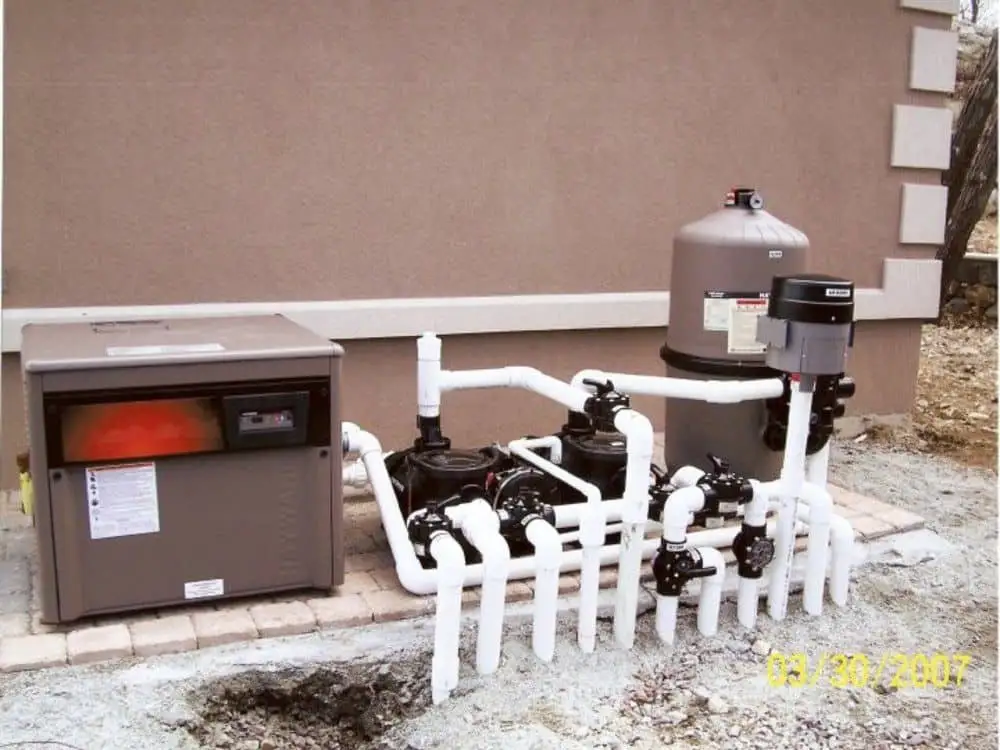
When we design a modern backyard oasis, we look at the pool as a complete hydraulic system. Energy efficiency is not just about buying a green-labeled product; it is about reducing the physical work your equipment has to do to keep your water crystal clear.
At the center of this design is hydraulic resistance. Every bend, turn, filter, and chlorinator in your plumbing creates friction that fights against the flow of water. By decreasing the pool circulation system’s hydraulic resistance, you can reduce the pump’s electricity use by up to 40%.
To achieve this, we focus on:
- Pipe Diameter: Moving from standard 1.5-inch plumbing to 2-inch or 2.5-inch pipes dramatically lowers friction, allowing water to glide through the system with minimal effort.
- Streamlined Plumbing: Swapping out sharp 90-degree elbows for sweep elbows ensures that water does not slam into hard angles, preserving its momentum.
- Filter Selection: Large-capacity cartridge filters offer a massive surface area, which means less resistance and a much happier, longer-lasting pump.
Every decision made during the initial build or renovation phase impacts how hard your equipment has to labor. To learn more about how we integrate these principles from the ground up, explore More info about pool design.
Why Energy Efficient Pool Systems Require Variable-Speed Pumps
If you are still running a traditional single-speed pump, your pool system is essentially running a marathon at a full sprint just to tie its shoes. Single-speed pumps operate at a constant, high-velocity speed (usually around 3,450 RPM) whether they are vacuuming the pool or simply filtering the water.
Variable-speed pumps (VSPs) utilize permanent magnet motors (similar to those used in electric vehicles) to run at precisely programmed speeds. This is where physics works in your favor through the affinity laws: reducing a pump’s speed by one-half allows the pump to use just one-eighth as much energy.
By running a VSP at a lower speed for a slightly longer duration, you achieve the exact same daily water turnover while slashing your electricity consumption. A variable-speed pump can use up to 80% less electricity compared to a single-speed pump, saving pool owners anywhere from $300 to $1,500 annually on electricity costs.
Additionally, look for the ENERGY STAR certification on your equipment. Certified in-ground pool pumps use 20% less energy than standard pool pumps and can save approximately $50 a year in energy bill costs over older baseline models. For homeowners in Massachusetts, you can check out the ENERGY STAR Pool Pumps on Mass Save registry to find certified units that qualify for local rebates.
High-Efficiency Filtration and Plumbing Design
To maintain pristine water quality, your pool relies on its turnover rate—the amount of time it takes for the entire volume of pool water to pass through the filter. However, the type of filter you pair with your pump dictates how much energy is wasted in the process.
We highly recommend cartridge filters over traditional sand or Diatomaceous Earth (DE) filters for energy-conscious homeowners in Eastern MA and Southern NH.
- Lower Flow Resistance: Cartridge filters do not require a multiport valve, which is a major source of hydraulic restriction. Less restriction means your variable-speed pump can run at even lower, more energy-efficient RPMs.
- No Backwashing: Sand and DE filters must be “backwashed” regularly to flush out dirt, sending thousands of gallons of chemically treated, heated water down the drain. Cartridge filters are simply rinsed off with a hose, saving water, chemicals, and energy.
- Longer Lifespan: Because cartridge filters have a larger surface area, they can often go months—or even an entire season—before needing to be cleaned.
Keeping your filtration system optimized is a core pillar of maintaining your investment. For a deeper dive into preserving your pool’s finish and equipment health, see More info about gunite pool care.
Eco-Friendly Pool Heating: Solar, Heat Pumps, and Gas
Heating a pool in New England can feel like a battle against the elements. Cool spring nights in Andover, MA, or early autumn breezes in Exeter, NH, will quickly pull warmth from your pool. The most economical way to heat a pool relies on two concepts: how efficiently you generate heat, and how well you retain it.
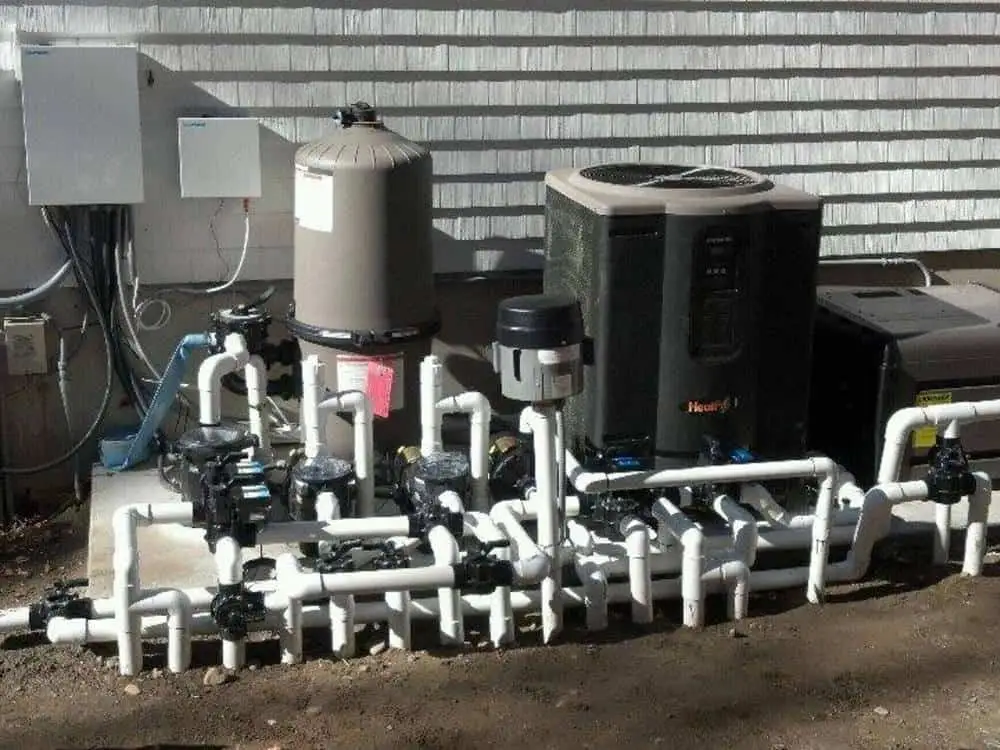
When selecting a heating system, we look closely at the Coefficient of Performance (COP). A standard gas heater has a COP of less than 1.0, meaning it converts fuel to heat at less than 100% efficiency. In contrast, electric heat pumps extract heat from the surrounding air, compress it, and transfer it to the pool water. This process allows them to achieve COPs of 5.0 to 11.6 or higher—meaning they can produce up to 5 to 11 times more heat energy than the electricity they consume.
While gas heaters are ideal for quickly heating a spa on demand, electric heat pumps are incredibly efficient at maintaining a stable, comfortable temperature throughout the swimming season. For a premium, ultra-quiet heating and cooling option, you can explore the Eco Inverter Pool Heat Pump by Madimack, which utilizes advanced inverter technology to scale its power draw up or down based on real-time heating demands.
Comparing Solar Collectors and Hybrid Heat Pumps
If you want to take your energy savings even further, solar thermal collectors and hybrid heat pumps represent the absolute peak of green pool technology.
- Solar Thermal Collectors: These systems pump pool water directly through panels mounted on your roof or a nearby sunny structure. While they have almost zero operating costs, they are entirely dependent on direct sunlight and struggle to provide consistent heat during cloudy New England stretches.
- Hybrid AC/DC Heat Pumps: A game-changing alternative is the hybrid solar heat pump. Units like the Deye Solar R32 Swimming Pool Heat Pump connect directly to rooftop solar panels (photovoltaic direct drive) to heat your pool using free solar electricity during peak daylight hours. When the sun goes down or clouds roll in, the system seamlessly pulls power from the local electrical grid to keep your pool warm without interruption.
Maximizing Efficiency with Covers, Cleaners, and LED Lighting
Upgrading your pump and heater forms the foundation of energy efficient pool systems, but complementary equipment upgrades can squeeze out massive additional savings.
The Power of Pool Covers
Did you know that evaporation is responsible for roughly 70% of total pool heat loss? When water evaporates, it takes your expensive heating energy and your pool chemicals with it.
Covering a pool when it is not in use can reduce pool heating costs by 50% to 70%, minimize chemical use by 35% to 60%, and conserve water by 30% to 50%. Whether you choose a simple solar blanket or a custom-anchored automatic safety cover, keeping your pool covered is the single easiest way to stop burning cash.
Robotic Cleaners vs. Pressure Cleaners
Older pressure-side pool cleaners require a dedicated booster pump running alongside your main pool pump, consuming massive amounts of electricity. Modern robotic pool cleaners operate independently on low-voltage DC electricity.
In fact, robotic cleaners use a fraction of the energy of booster-pump-driven pressure cleaners—drawing only about 197 kWh per year compared to the 1,675 to 2,989 kWh per year consumed by older, pressure-side systems.
LED Lighting Upgrades
If you are still illuminating your evening swims with old-school, 500-watt halogen or incandescent floodlights, you are missing out on easy savings. Replacing a standard flood-style pool light bulb with an LED replacement bulb can reduce watt consumption from 500 watts to just 14 watts—a whopping 97% reduction in energy use for the exact same brightness.
Smart Automation for Energy Efficient Pool Systems
Modern pool ownership should be about relaxation, not running back and forth to a manual equipment pad. Smart automation systems tie all of your energy-efficient components together into a single, cohesive ecosystem controlled right from your smartphone.
With smart controls, you can:
- Schedule Smart Cycles: Program your variable-speed pump to run at low, whisper-quiet speeds during off-peak electricity hours.
- Automate Heating: Set your heater to only run during the warmest parts of the day when heat pumps are at their highest COP, or lower the temperature by a few degrees when you know you will be away for the weekend (remember, each higher degree in pool temperature will cost you 10% to 30% more in energy consumption!).
- Integrate Chemical Automation: Keep your water chemistry perfectly balanced, which reduces the load on your filtration system and prevents the need for energy-intensive “shock” treatments to clear up neglected water.
Rebates, Incentives, and Professional Installation in MA and NH
Upgrading your pool equipment is an investment that pays for itself over time, but you do not have to shoulder the upfront costs alone. Local utility programs in Massachusetts and New Hampshire offer substantial financial incentives to help homeowners transition to energy-efficient systems.
- Mass Save: Massachusetts homeowners can take advantage of generous rebate programs for installing ENERGY STAR certified variable-speed pool pumps, often saving hundreds of dollars on the purchase price.
- NHSaves: New Hampshire residents can access similar financial incentives through the NHSaves Variable-Speed Pool Pumps program, making it easier than ever to upgrade older, noisy single-speed pumps in towns like Hampton and Salem, NH.
While it can be tempting to try to install these systems yourself, pool equipment upgrades require professional expertise to guarantee peak efficiency. Incorrectly sizing a pump or failing to balance the water flow through a heat pump can lead to system errors, voided warranties, and premature equipment failure.
Our team ensures that your plumbing, electrical, and equipment configurations are perfectly engineered for your pool’s unique volume and layout. To understand what goes into a professional backyard installation, read More info about pool installation.
Frequently Asked Questions about Energy-Efficient Pools
How much money can I save by upgrading to a variable-speed pool pump?
Most homeowners save between $300 and $1,500 annually on their electricity bills after upgrading from a single-speed pump to an ENERGY STAR certified variable-speed pump. In Eastern MA and Southern NH, where electricity rates are higher than the national average, the payback period for a new pump is often less than two years.
How many hours a day should I run my pool filter pump?
While single-speed pumps are often run for 12 to 24 hours a day to keep water clean, running a pool filter only 6 hours a day versus 24 hours will reduce energy use by 75%. With a variable-speed pump, you can run the system at a very low speed for 8 to 12 hours, achieving superior filtration and water clarity while using a fraction of the electricity.
What is the average cost to install energy-efficient pool equipment?
Please note: All prices mentioned below are average costs sourced from publicly available internet data and do not represent the actual pricing or rates of Creative Edge Pools.
According to general industry averages and online data, the average cost to fully design, plumb, and install a complete suite of energy-efficient pool equipment (including a variable-speed pump, high-efficiency cartridge filter, and smart automation system) typically ranges from $4,000 to $15,000. The low end of this range represents basic equipment swaps, while the high end reflects comprehensive system overhauls with high-capacity heaters and automated controls. Because proper hydraulic balancing is crucial to achieving these energy savings, we always recommend hiring a certified professional for installation.
Build Your Dream Backyard with Creative Edge Pools
At Creative Edge Pools, we believe you shouldn’t have to choose between a luxurious backyard experience and an eco-friendly home. As a family-owned business with over 100 years of combined experience, we specialize in designing, installing, and renovating custom gunite pools and spas that look stunning and run with maximum efficiency.
Whether you are building a new pool in Andover, MA, upgrading your filtration pad in Reading, MA, or planning a complete backyard renovation in Exeter or Hampton, NH, we bring your unique vision to life with craftsmanship that lasts for generations.
Don’t let an outdated, noisy pool system drain your wallet. Contact our expert team today to discuss how we can build or upgrade your pool into a high-performance, energy-efficient masterpiece.
- Request a custom consultation: Get a Free Quote
- Explore our services: Build your dream pool with Creative Edge Pools