
Your Concrete Pool Deck Options at a Glance
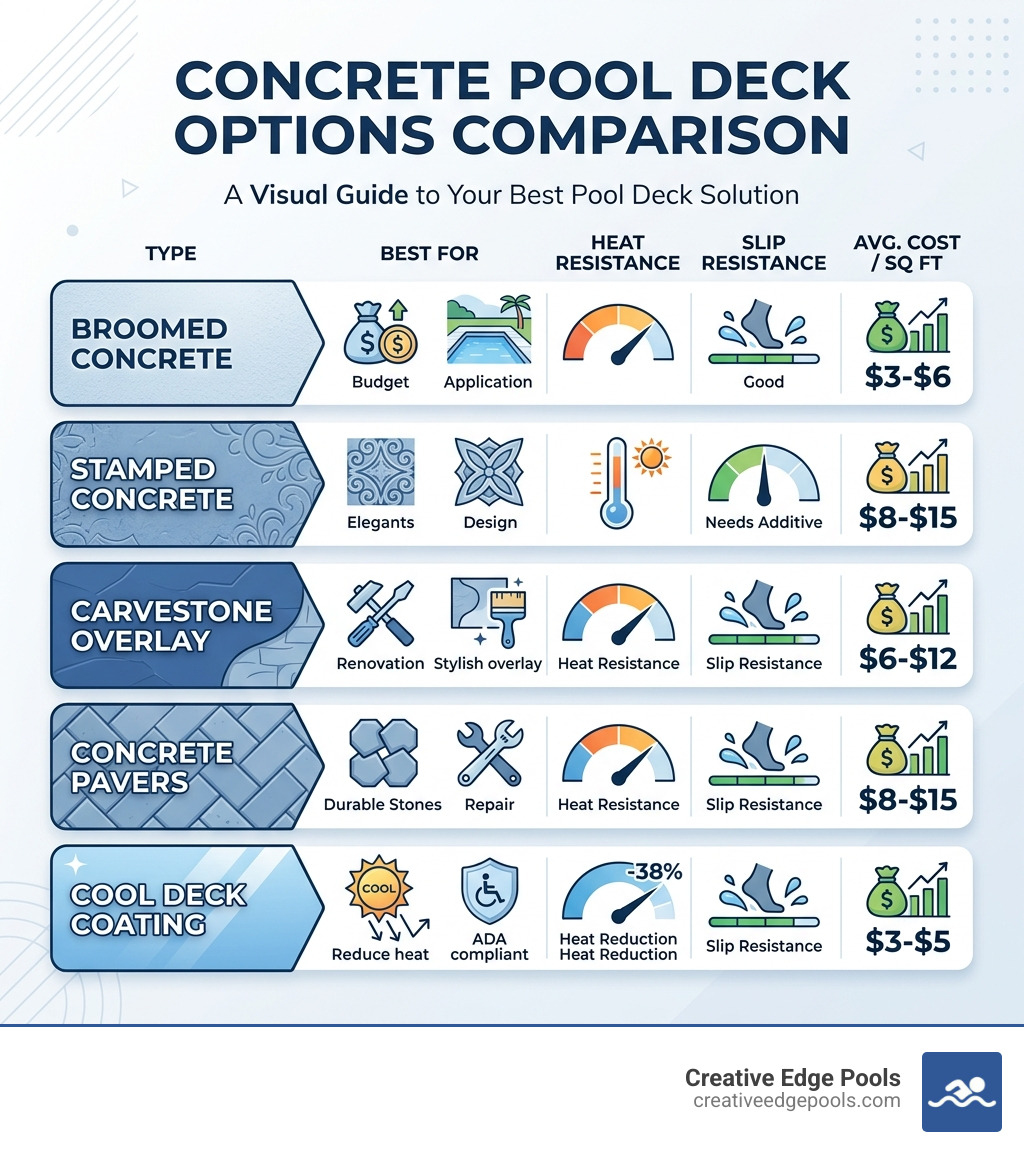
Concrete pool deck materials come in several popular types, each with different looks, costs, and performance levels. Here’s a quick comparison to help you choose:
| Material | Best For | Heat Resistance | Slip Resistance | Avg. Cost/sq ft |
|---|---|---|---|---|
| Broomed Concrete | Budget builds | Moderate | Good | $3-$6 |
| Stamped Concrete | Decorative looks | Moderate | Fair (needs additive) | $8-$15 |
| Carvestone Overlay | Renovations & style | Good | Very Good | $6-$12 |
| Concrete Pavers | Durability & repair | Good | Very Good | $8-$15 |
| Cool Deck Coating | Heat reduction | Excellent (-38%) | Good (ADA compliant) | $3-$5 |
Your pool deck is one of the first things people notice about your backyard. It sets the tone for everything — the vibe, the safety, the comfort underfoot on a hot summer day.
But with so many concrete options out there, choosing the right one can feel overwhelming. Broomed finish or stamped? Pavers or overlay? Reseal or replace?
The good news: concrete is one of the most versatile and cost-effective materials you can use around a pool. Whether you’re building from scratch or refreshing an aging deck, there’s a concrete solution that fits your budget, your style, and the demands of New England weather.
This guide breaks down every major concrete pool deck option — clearly and honestly — so you can make a confident decision for your backyard.
Concrete pool deck vocabulary:
Popular Types of Concrete Pool Decks
When we talk about a Concrete pool deck, we aren’t just talking about a gray slab of sidewalk. Modern technology has turned concrete into a chameleon capable of mimicking high-end stone, wood, or tile. In Eastern MA and Southern NH, we see a wide variety of finishes that balance aesthetics with the rugged durability needed for our freeze-thaw cycles.
- Broomed Finish: This is the “classic” choice. After the concrete is poured and leveled, a technician pulls a specialized push broom across the surface. This creates small ridges that provide excellent slip resistance. It is the most budget-friendly option and serves as a fantastic base if you ever decide to upgrade to an overlay later.
- Stamped Concrete: This involves pressing large rubber “stamps” into wet concrete to create patterns. It can look like slate, flagstone, or even wood planks. While beautiful, it requires careful installation to ensure the surface isn’t too slick when wet.
- Carvestone Overlays: This is a premium modified concrete overlay, usually applied at 1/4″ to 3/8″ thickness. It is hand-carved and colored to look like natural stone. Because it bonds molecularly to the substrate, it is incredibly strong—withstanding up to 6,000 PSI of direct pressure.
- Concrete Pavers: Unlike a solid pour, pavers are individual units set in a sand or gravel base. They are highly popular in New England because they can “flex” with the ground during winter, preventing the large cracks often seen in solid slabs.
For more inspiration on how these looks come together, check out our guide on inground pool hardscapes.
Comparing Pavers to a Standard Concrete Pool Deck
If you are debating between a solid pour and pavers, the “absorption rate” is a key statistic to remember. Quality concrete pavers are often rated for less than 5% absorption. Why does this matter? Low absorption means the material is much more resistant to oil, salt, and pool chemicals. In places like Andover, MA or Nashua, NH, where we use salt in the winter, this resistance is a lifesaver.
Pavers also offer a unique maintenance advantage. If a pipe leaks under your deck, we can simply pull up the necessary pavers, fix the pipe, and put them back. With a solid Concrete pool deck, you’d be looking at a jackhammer and a permanent “patch” look. We also use polymeric sand to fill the gaps between pavers, which hardens to keep weeds out while remaining flexible enough to handle the shifting New Hampshire soil. You can learn more about these hardscapes on our dedicated service page.
Customizing Your Stamped Concrete Pool Deck
The sky is the limit with stamped designs. You can choose Random Sandstone patterns for an earthy, natural feel or Arizona Flagstone stamps for a more rugged look. To make these designs pop, we use:
- Integral Color: The pigment is mixed into the entire batch of concrete so the color goes all the way through.
- Antiquing Agents: These are secondary colors applied to the surface to highlight the “cracks” and “textures” of the stamp, giving it a realistic, 3D appearance.
- Grouting: Some high-end stamped projects involve actually grouting the “joints” of the stamp for a look so authentic your neighbors will swear it’s real stone.
For those looking for that extra “wow” factor, there are several Six Pool Deck Finishing Touches that can elevate a standard design into a masterpiece.
Performance: Heat, Slip, and Moisture Resistance
In our region, a Concrete pool deck has to be a triathlete. It needs to stay cool in the July sun, keep kids from slipping when they jump out of the water, and survive the moisture of a humid August and a snowy January.
Heat Resistance
Standard dark gray concrete can reach temperatures of 140–160°F in direct sun—hot enough to burn feet and potentially damage pool liners. Light-colored concrete (whites, light tans, or buffs) stays significantly cooler, usually between 90–120°F. If you really want to beat the heat, “Cool Deck” coatings can reduce heat build-up by up to 38% compared to bare concrete. These coatings work by dissipating heat into the soil below rather than reflecting it back at your feet.
Slip Resistance
Safety is non-negotiable. According to Concrete Pool Deck: What Every Homeowner Needs to Know, the ASTM C1028 standard requires a minimum 0.6 static coefficient of friction for pool decks. While a broom finish naturally hits 0.7 to 0.9, sealed stamped concrete can drop to a dangerous 0.3 if not handled correctly. We solve this by mixing clear plastic grit or aluminum oxide into the final sealer coat to ensure a “non-skid” surface that meets ADA safety requirements even when wet.
| Performance Metric | Concrete | Travertine | Porcelain |
|---|---|---|---|
| Heat Absorption | Moderate (Low with Cool Deck) | Very Low | High (unless light colored) |
| Slip Resistance | High (with texture) | High | Variable (depends on finish) |
| Durability | High | High | Very High |
| Maintenance | Seal every 2 years | Minimal | Minimal |
Cost and Maintenance of Your Concrete Pool Deck
Budgeting for a Concrete pool deck requires looking at both the “now” and the “later.”
Installation and Resurfacing
A basic broomed deck typically starts around $3 to $6 per square foot. If you want the bells and whistles of stamped patterns or premium pavers, expect to pay between $8 and $15 per square foot. If your existing deck is structurally sound but looks like a relic from the 1970s, resurfacing is a brilliant middle ground. Resurfacing costs about 20–30% of what a full replacement would cost, often starting at $3–$5 per square foot.
The 2-Year Rule
To keep your deck looking like the day it was poured, you must seal it. We recommend sealing every 2 years. This prevents moisture from seeping into the pores, which is the leading cause of “spalling” (surface flaking) during New England winters. It also protects against chemical stains and UV fading.
If you notice small cracks starting to form, don’t panic. You can Fix Pool Deck Cracks relatively easily if they are under 1/8 inch. Addressing these early prevents them from becoming major structural issues.

Choosing the Right Material for New Builds vs. Renovations
If we are starting a new build for you in a town like Bedford, NH or Concord, MA, the most critical step isn’t the concrete—it’s what’s under it.
Subgrade Preparation
About 95% of backyards have some slope, meaning we have to use “fill dirt” to level the area. If you pour concrete over fresh fill, it will settle and crack. To prevent this, we often use a pier system. We drill 8-inch diameter holes down to “virgin” (unmoved) dirt and fill them with concrete to create structural stilts for your deck. This ensures your deck stays level even if the dirt underneath shifts over time.
Renovation Options
For renovations, you don’t always need to tear everything out. If your slab is stable, a Carvestone overlay is a fantastic choice. At just 1/4 inch thick, it doesn’t create “tripping hazards” at the door thresholds but provides a brand-new, 6,000 PSI surface. For more details on whether you should patch or pivot, see our Pool Deck Replacement Guide 2025.
Professional Concrete Pool Deck Resurfacing can often be completed in just a few days, giving you a total backyard makeover without the mess of a full demolition.
Frequently Asked Questions about Concrete Pool Decks
How often should I seal my concrete pool deck?
We recommend sealing every 2 years. In the harsh climate of Eastern MA and Southern NH, the combination of pool chemicals, salt, and freeze-thaw cycles can wear down protective barriers. Re-sealing ensures your deck remains moisture-resistant and colorful.
Is stamped concrete too slippery for a pool area?
It can be if it’s finished with a high-gloss sealer and no additives. However, when we install stamped decks, we use non-skid additives and ensure the texture depth is sufficient to provide grip. It’s all about the “static coefficient of friction”—we aim for safety first.
Can I apply a concrete overlay on my existing cracked deck?
Yes, provided the cracks aren’t “moving” (structural). We can grind down the old surface, repair the cracks, and apply a bonding agent that allows the new overlay to stick permanently. If the deck is heaving or has wide, deep cracks, a full replacement is usually safer.
Conclusion
At Creative Edge Pools, we know that a Concrete pool deck is more than just a place to put a lounge chair. It’s the foundation of your summer memories. As a family-owned business with over 100 years of combined experience, we’ve seen every backyard challenge New England can throw at us—from the rocky soil of Gloucester to the slopes of Amherst.
Whether you want the rugged beauty of concrete pavers or the sleek, heat-resistant finish of a cool deck coating, we are here to bring your vision to life. Your backyard has the potential to be the envy of the neighborhood; let’s make it happen.
Ready to start your transformation? Explore our hardscaping services to see how we can level up your outdoor living space.
