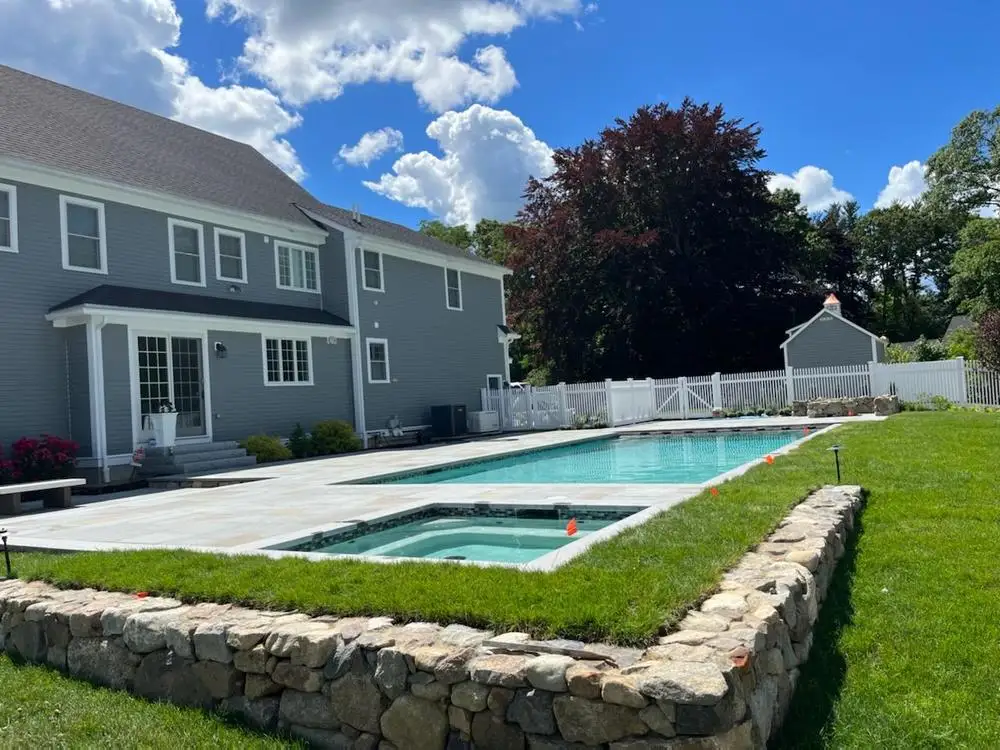
What Does a Gunite Pool Actually Cost in 2026?
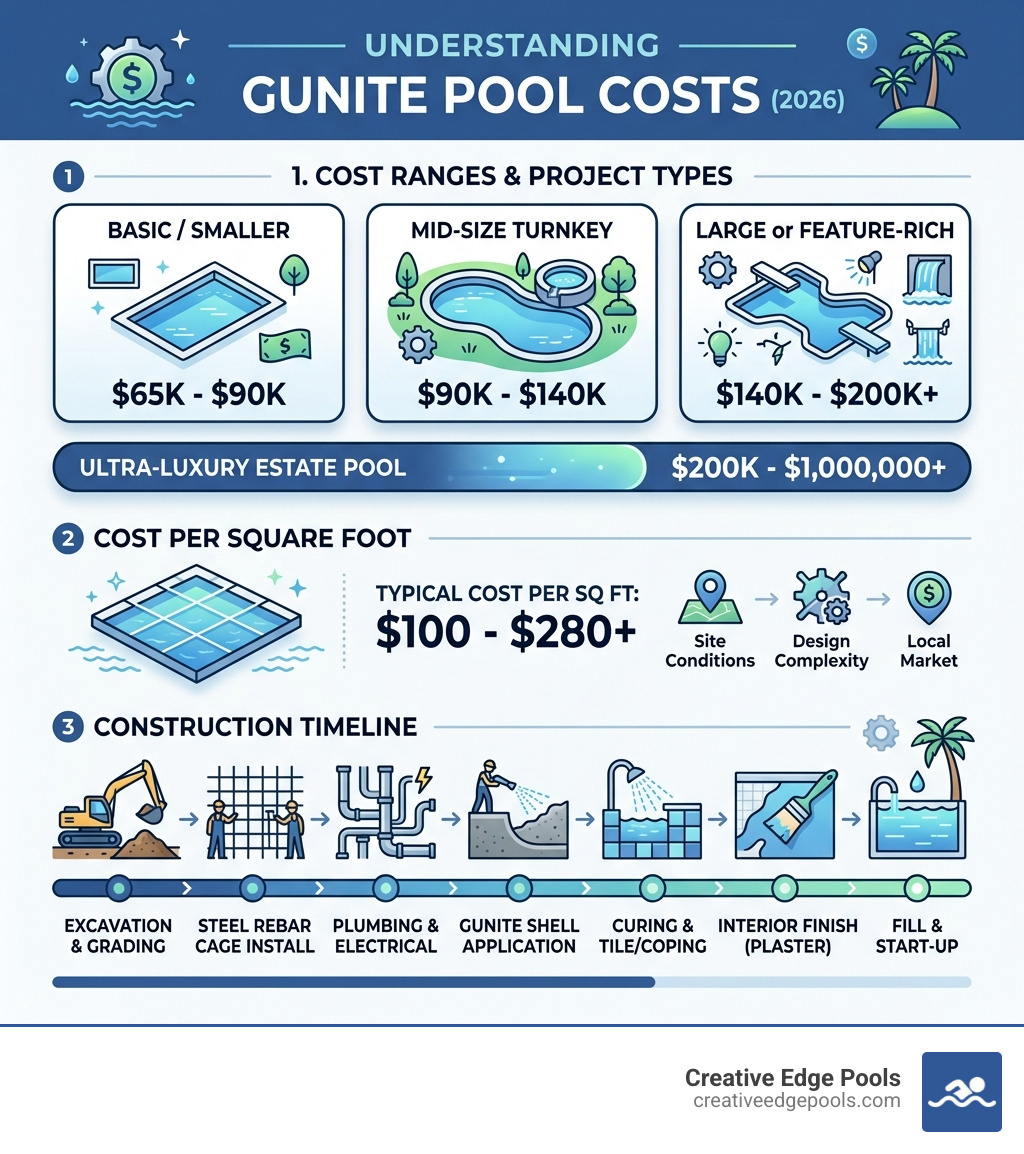
The cost gunite pool projects in 2026 typically fall in the ranges below, based on average internet data:
| Project Type | Typical Cost Range |
|---|---|
| Basic/smaller gunite pool | $65,000 – $90,000 |
| Mid-size turnkey installation | $90,000 – $140,000 |
| Large or feature-rich pool | $140,000 – $200,000+ |
| Ultra-luxury custom estate pool | $200,000 – $1,500,000+ |
| Per square foot | $100 – $1,500+ |
Note: These are average costs based on internet data. Your actual quote will depend on your site, size, features, and location.
So you’re thinking about a gunite pool. You’ve probably seen wildly different numbers online — $65,000 here, $200,000 there — and you’re trying to figure out what’s actually realistic before you call a single builder.
Here’s the short answer: gunite pools are fully custom, on-site builds. That’s what makes them so desirable. It’s also what makes the pricing hard to pin down without knowing your specific yard, your must-have features, and your local market.
Unlike fiberglass or vinyl liner pools — which use prefabricated shells — gunite is a specialized concrete application. A dry cement-and-sand mix is sprayed at high pressure through a hose, with water added at the nozzle. The result is a dense, seamless shell that can be shaped into virtually any form your backyard allows.
That flexibility is genuinely powerful. But it also means the price can swing dramatically based on dozens of variables — from soil conditions to spa integrations to the skill of the nozzleman applying the concrete.
At Creative Edge Pools, a company specializing in gunite pool installations, pool renovations, and custom pool design in Massachusetts and New Hampshire, we see this firsthand. Every project is different. And in a market like the Northeast — where soil, seasons, and permitting all add complexity — understanding the full cost picture before you start is essential.
This guide breaks down every major cost factor so you can plan with confidence, not guesswork.
Terms related to cost gunite pool:
Understanding the Average Cost Gunite Pool Owners Face in 2026
When we talk about the cost gunite pool owners should expect, we are looking at a premium investment. Creative Edge Pools, a company specializing in gunite pool installations, pool renovations, and custom pool design in Massachusetts and New Hampshire, notes that based on internet data, the average turnkey installation for a standard 14-by-28-foot pool often lands around $100,000. However, the range is vast. A basic, smaller project might start at $65,000, while ultra-luxury, custom-designed estates in areas like Weston, MA, or Bedford, NH, can easily exceed $1,000,000.
This isn’t just a “pool in a box.” A gunite pool is a permanent addition to your real estate. The inground pool cost reflects the fact that we are building a structure designed to last a century. According to the Average Cost of Gunite Pool Installation and Maintenance 2026 – LatestCost, the initial installation typically ranges from $50,000 to $100,000+, but when you add in the “turnkey” elements—patio, fencing, and landscaping—most homeowners find themselves in the $90,000 to $140,000 bracket.
Breaking Down the Cost Gunite Pool Per Square Foot
If you prefer to calculate by size, the gunite pool price per square foot is a helpful metric. Based on internet data, you can expect to pay anywhere from $100 to $1,500+ per square foot.
Why such a massive range?
- Depth: A 10-foot deep diving pool requires more excavation, more steel, and more gunite than a 4-foot deep “cocktail pool.”
- Perimeter: A curvy, freeform pool has a longer perimeter than a rectangle of the same square footage, increasing the cost of tile and coping.
- Site Complexity: If we have to navigate a steep slope in Worcester or tight access in Somerville, the price per foot climbs.
When researching the price of a gunite pool, the “shell” is only one part of the equation.
Regional Pricing and Market Demand
In the Northeast, we face unique challenges that influence the cost gunite pool installers must charge. Market demand in Eastern MA and Southern NH remains high, and our shorter construction window (compared to Florida or Texas) means schedules fill up fast.
How much do inground pools cost in Massachusetts and New Hampshire? Generally, you’ll see higher labor and material costs here than in the South. Concrete and rebar prices have risen significantly in recent years, and specialized trades—like the licensed electricians required for pool bonding—command premium rates in our region. Regional variables like soil type and local frost lines also play a role in how we engineer your pool’s foundation to ensure it withstands the harsh New England climate.
Primary Factors Influencing Your Total Investment
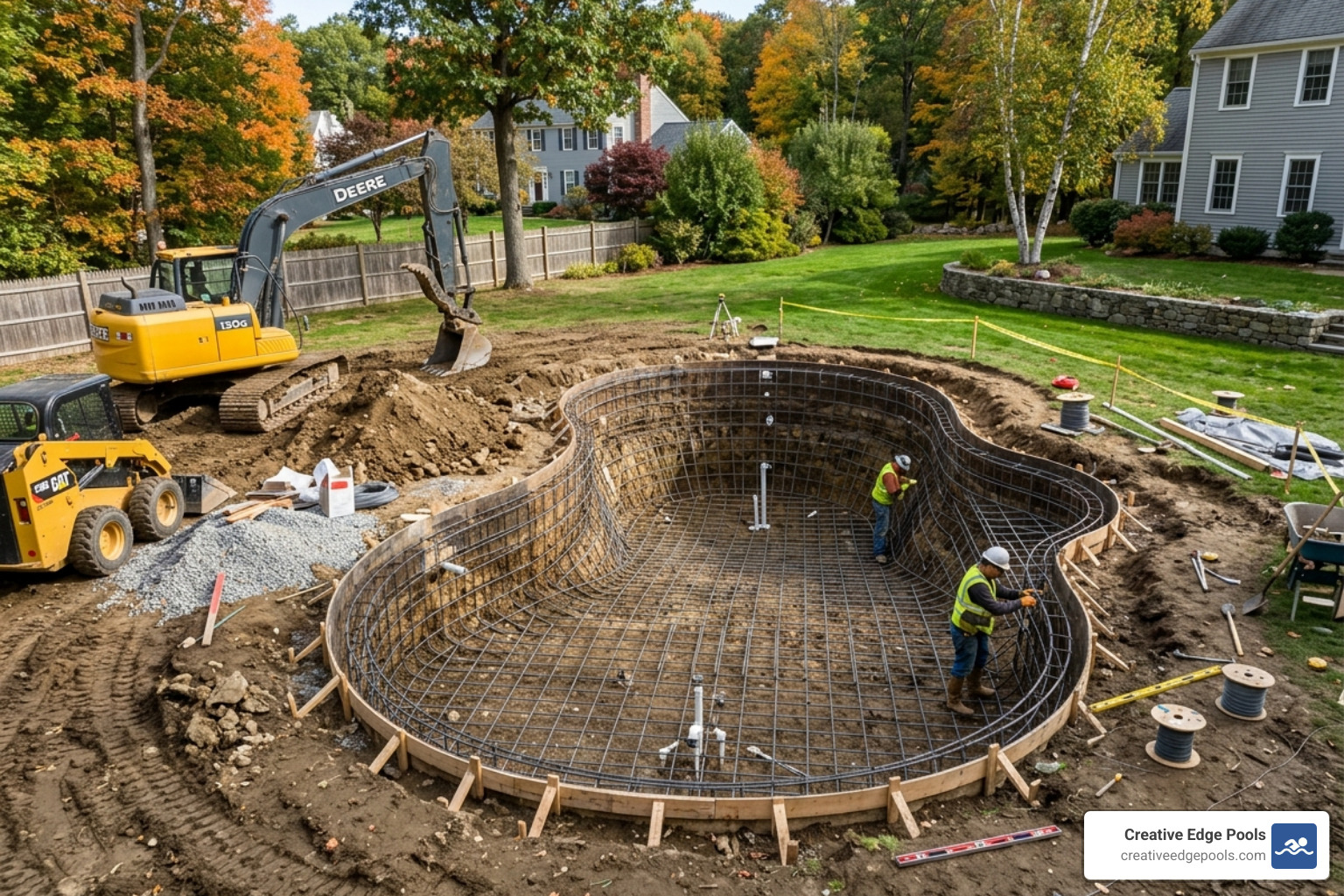
It’s easy to focus on the water, but the dirt is where the budget often lives. Several primary factors will dictate where your project falls on the price spectrum.
- Site Accessibility: Can we get a full-size excavator into your backyard in Andover, or do we need to use smaller, specialized equipment to “thread the needle” between your house and a neighbor’s fence? Tight access can add $3,000 to $55,000+ to the bill for the most challenging sites.
- Soil Conditions and Bedrock: This is the “big unknown” in New England. If we hit the famous Massachusetts granite (bedrock) or a high water table, excavation costs can skyrocket. Rock removal alone can add $1,000 to $30,000+ depending on the volume.
- Labor: Building a gunite pool is labor-intensive. According to Angi’s 2026 Guide, labor accounts for roughly 30% to 35% of the total project cost. You aren’t just paying for “diggers”; you’re paying for a master gunite pool builder, expert plumbers, electricians, and the “nozzleman” whose skill determines the structural integrity of your pool shell.
Hidden Expenses in the Cost Gunite Pool Construction Process
When budgeting, it’s the “invisible” items that can sink a budget. We always recommend our clients in places like Framingham or Nashua keep a contingency fund for:
- Utility Rerouting: Sometimes that perfect pool spot sits right over an old gas line or septic field.
- Dirt Hauling: Excavating a pool creates a massive amount of soil—often 80 to 150 cubic yards. If you can’t use it to grade your yard, hauling it away can cost thousands.
- Drainage Systems: To protect your investment and your home, we often need to install complex concrete inground pool cost items like French drains or retaining walls, especially on sloped lots.
- Tree Removal: Clearing a space and removing deep roots is a necessary gunite swimming pool cost that many homeowners overlook.
Permitting and Local Regulations
Every town—from Acton to Windham—has its own rules. HomeInDepth notes that permit fees typically range from $450 to $12,000+ in some high-end MA suburbs.
Beyond the permit itself, you must budget for:
- Safety Fencing: This is legally required and can cost anywhere from $2,000 to $80,000+ depending on the material and perimeter.
- Electrical Bonding and Inspections: To ensure the pool is safe from stray currents, rigorous electrical work and multiple inspections are mandatory.
Luxury Add-ons and Custom Features
This is where your vision truly comes to life. Because gunite is “shot” onto a rebar frame, we can build almost anything you can dream up.
- Integrated Spas: A gunite pool with spa is one of our most popular requests. Based on internet data, adding a custom-built, attached spillover spa typically adds $8,000 to $170,000+ to the project for complex custom designs.
- Tanning Ledges (Baja Shelves): These shallow areas are perfect for lounge chairs and umbrellas.
- Infinity Edges: If your property has a view, an infinity edge creates a stunning visual, though it can add $15,000 to $250,000+ due to the extra plumbing and catch basin required.
- Custom Finishes: While standard plaster is the base, many homeowners opt for Pebble Tec pool cost upgrades. These pebble or quartz finishes last longer and look more natural, typically costing $6,000 to $100,000+ more than standard plaster depending on the material and pool size.
Enhancing the Atmosphere with Lighting and Fire
Modern gunite pools are about more than just swimming; they are the centerpiece of your outdoor living space.
- LED Lighting: Color-changing LEDs allow you to set the mood. Plan for $200 to $11,000+ per light for high-end integrated systems.
- Fire Features: Fire bowls or integrated fire pits near the water add a “wow” factor that extends the pool’s use into the cool New Hampshire autumn evenings.
- Automation: A high-end gunite pool system allows you to control the heater, lights, and pumps from your smartphone. This convenience usually adds $2,500 to $40,000+.
Long-Term Maintenance and Operating Expenses
Owning a pool is a long-term financial commitment. Based on internet data, the average annual maintenance cost is approximately $5,000, though homeowners should budget for a wide range from $2,500 to $50,000+ annually depending on pool size, features, and local service rates.
Your annual gunite pool builders will tell you to expect:
- Chemicals: $400 to $800 per year.
- Electricity: Running a high-efficiency pump and heater can cost $300 to $1,200 per season.
- Professional Services: Opening and closing the pool, plus weekly cleaning, adds to the total.
Based on internet data, gunite pools require more chemicals than fiberglass because the surface is porous, which can harbor algae if not properly maintained.
Resurfacing and Structural Repairs
Unlike other pool types, gunite pools require periodic “renovations” to stay in top shape.
- Acid Washing: Every 3–5 years to remove stains ($250–$1,000).
- Resurfacing: The interior finish (plaster or pebble) will eventually wear down. The average cost to resurface a gunite pool is typically $12,000, with a wide range from $10,000 to $120,000+ every 10–15 years depending on the finish and pool size.
- Crack Repair: While gunite is incredibly strong, ground movement can occasionally cause minor cracks. Professional crack sealing typically costs from $75 to $750+ per linear foot.
If you’ve bought a home with an older pool, the resurfacing gunite pool cost or the general cost to redo pool is a smart investment to protect the underlying structure.
Maximizing Lifespan and Home Value
The “silver lining” to the higher cost gunite pool owners pay is the return on investment. A well-maintained gunite pool can increase your home’s value by 5% to 7%. More importantly, the structure itself can last 100 years.
If your current pool is looking dated, the gunite pool renovation cost is often much lower than building new. You can remodel a swimming pool by adding a new tile line, upgrading the decking, or switching to a saltwater system, giving your backyard a fresh look for a fraction of the original installation price.
Frequently Asked Questions about Gunite Costs
What is the typical construction timeline for a gunite pool?
Don’t expect to be swimming next week. A gunite pool is a slow-cooked masterpiece.
- Design & Permitting: 4–8 weeks (depending on your town).
- Excavation & Steel: 1–2 weeks.
- Gunite Application: 1–2 days.
- Curing: 28 days. This is non-negotiable. The concrete must cure to reach its maximum strength. We spend this time doing plumbing and tile work.
- Finishing & Decking: 2–4 weeks.
Total duration is usually 3 to 6 months. If you want to swim by Memorial Day, you should be talking to a gunite pool company near me in the previous autumn.
How can homeowners save money on a gunite project?
While the average price for gunite pool projects is high, there are ways to be smart:
- Simplicity: A rectangular pool is almost always cheaper than a complex freeform shape.
- Phasing: Install the pool and basic deck now; add the heater, waterfall, or outdoor kitchen in a few years.
- Off-Season Deals: Some builders offer better rates or quicker start dates if you sign during the winter months.
What factors contribute to the higher investment in a gunite pool?
The cost gunite pool owners pay is higher than vinyl or fiberglass because it is built entirely from scratch on your property. You aren’t paying for a factory-made product; you’re paying for a custom engineering project. The 15×30 gunite pool cost reflects the tons of steel rebar, the specialized high-pressure equipment, and the skilled craftsmanship required to ensure that shell stays watertight for decades.
Conclusion
Building a pool is one of the most exciting upgrades you can make to your home, but it requires a clear-eyed look at the numbers. From the initial excavation in your Massachusetts backyard to the long-term maintenance of your New Hampshire retreat, understanding the cost gunite pool installation entails is the first step toward success.
Creative Edge Pools, a company specializing in gunite pool installations, pool renovations, and custom pool design in Massachusetts and New Hampshire, is here to help you navigate these choices. As a family-owned business with over 100 years of combined experience, we focus on bringing homeowner visions to life with transparency and craftsmanship.
Ready to stop guessing and start designing? Let’s build something that will last for generations.