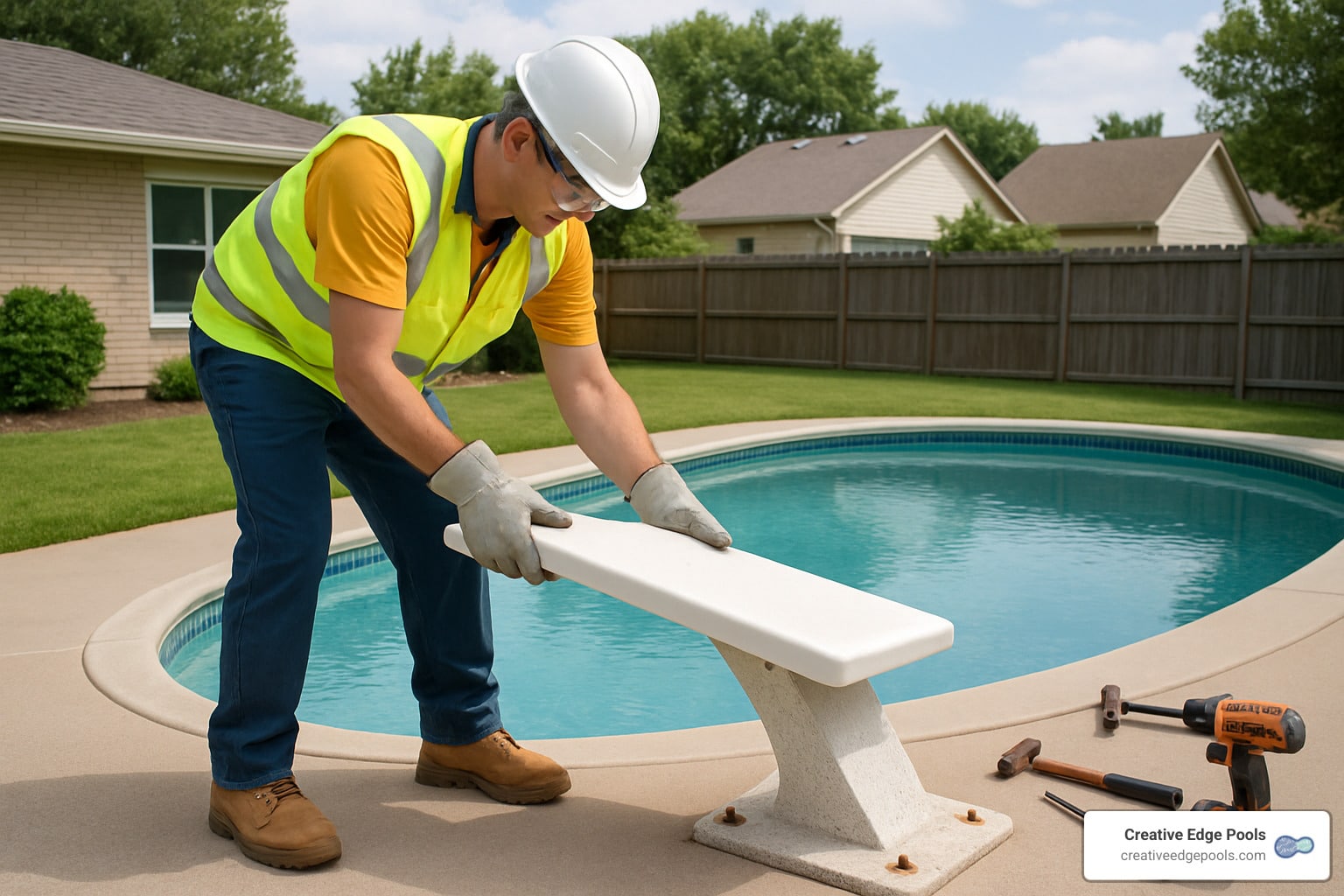
Cost to Remove Diving Board: 7 Powerful Savings in 2025
Why Homeowners Are Saying Goodbye to Their Diving Boards
The cost to remove diving board typically ranges from $100 to $500, depending on whether you hire a professional or tackle it yourself. Here’s what you need to know:
Quick Cost Breakdown:
- DIY removal: $50-150 (tools and disposal)
- Professional removal: $200-500 (labor included)
- Additional repairs: $100-300 (deck patching)
- Electrical work: $150-400 (if wiring involved)
That old diving board isn’t just taking up space—it might be costing you money in higher insurance premiums and creating safety risks for your family. Many homeowners are finding that removing their unused diving boards opens up new possibilities for their pool area while potentially boosting property value.
The removal process involves more than just unbolting the board. You’ll need to deal with embedded anchor bolts, patch concrete holes, and possibly handle electrical components. Some homeowners get lucky and find people willing to remove boards for free in exchange for the scrap metal value.
Whether you’re dealing with a cracked fiberglass board, want to create more swimming space, or simply haven’t used it in years, understanding the true cost helps you make the right decision for your backyard.
I’m David Brabant, owner of Creative Edge Pools, with over thirty years of experience in pool construction and renovations throughout Massachusetts and New Hampshire. I’ve helped countless homeowners evaluate the cost to remove diving board setups and transform their pool areas into safer, more functional spaces.
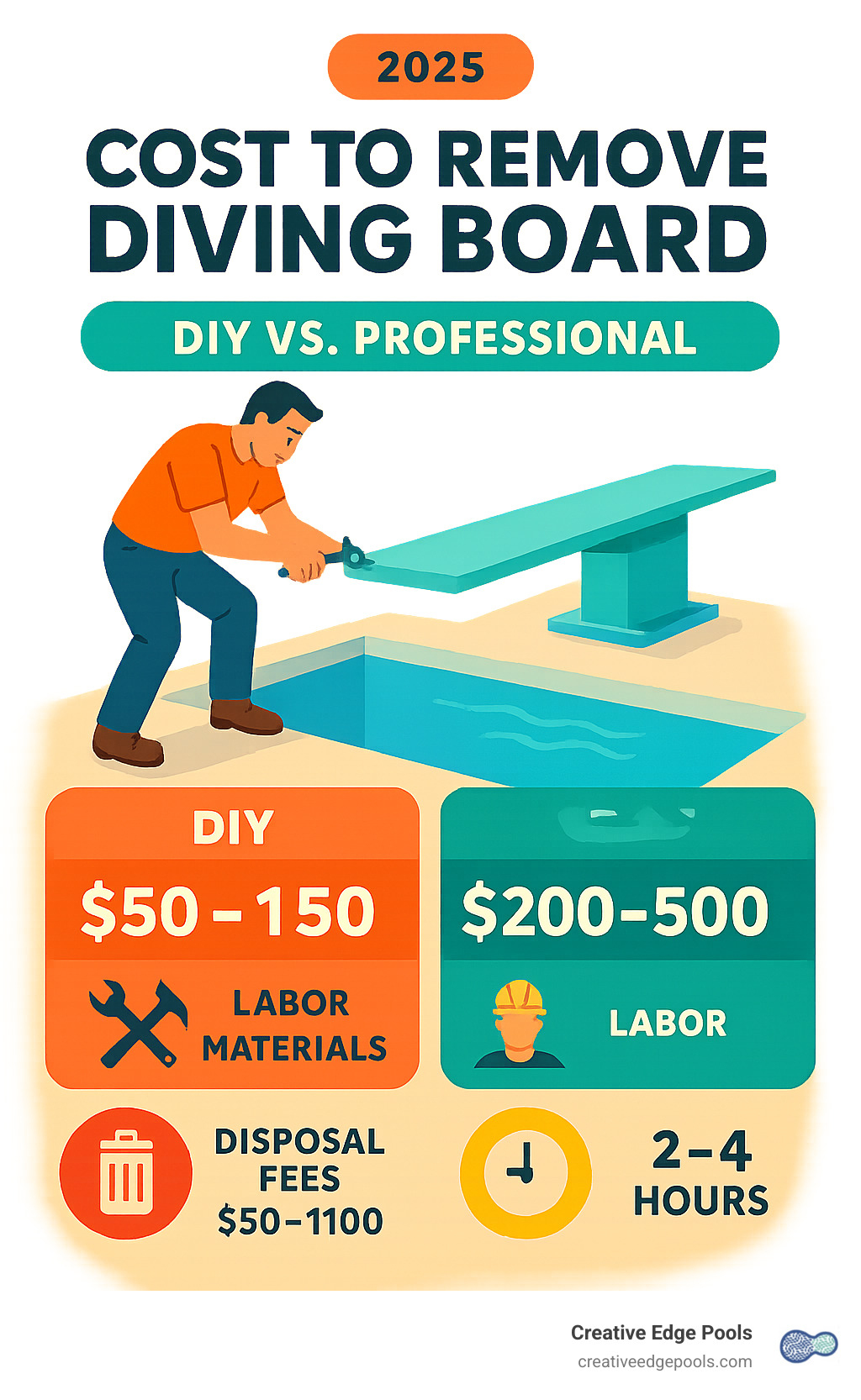
Cost to remove diving board vocab explained:
- cost to remove an above ground pool
- cost to remove and replace concrete pool deck
- cost to remove an inground pool
What Is the Average Cost to Remove a Diving Board?
When homeowners start researching the cost to remove diving board setups, they quickly find that pricing varies quite a bit depending on who does the work and what’s involved. The good news? Most removal projects fall into a predictable range that won’t break the bank.
| Removal Method | Cost Range | What’s Included |
|---|---|---|
| DIY Approach | $50-150 | Tools, disposal fees, your time |
| Professional Service | $200-500 | Labor, removal, basic cleanup |
| Full Restoration | $500-800 | Removal plus deck repair |
The most basic professional removal typically starts around $200-350 for straightforward jobs. This covers having someone show up with the right tools, unbolt your diving board, haul it away, and leave your deck area reasonably clean.
However, if your diving board is embedded deep in concrete or has complicated mounting hardware, expect costs to climb toward the $350-500 range. These jobs often require cutting tools and more time to safely remove everything without damaging your pool deck.
Regional labor rates definitely impact your final bill. Here in Eastern Massachusetts and Southern New Hampshire, we see most professional removals land between $150-400, with the variation depending mostly on how accessible the diving board area is and whether any special equipment is needed.
Typical cost to remove diving board in 2024
Current market conditions have pushed prices up from the bargain-basement rates some homeowners remember from a few years back. While online forums still mention that magical $100 baseline for basic haul-away services, today’s reality reflects both inflation and increased demand for pool modifications.
Most contractors now quote within these ranges:
- Basic removal and disposal: $200-350
- Complex removal requiring cutting: $350-500
- Complete restoration with deck patching: $500-800
The construction industry’s labor shortage has affected pool services too. What might have cost $100 for simple removal in previous years now typically runs $150-200 for the same level of service. It’s not just about the diving board anymore—disposal fees have increased, and skilled labor commands higher wages across the board.
Hidden expenses beyond the basic cost to remove diving board
The sticker shock often comes from expenses that aren’t obvious when you first start planning your diving board removal. Smart homeowners budget for these additional costs upfront to avoid surprises.
Deck repair materials represent the biggest hidden expense for most projects. Once that diving board base comes out, you’re left with anchor bolt holes and potentially damaged concrete that needs professional attention. Quality patching and refinishing to match your existing deck typically adds $100-300 to your project total.
Electrician fees catch many homeowners off guard, especially if their diving board area includes integrated lighting or electrical components. Licensed electricians charge $75-125 per hour, and even simple disconnection work can add $150-400 to your removal project.
Permit requirements vary significantly by location, but don’t assume you can skip this step. Some municipalities treat diving board removal as a structural modification requiring permits, which can cost anywhere from $50-200 depending on your local building department’s requirements.
Insurance documentation might seem like paperwork you can handle later, but updating your policy immediately after removal ensures you start receiving any available premium reductions for eliminating diving board liability from your property.
Factors That Change Your Diving Board Removal Price Tag
Not all diving board removals are created equal. What might cost your neighbor $150 could easily run you $400, and it all comes down to a few key factors that can make or break your budget.
The base type and installation method creates the biggest price swing in your cost to remove diving board project. If you’re lucky enough to have a simple bolt-on system with four standard mounting bolts, an experienced pro can have that baby out in about 10 minutes. But if your diving board base is buried deep in concrete like it’s going to survive a nuclear winter, you’re looking at cutting tools, extra labor, and a much bigger bill.
Board material and condition also plays a role in your final costs. Lightweight fiberglass boards are a breeze to handle and dispose of, while those heavy wooden or composite boards from decades past require more muscle and careful handling. Nobody wants to throw out their back wrestling with a waterlogged diving board.
Location and accessibility around your diving board can turn a simple job into an obstacle course. If your board is tucked between prize-winning rose bushes and a decorative fountain, expect to pay more for the extra time and care required. Contractors charge for difficulty, and tight spaces definitely qualify.
Local labor rates vary dramatically depending on where you live. Urban areas typically command premium pricing compared to rural locations, which directly impacts your total project cost. What costs $200 in a small town might run $400 in a major metropolitan area.
Here’s something interesting: scrap metal value can actually work in your favor. Steel diving board bases have real recyclable value, and some clever homeowners post “free removal” ads on Craigslist. You’d be surprised how many people will gladly remove your diving board in exchange for the scrap metal – essentially giving you free removal service.
The trend toward diving board removal isn’t just aesthetic. Scientific research on pool safety shows that many residential diving boards create genuine safety risks due to inadequate pool dimensions, which explains why removal requests keep increasing.
How electrical or lighting near the board affects the cost to remove diving board
Here’s where things get complicated – and expensive. If your diving board area has any electrical components, your simple removal project just became an electrical job requiring licensed professionals.
Pool lighting systems love to run conduit through or near diving board bases. Before anyone starts cutting or removing anything, that wiring needs careful evaluation. One wrong move and you could be dealing with damaged electrical systems and costly repairs.
GFCI breaker considerations become critical when electrical work enters the picture. Pool electrical systems require specific safety protections, and any modifications must maintain proper ground fault protection. This often means breaker panel work on top of the basic removal.
Licensed electrician requirements will add $150-400 to most projects involving electrical components. These professionals typically charge $75-125 per hour, and pool electrical work usually takes 2-4 hours for proper disconnection and code compliance. It’s not cheap, but it’s absolutely necessary for safety.
Code compliance verification ensures your pool area meets current electrical safety standards after the diving board is gone. This might involve inspection fees and potential upgrades to bring older installations up to current codes – another expense that catches homeowners off guard.
Can recycling offset the cost to remove diving board?
Absolutely! Smart homeowners are finding creative ways to reduce or even eliminate their removal costs through recycling and reuse strategies.
Steel base scrap value fluctuates with market conditions but typically ranges from $20-80 depending on your base size and current steel prices. Some homeowners report that this scrap value completely covers their basic removal costs – essentially getting free diving board removal.
Craigslist free pickup strategies work surprisingly well for diving board removal. Many homeowners successfully post free removal offers, attracting people willing to handle the entire removal process in exchange for keeping the recyclable materials. It’s a win-win situation that saves you money and keeps materials out of landfills.
Eco-friendly disposal options include donating functional boards to community pools or recreation centers. While this approach doesn’t put money back in your pocket, it avoids landfill fees and supports local recreation programs. Plus, it feels good knowing your old diving board will continue bringing joy to swimmers.
Landfill fees for diving board disposal typically run $25-75, making recycling an attractive alternative both economically and environmentally. When you factor in the time and effort to haul materials to the dump, finding someone who wants your diving board for scrap becomes even more appealing.
Step-by-Step Removal Process & Safety Checklist
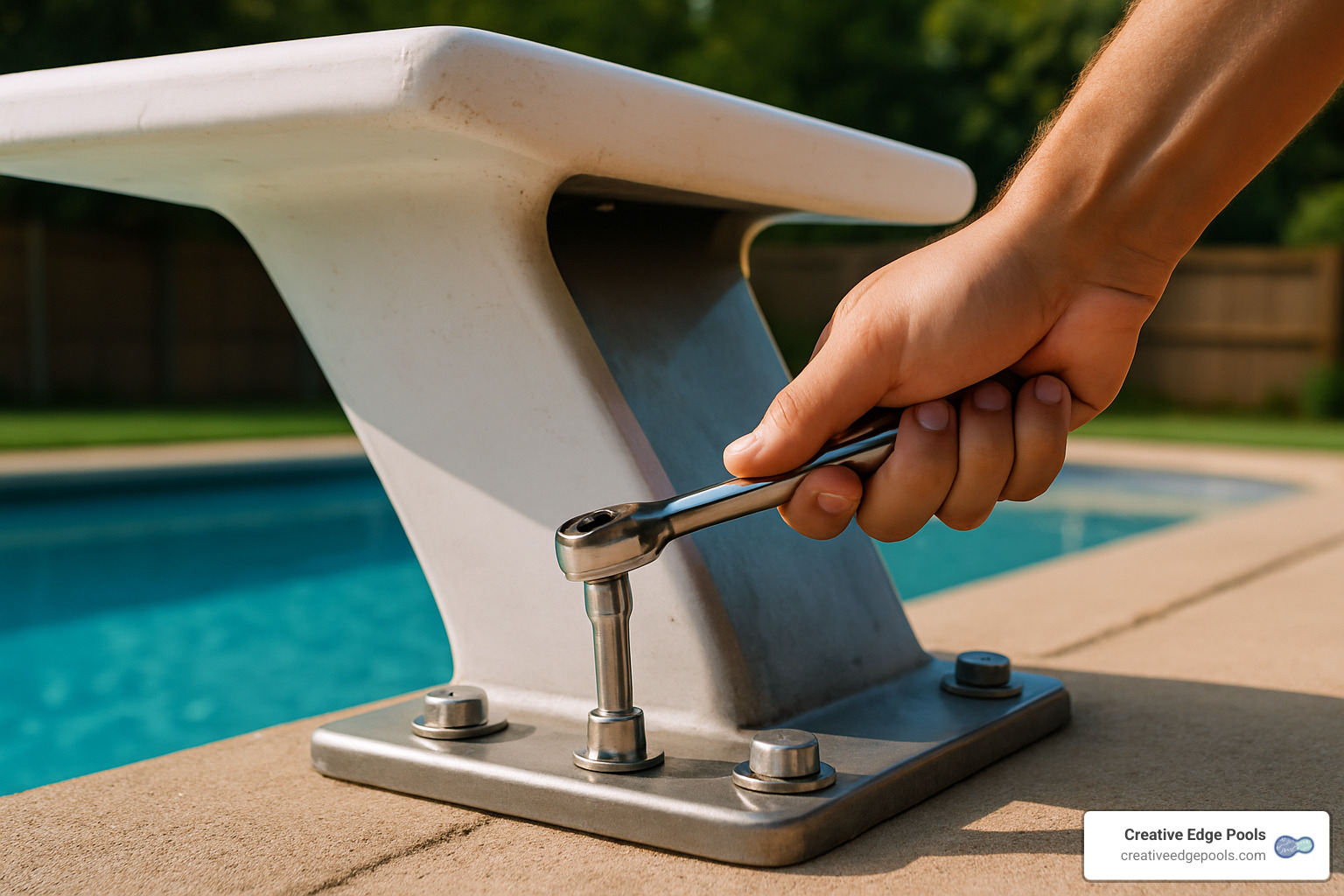
Removing a diving board might look straightforward, but there’s definitely a right way to do it safely. After helping homeowners with countless pool modifications over the years, I’ve seen what happens when people skip steps or cut corners on safety.
The process starts with gathering the right tools. You’ll need a socket wrench set with extension bars, an angle grinder with metal cutting discs, safety glasses, hearing protection, work gloves, steel-toed boots, concrete patching materials, and a tarp for cleanup. Having everything ready before you start makes the job go much smoother.
Unbolting the diving board itself is usually the easy part. Most boards attach to their base with four standard bolts that come off pretty quickly with basic tools. This step typically takes about 10 minutes if you’re dealing with a standard installation.
The tricky part comes with cutting the anchor studs. Those embedded bolts need to be cut flush with your concrete deck using an angle grinder. This is where things get serious – you’re dealing with sparks, noise, and metal debris flying around. Proper safety gear isn’t optional here.
Grinding everything flush and patching the concrete completes the structural work. Every bit of metal needs to be ground smooth with your deck surface, then you’ll need professional-grade concrete patch to fill the holes and make everything look clean again.
The cost to remove diving board can escalate quickly if you damage your deck during this process, so taking your time pays off.
DIY removal vs. hiring a pro: which saves more on the cost to remove diving board?
This decision really comes down to your comfort level with power tools and your tolerance for risk. DIY removal can save you $150-350 in labor costs, but you need to be honest about your skills and available time.
Pool contractors bring experience with different installation types and carry insurance if something goes wrong. They’ve seen the weird custom installations and embedded bases that can turn a simple removal into a major project.
Handyman services often offer a middle ground – professional expertise at lower rates than specialized pool contractors. They’re usually comfortable with the basic tool work and have their own equipment.
Some complex installations require welding expertise to safely cut embedded components without damaging your pool deck. Professional welders have specialized equipment and know how to work around pool structures safely.
When you’re weighing risk versus savings, mistakes can be expensive. Cracked concrete, damaged pool structures, or personal injury can quickly wipe out any savings from doing it yourself.
If you’re considering larger pool area changes, our pool removal services can help you explore comprehensive backyard renovation options.
Safety considerations before touching that first bolt
Let me be clear about this – diving board removal involves real safety risks that you need to take seriously. I’ve seen too many weekend projects turn into emergency room visits or expensive repairs.
Slip hazards around pools are already dangerous, and they get worse when you’re carrying heavy equipment or a 100-pound diving board. Wet concrete is slippery, and you’re often working at awkward angles near the water’s edge.
Heavy lifting is a major concern since most diving boards weigh between 50-150 pounds. That’s not something you want to drop on your foot or strain your back trying to muscle around by yourself.
Eye protection becomes critical when you fire up that angle grinder. Metal particles and concrete dust will fly everywhere, and one piece in your eye can cause permanent damage. Same goes for hearing protection – angle grinders are loud enough to damage your hearing.
Liability issues matter too. Make sure your homeowner’s insurance covers DIY projects, and check if your local building department requires permits for pool modifications. Some areas treat diving board removal as a structural change that needs official approval.
Pool code compliance can be surprisingly complex, especially if there’s electrical work involved or if the removal affects your pool’s safety systems. Getting crosswise with code enforcement is never fun and can be expensive to fix later.
Life After the Board: Repairs, Repurpose Ideas & Property Value
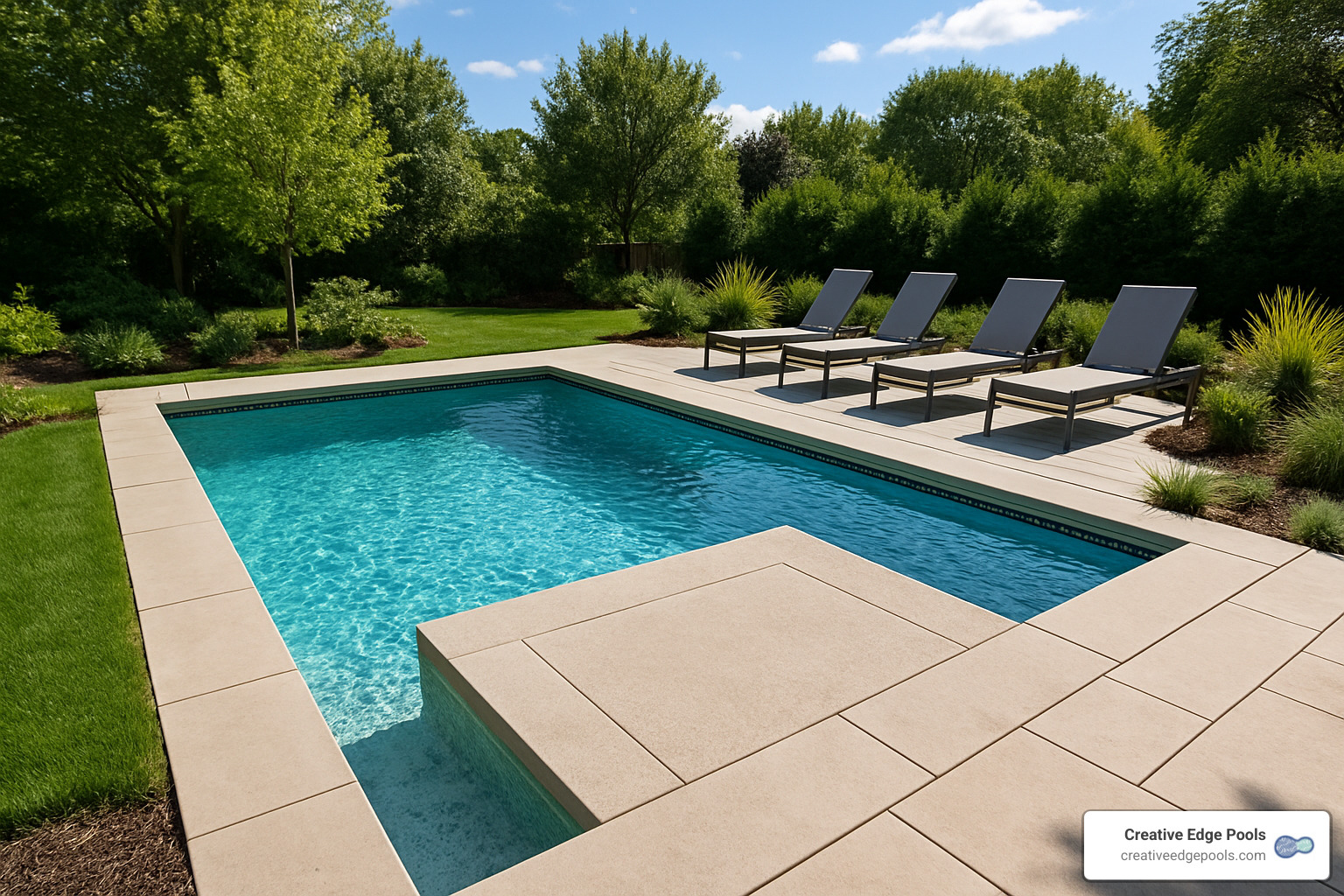
Once you’ve tackled the cost to remove diving board and completed the removal, you’re left with exciting possibilities for your pool area. That empty space where your diving board once stood isn’t just a blank canvas—it’s an opportunity to create something your family will actually use and enjoy.
The change possibilities are genuinely exciting. Deck resurfacing can turn that patched concrete into a seamless, beautiful surface that looks like it was always meant to be there. You might choose stamped concrete that mimics natural stone, or go with decorative overlays that add color and texture to your entire pool deck.
Many of our clients at Creative Edge Pools get particularly excited about sun shelf installations in their newly reclaimed space. These shallow ledges create perfect spots for lounging with a book or letting little ones play safely in just a few inches of water. They’re infinitely more useful than a diving board that collected dust for years.
Lounge area conversions represent another popular direction. Picture built-in seating where the diving board used to dominate, or a dedicated space for outdoor furniture that doesn’t crowd your swimming area. Some homeowners add pergolas or shade structures, creating genuine outdoor living spaces.
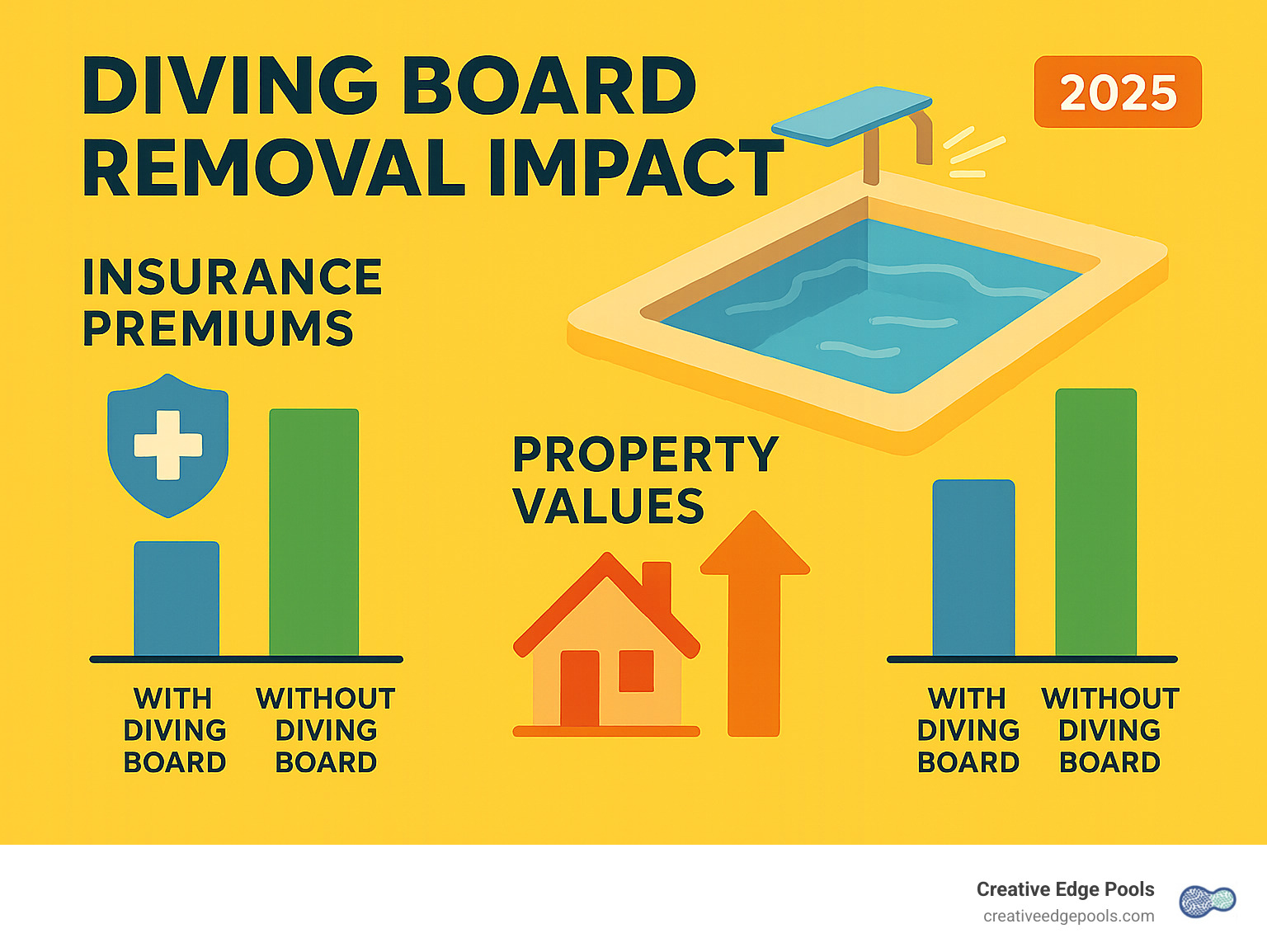
The financial benefits extend beyond just avoiding the cost to remove diving board. Home resale value often increases when you eliminate unused diving boards and create more functional pool areas. Today’s pool buyers typically want maximum swimming space, especially in smaller backyards where every square foot counts.
Your insurance premiums might drop too. Many insurance companies charge higher rates for pools with diving boards due to liability concerns. That annual savings can help offset your removal investment over time.
Budgeting for deck repair after the cost to remove diving board
The reality is that proper deck restoration makes the difference between a pool area that looks professionally updated versus one that looks like something was hastily removed. Smart budgeting for this phase ensures your investment pays off in both appearance and property value.
Concrete patch costs vary significantly based on how well you want the repair to blend with your existing deck. Basic patching might run $50-150 and gets the job done functionally. However, decorative matching that makes the repair invisible typically costs $150-300 and delivers dramatically better results.
Masonry labor in Eastern Massachusetts and Southern New Hampshire runs $75-125 per hour for skilled craftsmen who can properly match existing finishes. Most diving board area repairs require 2-4 hours of professional time, depending on the complexity of your deck’s finish and the size of the area needing attention.
Decorative overlay options can transform your entire pool deck while cleverly concealing any removal repairs. Stamped concrete overlays, decorative coatings, or tile installations typically cost $8-25 per square foot. While this represents a larger investment, it can turn your diving board removal project into a complete pool area makeover.
Some homeowners find that addressing the diving board removal opens conversations about larger backyard changes. If you’re considering more extensive modifications, our pool removal cost information covers comprehensive backyard renovation options.
Frequently Asked Questions about Diving Board Removal Costs
How long does diving board removal take?
Most professional diving board removals wrap up in 2-4 hours for standard installations. If you’ve got a straightforward bolt-on system, you might be looking at under an hour of actual work. But those older installations with deeply embedded bases? That’s when you’re talking about a full day project.
Here’s what typically happens during removal: Initial assessment and prep work takes about 30 minutes while the crew figures out exactly what they’re dealing with. Board and base removal usually requires 1-2 hours, depending on how cooperative those bolts want to be after years of weather exposure.
The time-consuming part is cutting and grinding anchor studs flush with your deck surface – that’s another 1-2 hours of careful work. Nobody wants gouges in their concrete deck from rushing this step. Cleanup and basic patching adds another 30-60 minutes to make sure you’re not left with a mess.
Weather can throw a wrench in the timeline, especially if rain makes surfaces slippery or if extreme heat makes metal-cutting work dangerous. Accessibility issues around your pool area can also slow things down considerably.
DIY removal generally takes much longer since you’re learning as you go and need to take frequent safety breaks. Don’t be surprised if your weekend project stretches into multiple days.
Do I need a permit to remove my diving board?
The permit question doesn’t have a simple yes-or-no answer – it really depends on where you live. Most municipalities treat diving board removal as routine maintenance rather than structural modification, but some areas have stricter rules.
Check with your local building department before you start, especially if your removal involves electrical work or affects pool safety systems. Some jurisdictions get particular about any modifications to pool areas, viewing them as potential safety issues.
You’ll definitely want to verify permit requirements if you’re planning to do deck modifications at the same time or if your diving board has integrated lighting systems. Permit costs typically run $50-200 where they’re required, but it’s worth it to avoid potential headaches down the road.
The good news is that most areas recognize diving board removal as a safety improvement rather than a risky modification. Still, a quick phone call to your building department can save you from finding permit requirements after the work is already done.
Will removing my board lower my insurance bills?
This is one of those pleasant surprises that many homeowners find after removal. Insurance companies often charge higher premiums for pools with diving boards because they represent increased liability risks and injury potential.
Premium reductions typically range from $50-200 annually, though the exact amount varies by insurance company and your specific policy. Some homeowners are shocked to learn how much extra they’ve been paying for a diving board they haven’t used in years.
Contact your insurance agent to document the removal with photos and update your policy to reflect the modification. Many agents will walk you through available discounts for improved pool safety – it’s worth asking about other potential savings while you’re at it.
The liability reduction benefits extend well beyond premium savings. Removing an unused or deteriorating diving board eliminates potential injury risks and the associated legal exposure that keeps insurance companies nervous.
When you factor in the annual insurance savings over several years, the cost to remove diving board often pays for itself through reduced premiums alone. It’s one of those home improvements that actually saves you money while making your backyard safer for family and friends.
Conclusion
The cost to remove diving board setups really depends on your specific situation, but now you have a clear picture of what to expect. Basic removal might only run you $100 if you find someone willing to haul it away for the scrap value, but most homeowners end up spending $200-500 for professional removal that includes proper cleanup and basic deck repair.
Here’s the thing – this isn’t just about getting rid of an old diving board. You’re making a smart investment in your backyard’s future. The safety improvements alone make it worthwhile, especially if you have kids or grandkids who use the pool. Plus, those insurance premium savings can add up to real money over time.
Most of our clients are pleasantly surprised by how much more usable their pool becomes once that diving board is gone. Suddenly you’ve got room for pool games, more swimmers, or even space to add features like a sun shelf or built-in seating area. The change can be pretty dramatic.
Professional removal versus DIY really comes down to your comfort level with tools and your available time. If you’re handy and have the right equipment, you might save a few hundred dollars. But if cutting embedded anchor bolts or dealing with electrical components sounds intimidating, it’s worth paying for professional expertise and insurance coverage.
The deck restoration piece is crucial – don’t skip this step. A properly patched and finished deck makes the difference between a professional-looking pool area and something that obviously had a diving board removed. It’s usually only a few hundred dollars more but makes a huge impact on your pool’s appearance.
At Creative Edge Pools, we’ve guided many families through this decision over our thirty years serving Eastern Massachusetts and Southern New Hampshire. Every situation is unique, but the peace of mind and improved functionality almost always make it a decision homeowners are happy they made.
For comprehensive information about pool modifications and removal services, visit our pool removal cost resource page to explore all your backyard change options.