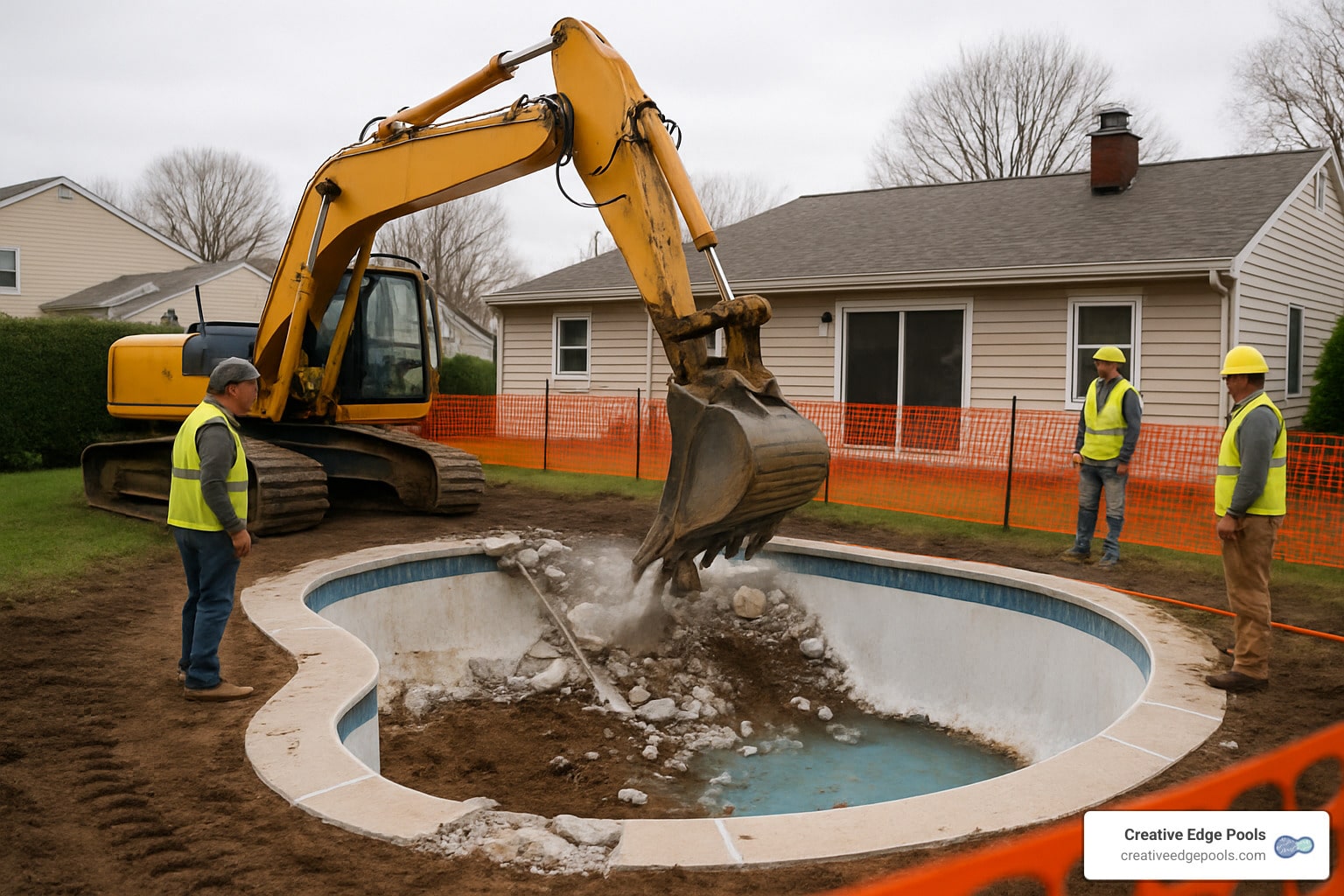
Cost to Remove an Inground Pool: 9 Key Price Factors 2025
The True Cost of Reclaiming Your Backyard Space
The cost to remove an inground pool typically ranges from $5,000 to $15,000, with a national average of about $6,000. Prices vary based on several key factors:
| Removal Type | Price Range | Timeline | Best For |
|---|---|---|---|
| Partial Removal | $3,000-$10,300 | 1-3 days | Limited budgets, no future building plans |
| Full Removal | $4,300-$22,500 | 3-7 days | Future construction, complete restoration |
That neglected swimming pool in your backyard—once the center of summer fun—can become an expensive eyesore and maintenance headache. Whether your pool has fallen into disrepair, your family’s needs have changed, or you’re simply tired of the ongoing maintenance costs, understanding the financial commitment of pool removal is the first step toward reclaiming your outdoor space.
Pool removal isn’t just about demolition—it’s about change. It’s about reimagining possibilities for your property and potentially increasing its value. But before you dive into this significant project, you need clear information about costs, methods, and what to expect.
I’m David Brabant, owner of Creative Edge Pools with over thirty years of experience in the swimming pool industry, and I’ve personally overseen dozens of cost to remove an inground pool projects throughout Eastern Massachusetts and Southern New Hampshire, helping homeowners transform their outdoor spaces into something new and usable again.
What Is the Real Cost to Remove an Inground Pool in 2024/2025?
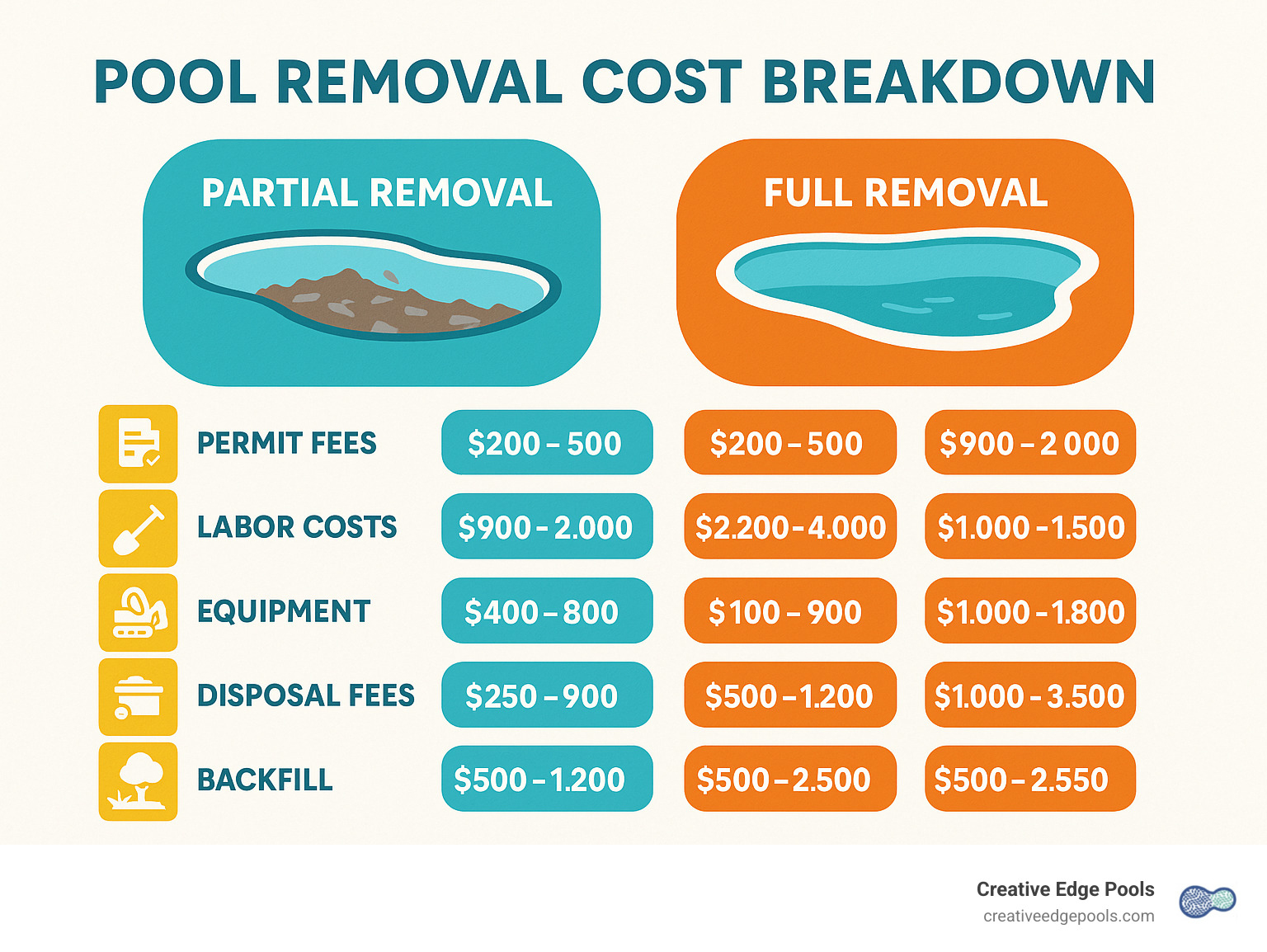
Wondering what that backyard change will actually cost you? Let’s talk real numbers. The national average cost to remove an inground pool in 2024/2025 typically falls between $5,000 and $15,000, with most homeowners paying around $6,000 for a standard removal. Breaking it down by square footage, you’re looking at roughly $13.50 per square foot – though as with most home projects, your mileage may vary.
For those complex projects (you know, the ones with massive concrete pools tucked behind a narrow gate, or sitting on a steep hill), costs can climb up to $22,500. And yes, inflation has definitely crashed this pool party too – material costs for backfill and equipment rentals have jumped 5-10% in many regions over the past year.
I remember a family in Andover we helped last summer. Their 20-year-old concrete pool had been sitting unused for three seasons, developing cracks that would have cost over $25,000 to repair. Instead, we removed their 16′ x 32′ pool for $11,840 – covering demolition, backfill, and basic grading. That’s the kind of math that makes sense!
For more comprehensive information about pool removal costs and factors, check out the Forbes guide to inground pool costs.
National Averages & Ranges for the Cost to Remove an Inground Pool
The cost to remove an inground pool isn’t the same everywhere you go. Our 2024/2025 data shows some significant regional differences:
- Northeast (including our service area in Massachusetts and New Hampshire): $6,000-$16,000
- Southeast: $4,000-$12,000
- Midwest: $5,000-$14,000
- West Coast: $7,000-$20,000
These variations aren’t random – they reflect differences in labor rates, disposal fees, local permit requirements, and even typical pool construction methods used in different climates.
Here in Eastern Massachusetts and Southern New Hampshire, most of our customers pay between $5,500 and $15,000. Partial removals tend to fall on the lower end, while full removals with landscaping hit the higher marks.
Partial vs. Full Removal Costs at a Glance
When it comes to saying goodbye to your pool, you’ve got two main options – and your choice makes a big difference in both price and future possibilities:
| Aspect | Partial Fill-In | Full Demolition |
|---|---|---|
| Cost Range | $3,000-$10,300 | $4,300-$22,500 |
| Timeline | 1-3 days | 3-7 days |
| Process | Break holes in bottom, collapse walls partially, backfill | Complete removal of all materials |
| Future Use | Landscaping, garden, lawn | Any use including buildings |
| Disclosure | Required when selling property | Not required |
| Best For | Budget-conscious homeowners | Future construction plans |
With a partial fill-in, we break drainage holes in the pool bottom, knock down the top portion of the walls (usually 1.5-3 feet), and then backfill with rubble and soil. It’s the budget-friendly route, but it does limit what you can do with that space later.
Full demolition means we remove everything – all pool materials leave the site, and we properly backfill and compact the soil. Yes, it costs more upfront, but it gives you complete freedom for future property use and typically offers better value long-term.
Material Matters: Concrete vs. Vinyl vs. Fiberglass Pricing
Your pool’s construction material plays a huge role in what you’ll pay to remove it:
Concrete/Gunite Pools are the toughest customers, typically costing $3,000 to $15,000 to remove. Breaking up all that dense material requires heavy machinery, specialized cutting tools, and significantly more labor hours. These pools put up a fight!
Vinyl-Lined Pools fall in the middle, with removal costs typically between $3,000 and $10,000. The vinyl liner itself comes out easily enough, but there’s usually a steel wall structure and concrete collar that need proper demolition.
Fiberglass Pools can sometimes be a pleasant surprise. If the shell is in good condition, we can sometimes remove it in one piece – which can save you money on labor costs. Last year in Nashua, we lifted out an intact 15-year-old fiberglass shell with an excavator, saving the homeowners about $2,000 compared to breaking it up onsite. If the shell needs to be broken up, though, costs run similar to vinyl pools, between $5,000 and $15,000.
9 Cost Factors That Can Make or Break Your Budget
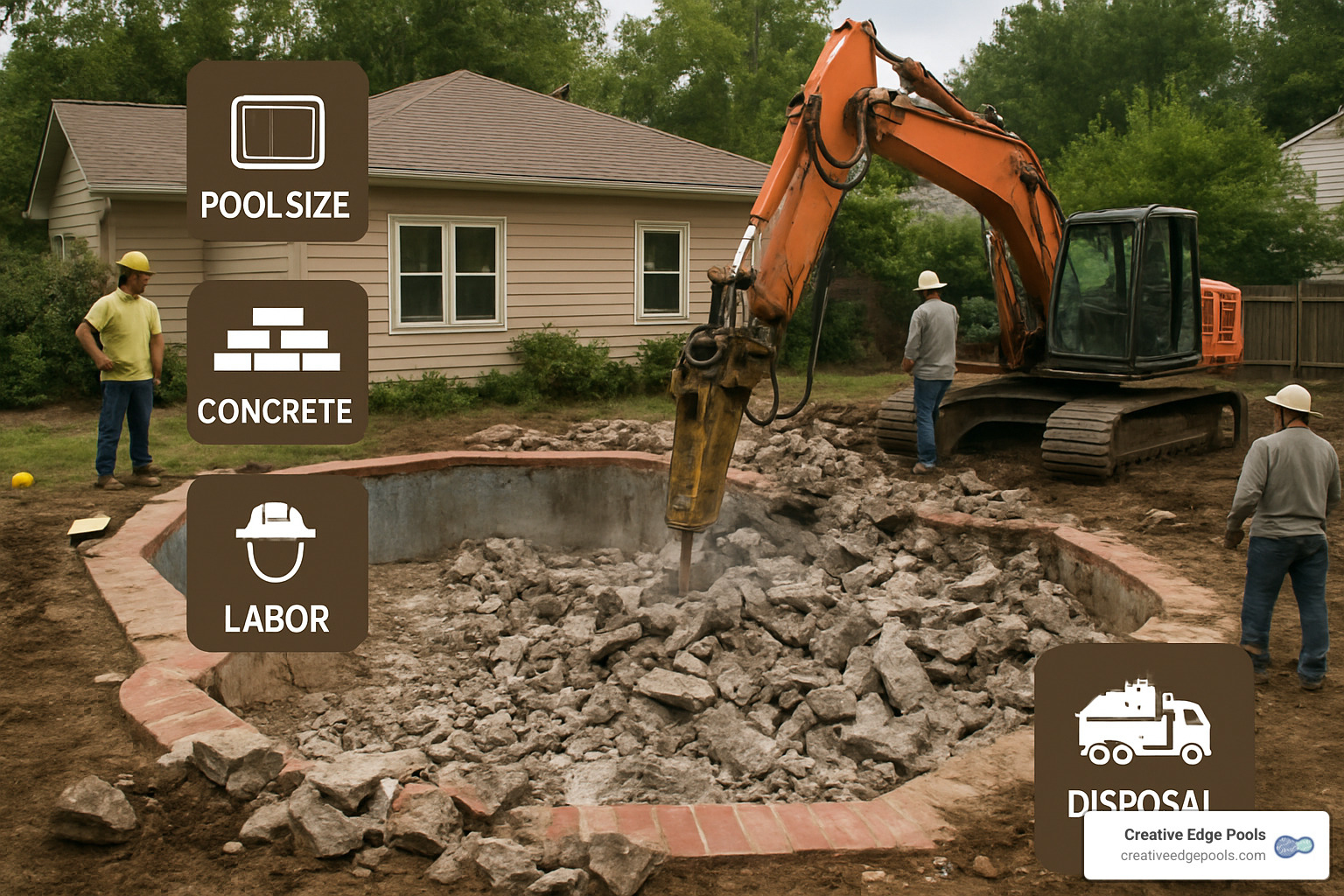
When planning your pool removal project, the final price tag can vary dramatically based on several key factors. After helping dozens of homeowners reclaim their backyards, I’ve seen how these variables can either keep your budget intact or send costs soaring. Let’s explore the nine most influential factors affecting the cost to remove an inground pool.
Factor 1 – Pool Size & Shape
It’s no surprise that bigger pools cost more to remove. A sprawling 20′ x 40′ pool generates substantially more debris and requires more backfill material than a modest 12′ x 24′ design.
Small pools under 300 square feet typically run $4,000-$8,000, while medium pools between 300-600 square feet average $6,000-$15,000. Those larger luxury pools exceeding 600 square feet can reach $10,000-$22,500 for complete removal.
Shape matters too—that freeform pool with curves and a built-in spa might look beautiful, but it’ll cost more to remove than a simple rectangle. Just last month, we removed a kidney-shaped pool in Andover that required extra labor hours simply because of its curving walls and varying depths.
Factor 2 – Site Accessibility
Your backyard’s layout can significantly impact your removal costs. I remember a project in Winchester where we had to bring in specialized compact equipment because the only access point was a narrow side yard passage. That equipment limitation added nearly 15% to the project cost.
Factors like narrow gates, steep slopes, overhead wires, and nearby structures can all complicate access and drive up prices. If heavy machinery can roll right up to your pool, you’ll save money. If workers need to hand-carry debris or use smaller equipment that takes longer, expect to pay more.
Factor 3 – Local Regulations & Permits
Every town has its own rules when it comes to pool removal. In our service area across Eastern Massachusetts and Southern New Hampshire, permit fees typically range from $200 to $400, but the requirements behind those permits vary dramatically.
Some towns require multiple inspections throughout the process, while others want structural engineer sign-offs. A few municipalities even have specific requirements about drainage systems and backfill materials. At Creative Edge Pools, we handle all permitting paperwork for our clients, but these varying requirements directly impact both timeline and budget.
For detailed information about specific permit requirements, check out our permit requirements guide.
Factor 4 – Disposal & Dumpster Fees
Where does all that concrete, vinyl, fiberglass, and metal go? Landfill and recycling fees have been climbing steadily in recent years, with disposal costs now ranging from $150 to $500 depending on volume and material type.
Dumpster rental fees ($300-$700 per week) are another consideration. A typical 16′ x 32′ concrete pool can fill multiple 20-yard dumpsters. When we tackle a removal project, we coordinate efficient loading and hauling to minimize these costs, but they remain a significant budget factor.
Factor 5 – Post-Removal Landscaping
Once your pool is gone, what happens to that space? This decision dramatically affects your total project cost. Basic grading and seeding might add just $500-$1,500, while a full patio installation could run $2,000-$10,000 or more.
Many of our clients find it most cost-effective to plan their new landscape design before removal begins. This allows us to prepare the site specifically for its future use, whether that’s a level lawn for the kids to play on or properly compacted soil for a future garden or patio space.
Factor 6 – Seasonality & Market Rates
Timing your pool removal can save you money. Just like hotels offer off-season rates, pool removal companies often discount their services during slower periods. In New England, scheduling your removal for late fall through early spring might save you 10-15% compared to peak summer pricing.
Current market conditions affect pricing too. With recent inflation and fuel price fluctuations, equipment operation costs and material prices have seen increases of 5-10% in many regions. We work hard to keep our pricing stable, but these external factors do influence the final numbers.
Factor 7 – Structural Engineer & Soil Tests
If you’re planning to build anything on your former pool site, professional engineering oversight becomes essential. A structural engineer (typically $500-$1,500 for a standard project) will create a compaction plan, specify appropriate fill materials, and conduct density tests.
Even if construction isn’t in your future plans, proper compaction prevents the dreaded “sinking hole” where your pool once stood. We’ve been called to fix improper removals where homeowners found themselves with a depression in their yard years later—always more expensive than doing it right the first time.
Factor 8 – Existing Decks, Fences & Extras
Your pool probably isn’t sitting in isolation. Surrounding decks, fences, lighting systems, and pool houses all add to removal complexity and cost. Concrete decking removal adds $5-$15 per square foot, while wooden deck demolition runs $2-$5 per square foot.
I recall a project in Bedford where removing the elaborate surrounding structures—a wooden deck, pergola, and outdoor kitchen—nearly doubled the total project cost. However, the change to a spacious lawn with a simple patio was exactly what the family wanted, making the investment worthwhile.
Factor 9 – Contractor Expertise & Insurance
The contractor you choose significantly impacts both your final cost and results. While it’s tempting to choose the lowest bid, consider what’s behind that price. Properly licensed and insured contractors provide crucial protection but may charge more than uninsured operations.
Experience matters too. At Creative Edge Pools, our decades of experience mean we can anticipate and prevent costly problems before they occur. When comparing quotes, ask about warranties, insurance coverage, and the specific equipment that will be used. Check references and read reviews to ensure you’re choosing a reputable provider.
For a comprehensive breakdown of pool removal costs and what to expect, check out Bob Vila’s guide to pool removal costs.
For help finding qualified contractors in your area, visit our Pool Removal Service page.
The right contractor might not offer the lowest initial price, but they’ll deliver the best long-term value by doing the job correctly the first time. After all, proper pool removal is as much about what you don’t see (proper drainage, correct compaction) as what you do see (your beautiful new yard space).
The Pool Removal Process & Timeline: Day 1 to Day 7
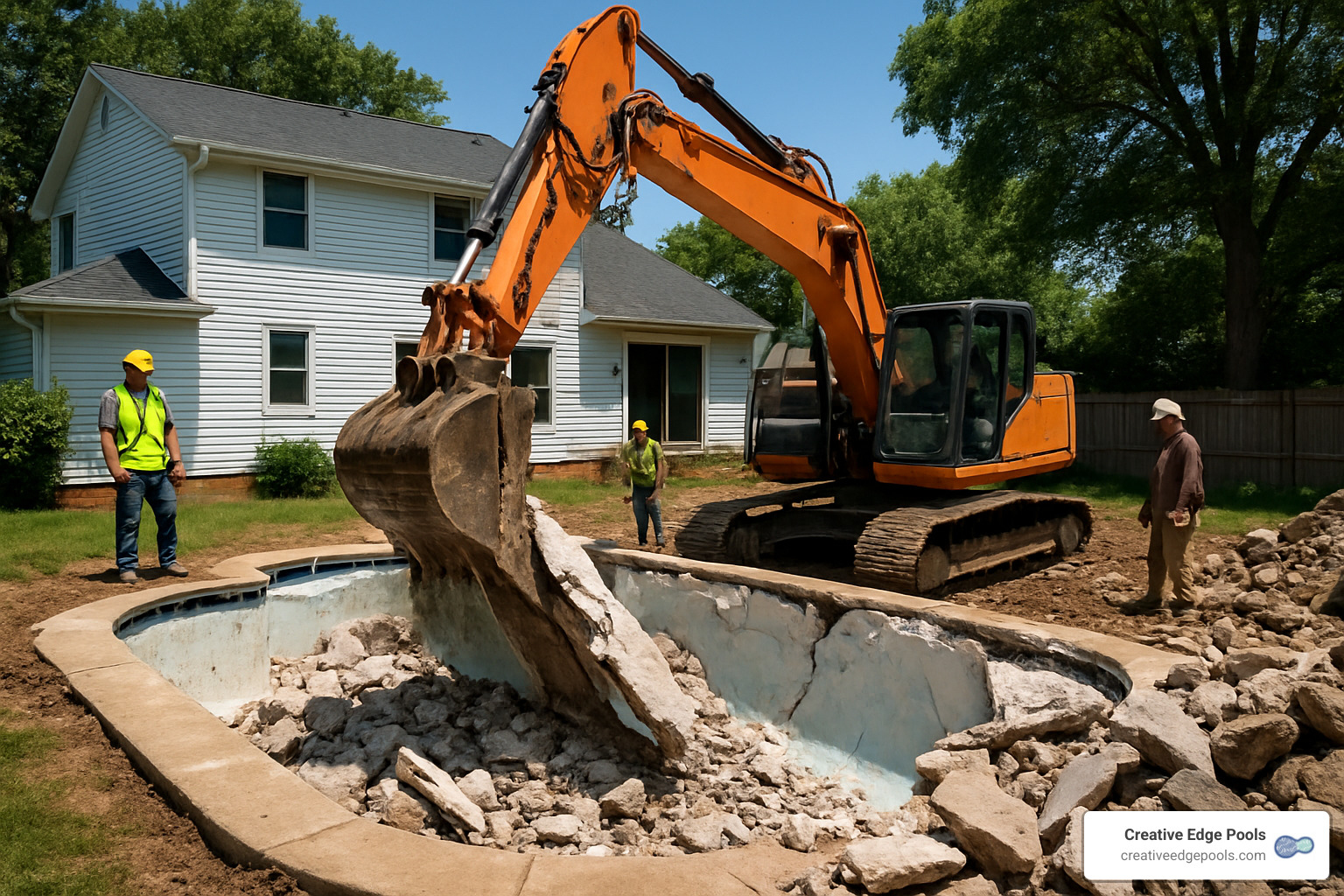
Ever wonder what actually happens when you decide to say goodbye to your backyard swimming hole? Let me walk you through the typical week-long journey of pool removal. While every project has its unique quirks (just like every pool), this timeline gives you a realistic picture of what to expect when calculating the cost to remove an inground pool.
Day 1 – Permits, Utility Shut-Off & Draining
The first day is all about preparation and paperwork. We start by confirming all permits are in order – something we handle for our clients because, let’s face it, permit offices aren’t anyone’s idea of a fun afternoon. Next comes the crucial step of disconnecting all utilities – electrical lines to pumps and lights, gas lines to heaters, and plumbing connections.
Then the draining begins. This isn’t as simple as pulling a plug! Professional submersible pumps remove thousands of gallons of water, and we’re careful about where that water goes. Most towns have strict regulations about chlorinated water – you can’t just send it rushing into storm drains or local streams. We either use neutralizing chemicals or direct it to sanitary sewer systems as required by local codes.
“Last summer, we had a client in Methuen who tried draining their pool themselves before calling us,” recalls our operations manager. “They ended up with a citation from the town and a small flood in their neighbor’s yard. Sometimes DIY isn’t worth the headache!”
If you’re handling the draining yourself, pump rentals typically run $40-$70 daily, but please check those local regulations first.
Day 2-3 – Shell Demolition & Debris Sorting
Now comes the dramatic change. For concrete pools, our team brings in the heavy artillery – jackhammers and excavators break the shell into manageable chunks. Vinyl and fiberglass pools start with liner or shell removal before we tackle the supporting structures.
We’re careful to separate materials during demolition. Rebar and metal components go to recycling centers, while concrete and other materials are loaded into dumpsters. This sorting process isn’t just environmentally responsible – it can actually reduce your disposal fees.
“This is definitely the most satisfying part for homeowners,” says our demolition specialist. “There’s something cathartic about watching that unused money pit being reclaimed. One client in Londonderry actually brought out lawn chairs and watched the whole process with a cooler of drinks. Said it was better than anything on Netflix!”
For more details about the removal process, you can check out our comprehensive guide on removing an inground swimming pool.
Day 4-5 – Backfill & Soil Compaction
With the pool gone, we’re left with what essentially looks like a small crater in your yard. Filling this space properly is critical to the long-term success of your project.
We bring in clean fill material – usually a combination of crushed stone and soil – and add it in carefully measured layers. Each layer gets thoroughly compacted before adding the next. This methodical approach achieves 90-95% density, which prevents the nightmare scenario of sinkholes forming years later.
Proper drainage planning happens during this phase too. The last thing you want is for your former pool area to become a soggy mess every time it rains.
“I can’t stress enough how important proper compaction is,” our site foreman emphasizes. “We’ve been called to fix other contractors’ work where they rushed this step. One family in Chelmsford had a six-foot sinkhole appear in their yard three years after a cut-rate pool removal. Saving a few hundred dollars upfront cost them thousands down the road.”
Day 6 – Rough Grading & Safety Inspection
As we approach the finish line, the filled area gets roughly graded to match the surrounding landscape. This is when you really start to see your new yard taking shape.
For many projects, especially if you plan to build on the site later, a structural engineer visits to inspect the work. They’ll verify proper compaction, check drainage patterns, and make recommendations for any necessary adjustments.
If you’ve hired an engineer (or if your town requires one), they’ll conduct density tests and provide documentation certifying that everything was done according to specifications. This paperwork becomes valuable if you ever sell your home or apply for building permits in the future.
Day 7 – Final Grading, Seed & Straw
The final day brings your change full circle. We add a layer of quality topsoil, carefully graded for proper drainage. Depending on your preferences and the season, we’ll either apply grass seed or install sod. A protective layer of straw or erosion control materials shields your new soil while grass establishes.
After a thorough cleanup that leaves your yard tidy and safe, you’re ready to enjoy your reclaimed outdoor space.
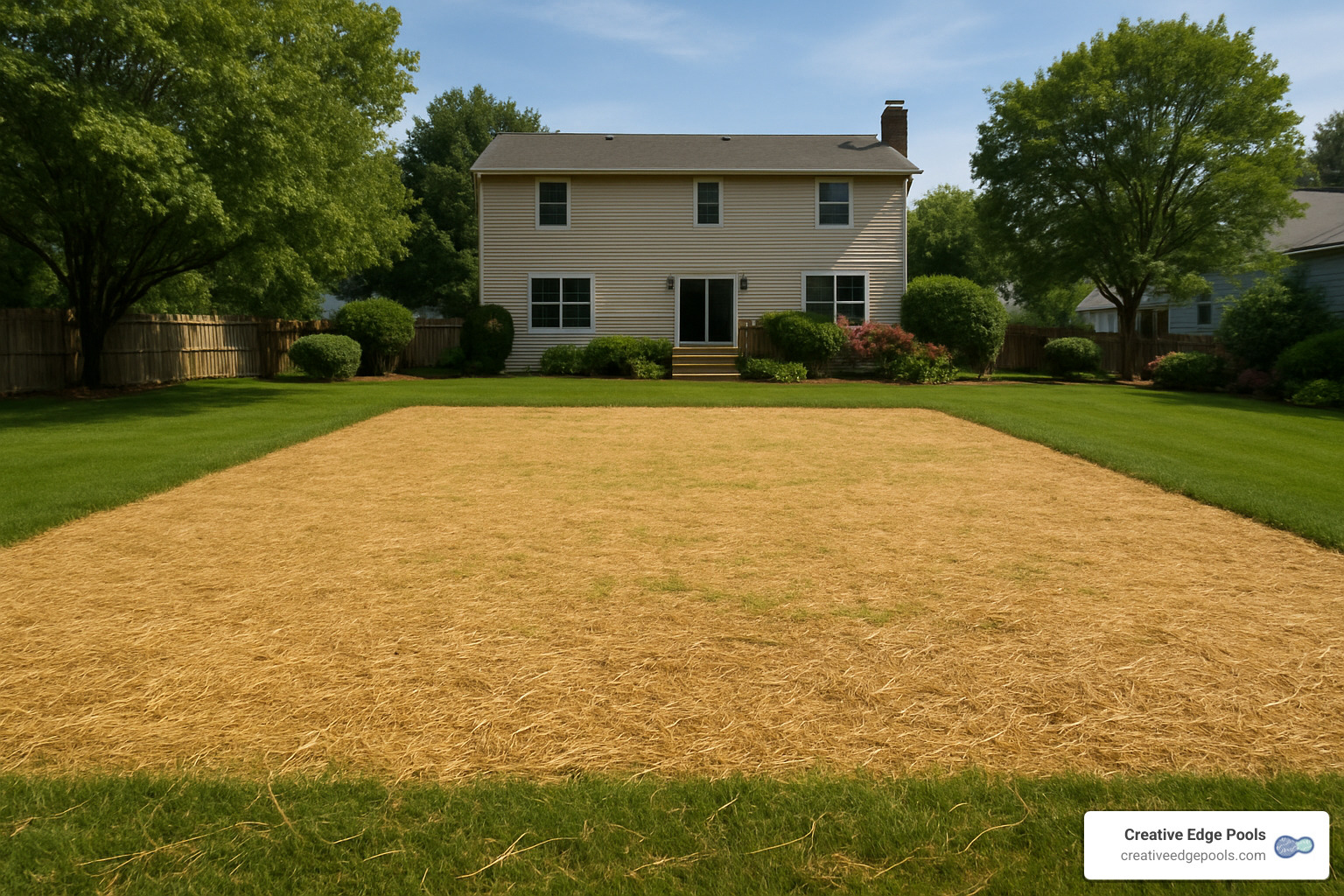
“The before-and-after is truly remarkable,” our landscape designer often notes. “In just one week, that eyesore that was costing you money and giving you headaches transforms into a blank canvas full of possibilities. Whether you’re planning a garden, patio, or just want more usable lawn space, you’ve reclaimed valuable real estate on your property.”
When calculating the cost to remove an inground pool, this comprehensive process requires specialized equipment, expertise, and proper disposal methods – all essential investments in your property’s future.
Can You Save Money? DIY vs. Pro Strategies
Let’s talk about what’s probably on your mind right now – saving money. When staring down a $5,000-$15,000 bill for pool removal, it’s natural to wonder if doing it yourself might be the way to go. While DIY is technically possible, there’s more to the story than just avoiding labor costs.
True Cost of DIY Pool Removal
The reality of DIY pool removal often surprises homeowners who dive in without fully understanding the commitment. Beyond just sweat equity, you’ll need to budget for:
Equipment isn’t cheap – expect to pay $300-$600 per day for an excavator rental alone. Add in jackhammers, pumps, and compactors at $100-$300 daily, and costs mount quickly. Dumpsters run $300-$700 weekly, and you’ll still face the same disposal fees ($150-$500) and fill material costs ($8-$12 per cubic yard) as the professionals.
One homeowner in our community learned this lesson the hard way: “I thought I’d save by doing it myself. Rented an excavator for the weekend and quickly realized I was in over my head. Ended up hiring a pro anyway, so I wasted money on the rental.”
Beyond the financial investment, consider the physical demands of demolition work, the safety risks of operating heavy machinery, and the liability if something goes wrong. What professionals complete in a week might take you two or three weekends – assuming everything goes perfectly.
For real-world perspectives on DIY pool removal challenges, check out this Reddit thread where homeowners discuss their inground pool removal experiences.
Money-Saving Tips When Hiring Pros
The good news? There are legitimate ways to reduce the cost to remove an inground pool without doing it all yourself:
Timing is everything. “We offer discounts of 10-15% during our slower months,” confirms our scheduling manager at Creative Edge Pools. Winter and early spring typically see lower demand, potentially saving you thousands.
Get multiple quotes – at least three – and pay attention to what’s included. Some companies bundle services differently, making direct comparisons tricky. Ask detailed questions about backfill quality, compaction methods, and what happens with the debris.
Consider handling some prep work yourself. Removing decking, fencing, or draining the pool (where permitted locally) can reduce labor costs. Many homeowners also salvage pool equipment like pumps and heaters, which might have resale value or use elsewhere.
If appropriate for your property, a partial removal costs significantly less than full demolition. Just be sure you understand the implications for future land use and property disclosure requirements.
Are Rebates or Government Programs Available?
While I wish I could point you toward a generous pool removal rebate program, the truth is that direct financial assistance is relatively rare. That said, it’s worth exploring a few possibilities:
In drought-prone regions, some water conservation districts offer modest rebates for removing water-intensive features like pools. These programs come and go with budget cycles and water conditions, so check with your local water authority.
Property tax reassessments after pool removal might lower your annual tax burden, though the savings accumulate slowly over time rather than offsetting immediate removal costs.
One often-overlooked benefit: insurance premium reductions frequently follow pool removal. Many homeowners save $200-$400 annually on liability coverage after eliminating their pool – not enough to pay for removal, but a nice long-term bonus.
At Creative Edge Pools, we sometimes help clients identify creative financing options or phase their projects to make costs more manageable. After all, changing your backyard should be exciting, not financially stressful.
The bottom line? While DIY might seem tempting, most homeowners find that professional removal offers better value, safety, and results in the long run. The peace of mind alone – knowing the job is done right, with proper permits and no future surprises – is worth considering when weighing your options.
For more detailed information about pool removal costs, visit our Pool Removal Cost page.
Permits, Property Value & Life After Removal
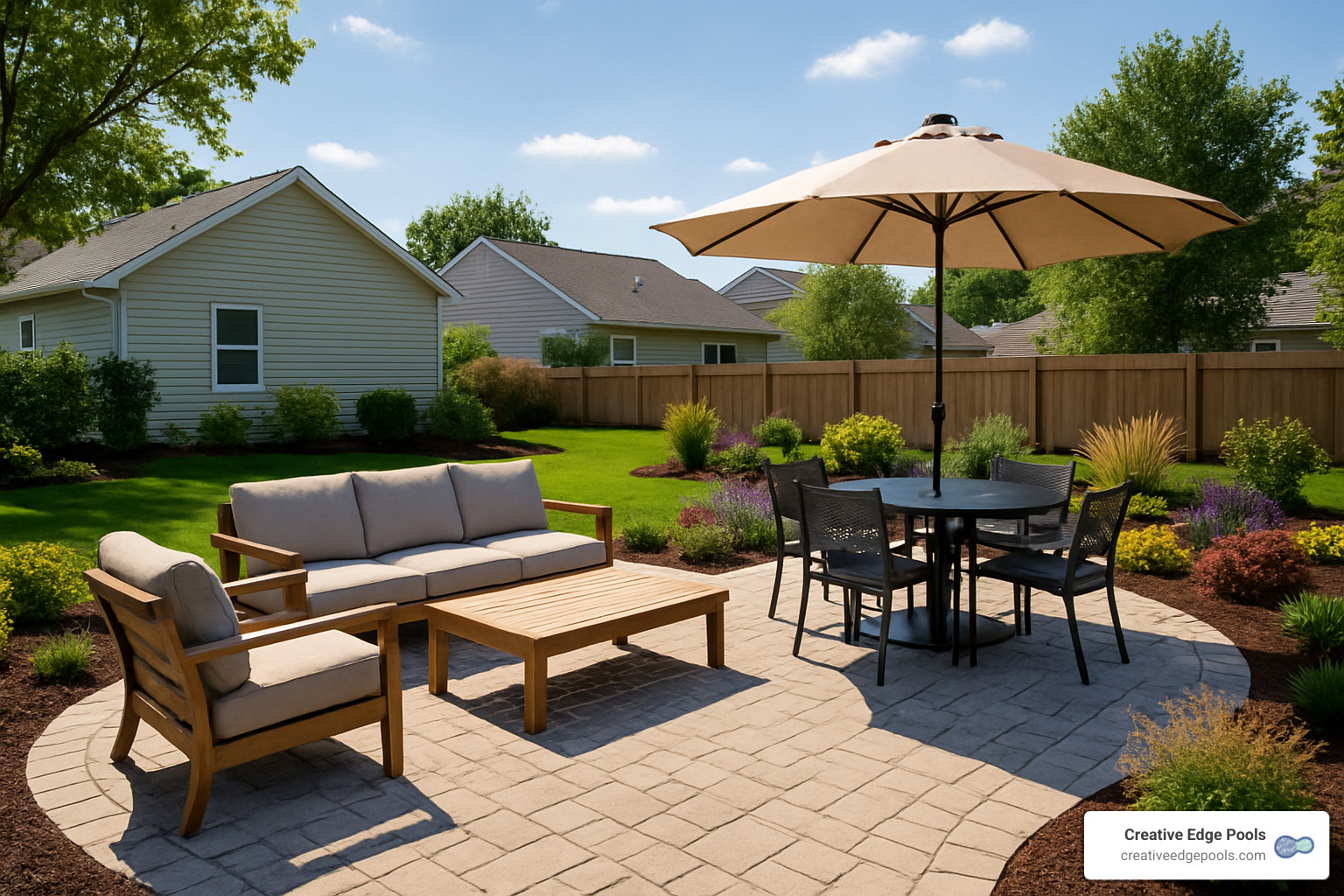
Saying goodbye to your pool opens up exciting new possibilities for your property, but it also comes with some important considerations that go beyond just the physical work of removal. Let’s explore what happens after your pool is gone.
How Pool Removal Affects Home Value
“Will removing my pool hurt my home’s value?” This is probably one of the first questions you’re asking yourself. The answer isn’t one-size-fits-all, but generally speaking, the impact can be quite positive.
In our years working throughout Eastern Massachusetts and Southern New Hampshire, we’ve seen property values typically increase by 5-10% after removing an aging pool and creating beautiful, usable outdoor space. Today’s homebuyers often view older pools as maintenance headaches and potential money pits rather than luxuries.
The value impact depends on several key factors. If you live in a neighborhood where nearly every home has a pool, removal might slightly decrease your comparative value. However, if your pool is deteriorating or outdated, removing it almost always improves appeal. The quality of what replaces your pool matters too—a thoughtfully designed patio or garden adds more value than simply laying down grass.
One important note: partial removals require disclosure when selling your property. This transparency might raise questions from potential buyers about what lies beneath their new yard. Full removals with proper documentation generally eliminate these concerns entirely.
Building on the Land After Removal
That empty space where your pool once stood opens up possibilities—perhaps a shed, gazebo, or even a home addition? If building is in your future plans, your removal approach becomes even more critical.
Full removal is essential for future construction. There’s simply no way around this if you plan to build anything substantial. You’ll need an engineer’s certification documenting that the site meets building code requirements for stability. The compaction testing must show proper density levels (usually 90-95%), and in some cases, the soil composition might need adjustment to properly support foundations or footings.
“Last year, we helped a family in Bedford remove their pool to make way for a beautiful sunroom addition,” shares our project manager. “Because we followed proper engineering protocols during removal, they had zero issues getting building permits approved. Their contractor actually thanked us for the thorough documentation we provided.”
With the right paperwork in hand, your former pool site can support virtually any structure you might envision for your evolving backyard paradise.
Risks of an Improper Removal
Cutting corners during pool removal is penny-wise but pound-foolish. The risks of improper work can haunt you for years to come.
Soil settling is perhaps the most common issue. When backfill isn’t properly compacted in layers, it eventually compresses under its own weight, creating depressions or even dangerous sinkholes in your yard. Drainage problems frequently accompany poor removal work, potentially causing water to accumulate where your pool once was or, worse, directing water toward your home’s foundation.
These issues don’t just create eyesores—they can lead to costly repairs. Insurance companies typically deny claims related to improper pool removals, considering them pre-existing conditions. And when it’s time to sell, you’ll face disclosure requirements about the removal that might scare away potential buyers.
“The most expensive pool removals we’ve ever done were actually re-dos of botched jobs,” our remediation specialist explains. “In one case in Nashua, the homeowners had paid someone to ‘fill in’ their pool with demolition debris and minimal compaction. Three years later, half their yard had sunk nearly two feet. Fixing it properly cost them almost double what a correct removal would have in the first place.”
Choosing the Right Contractor
The success of your pool removal project ultimately depends on who you hire to do the work. This isn’t the time to choose based solely on the lowest bid.
Start by verifying proper licensing and insurance. This protects you from liability if accidents occur on your property. Ask for and actually call references from previous clients who had similar pools removed. A reputable contractor will happily provide these.
Make sure they pull all required permits rather than suggesting ways to work around them. Get everything in a detailed written contract that specifies exactly what work will be done, what materials will be used, and what warranties are provided.
“Ask potential contractors how many pool removals they complete annually,” suggests our customer service manager. “Experienced removal specialists will have dozens under their belt and can show you before-and-after photos of similar projects.”
At Creative Edge Pools, we’ve handled pool removals throughout Eastern Massachusetts and Southern New Hampshire for years. We understand the unique challenges of New England properties and soils, and we provide comprehensive Pool Removal Near Me services with proper documentation and warranties. Our approach to Swimming Pool Removal ensures your property is ready for whatever comes next.
The cost to remove an inground pool is significant, but the peace of mind that comes from knowing the job was done right is priceless. Your backyard’s next chapter deserves a proper foundation—both literally and figuratively.
Frequently Asked Questions About the Cost to Remove an Inground Pool
How long does an average inground pool removal take?
When homeowners ask me about timelines, I always start by explaining that each project has its own rhythm. For a partial removal, most of our crews wrap up in just 1-3 days—quick enough that you can start planning your new space by the weekend. Full removals naturally take longer, typically 3-7 days from start to finish.
“We had planned a family gathering three weeks after our pool removal started,” shares Maria from Lexington. “I was nervous about timing, but the Creative Edge team finished in five days, and we had a beautiful flat yard ready for the party.”
Several factors can stretch your timeline. Larger concrete pools obviously demand more time than smaller fiberglass ones. Limited access to your backyard might mean smaller equipment that works more slowly. And let’s not forget Mother Nature—a week of rain can push everything back.
One detail homeowners sometimes overlook: permit approvals. Depending on your town, this administrative step might add 1-3 weeks before shovels can hit the ground. We always recommend building this waiting period into your planning calendar.
Will I need a structural engineer for my project?
The question of whether you’ll need a structural engineer comes down to four key considerations:
First, check what your local building department requires. Some towns in our Massachusetts and New Hampshire service area mandate engineering oversight for any pool removal, while others only require it for full removals or when future building plans exist.
Second, think about your future plans. If you might build a shed, garage, or home addition on that spot someday, professional engineering certification will save you headaches later. Without it, you might face expensive soil testing and remediation years down the road.
Third, consider your removal method. Full removals benefit significantly from engineering guidance to ensure proper compaction and soil stability, while even partial removals can be more successful with professional input.
Finally, your insurance company or mortgage holder might have requirements worth checking before you begin.
Even when not strictly required, I’ve found that the $500-$1,500 investment in engineering oversight provides valuable peace of mind. As one client put it, “Having that official letter certifying the work was worth every penny when we sold our home two years later.”
Can I partially remove my pool and still build on the area later?
I’m always direct with homeowners about this question: it’s technically possible but rarely advisable. Partial removal leaves portions of the original pool structure underground, creating potential foundation issues for future construction.
“I saved $4,000 going with partial removal,” admits James from Nashua, “but when we decided to add a sunroom three years later, we ended up spending nearly $7,000 on additional excavation and foundation work. I wish I’d gone with full removal from the start.”
If you’re considering this approach, here are some practical considerations:
Building codes in many municipalities explicitly prohibit construction over partially removed pools. Even with engineering approval, you’ll likely face additional excavation and site preparation costs that quickly erase any initial savings.
For homeowners who are truly uncertain about future plans, I recommend this middle path: opt for full removal but choose a simpler landscaping solution initially. This gives you maximum flexibility without the premium cost of doing the job twice.
“We always ask about the five-year vision for the space,” explains our consulting engineer. “That simple question has saved countless homeowners from making costly short-term decisions.”
Conclusion
There’s something incredibly satisfying about changing an unused, money-draining pool into a beautiful, functional backyard space. Understanding the cost to remove an inground pool isn’t just about budgeting—it’s about reimagining what your outdoor living area could become.
Throughout my years helping homeowners throughout Eastern Massachusetts and Southern New Hampshire reclaim their yards, I’ve seen the relief on people’s faces when that deteriorating concrete hole is finally gone. At Creative Edge Pools, we’ve guided hundreds of families through this change process, turning maintenance headaches into spaces where new memories can be made.
Whether you’re dreaming of a lush green lawn where your kids can play, a vegetable garden that brings fresh produce to your table, or an expansive patio for entertaining, the journey begins with a properly executed pool removal. The investment you make today—typically between $5,000 and $15,000—eliminates those endless maintenance costs while potentially increasing your property’s value.
Your specific situation is unique. The size and construction of your pool, the layout of your property, your budget constraints, and your vision for the future all shape the best approach for your project. That’s why working with experienced professionals who understand these nuances makes all the difference in achieving results you’ll love for years to come.
Cutting corners during removal can lead to expensive problems down the road. Proper drainage, appropriate fill materials, and professional compaction aren’t just technical details—they’re the foundation of your yard’s future success. When done right, your transformed space will be stable, usable, and trouble-free.
Ready to take the plunge and reclaim your backyard? We’d love to help you explore your options. Contact us today for a free, no-obligation consultation about your pool removal project. Our team will walk you through every step of the process, from initial assessment through final landscaping, helping you create the outdoor space you’ve been imagining—without that old pool getting in the way.
More info about pool removal costs