
How much will it cost to fill a pool: Save $90!
Understanding Pool Filling Costs: Water vs. Dirt
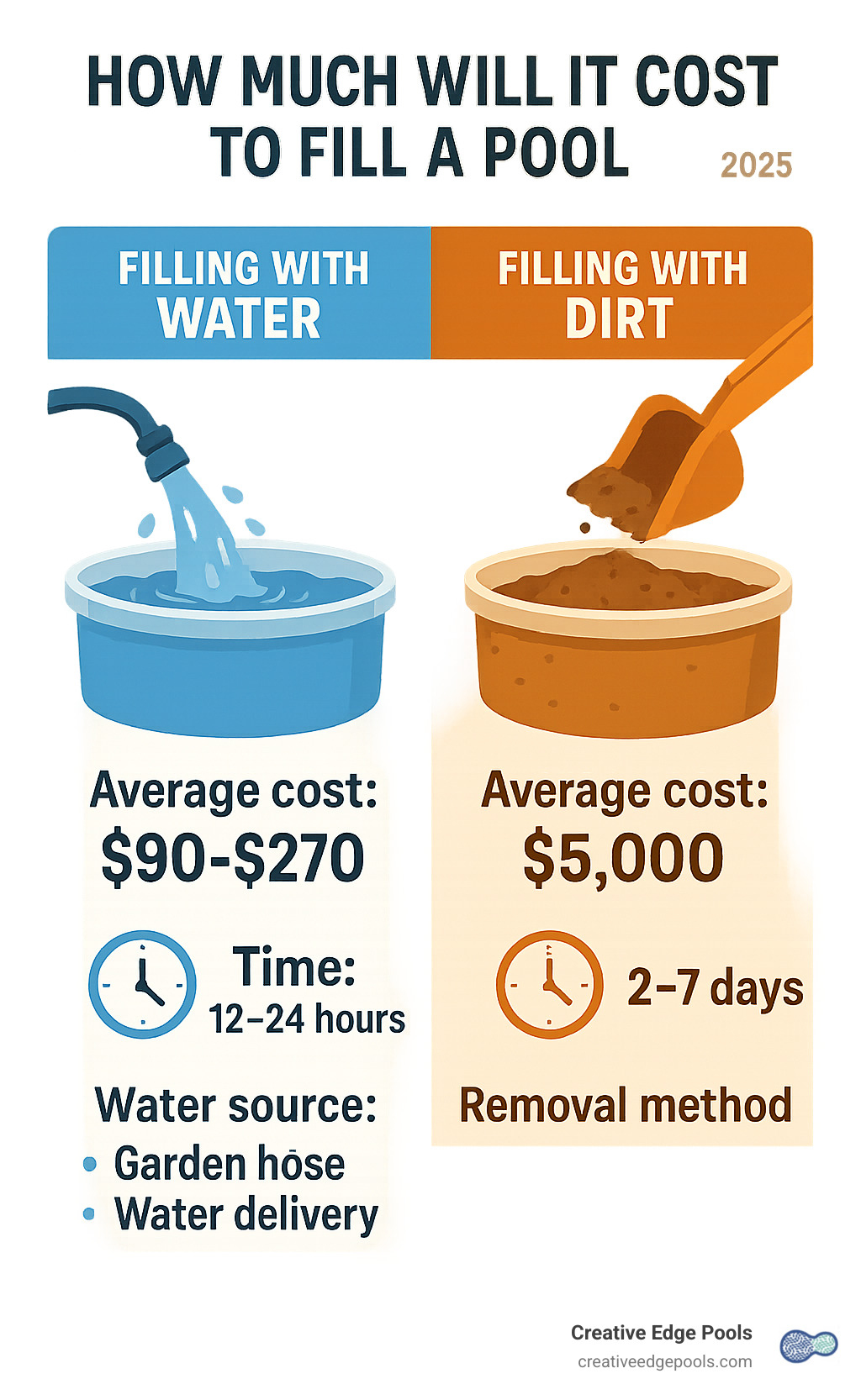
How much will it cost to fill a pool depends entirely on what you’re filling it with. Most homeowners think about filling a pool with water, but some are looking to fill it with dirt for removal. Both are significant projects, but with vastly different costs and implications for your backyard. Here’s what you need to know:
Filling with Water (for use):
- Average cost: $90-$270
- Garden hose: $4-$10 per 1,000 gallons
- Water delivery: $30-$100 per 1,000 gallons
- Time: 12-24 hours with hose, 1-3 hours with delivery
Filling with Dirt (for removal):
- Average cost: $5,000
- Range: $2,500-$8,500
- Full removal: $4,000-$16,000
- Partial removal: $2,000-$10,000
- Time: 2-7 days
The cost difference is dramatic. Water filling is about maintaining or starting pool ownership, while dirt filling is about ending it. Both have their place depending on your goals for your backyard space.
As David Brabant, owner of Creative Edge Pools, I’ve helped countless homeowners in Eastern Massachusetts and Southern New Hampshire steer decisions about how much will it cost to fill a pool – whether they’re looking to enjoy crystal-clear water or reclaim their yard space. With over thirty years in the swimming pool industry, I’ve seen both sides of this equation and can help you make the right choice for your situation.
The Cost of Filling Your Pool with Water
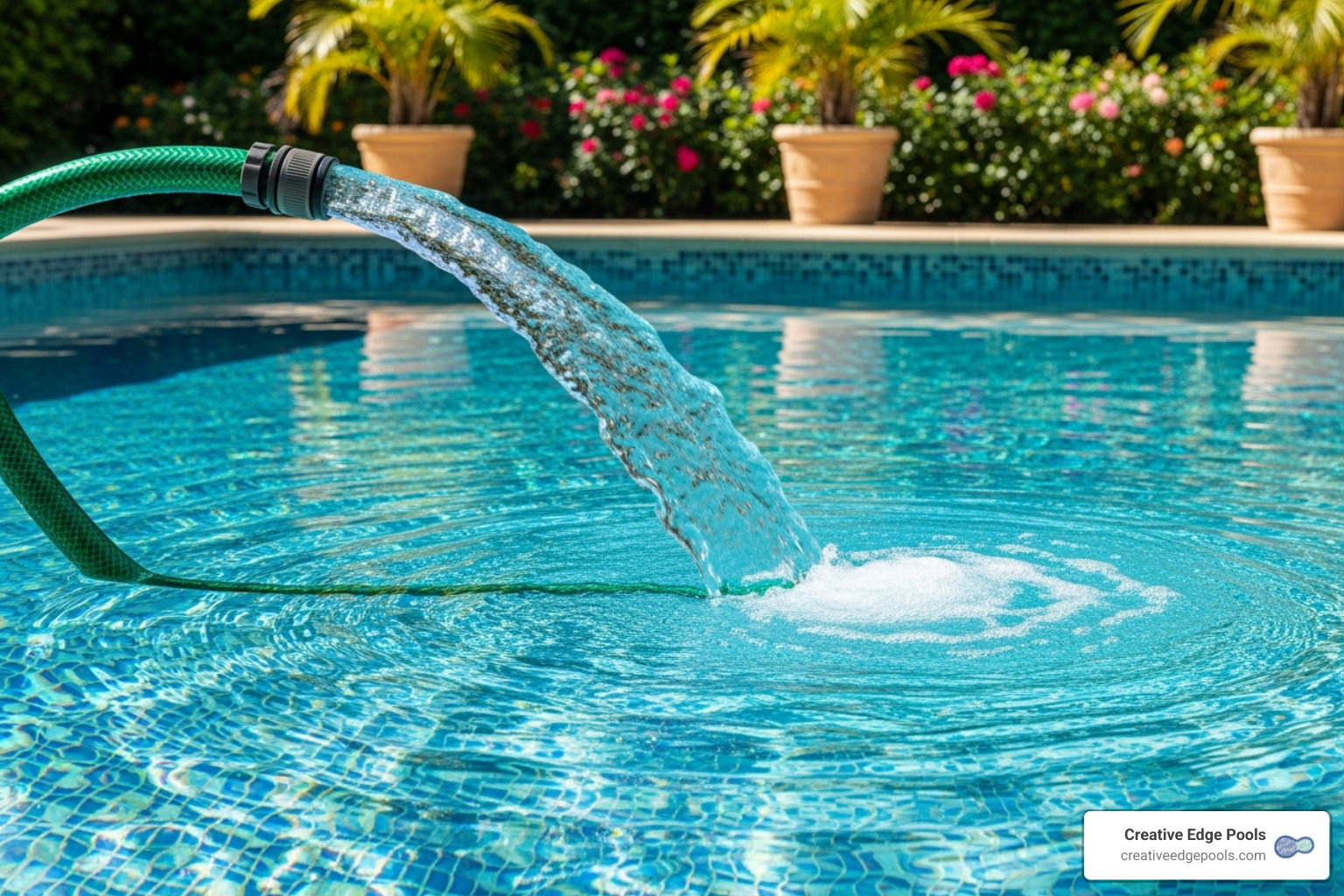
There’s something magical about that first moment when you watch your new pool fill up with sparkling water. The average cost to fill a pool with water typically ranges from $90 to $270 – not too bad when you consider you’re creating your own backyard oasis! Of course, this depends on your water source, how big your pool is, and whether you’re doing a complete fill or just topping off.
How much will it cost to fill a pool also depends on timing. Using a standard garden hose, you’re looking at anywhere from 12 to 24 hours for an average-sized pool – perfect for starting on a Friday evening and having it ready for the weekend. If you’re in a hurry, water delivery services can have your pool filled in just 1 to 3 hours, though you’ll pay more for the convenience.
How to Calculate Your Pool’s Volume and Water Needs
Before you even think about turning on that hose, you need to figure out exactly how much water your pool holds. This is your first step in calculating how much will it cost to fill a pool with water. Don’t worry – the math isn’t too complicated!
For rectangular pools, here’s the simple formula:
Length (feet) × Width (feet) × Average Depth (feet) × 7.5 = Total gallons
Let’s say you have a 20-foot long, 10-foot wide pool with an average depth of 5.5 feet. That gives you 8,250 gallons (20 × 10 × 5.5 × 7.5). Not bad!
Round pools use a slightly different calculation:
Diameter (feet) × Diameter (feet) × Average Depth (feet) × 5.9 = Total gallons
So an 18-foot diameter pool that’s 4 feet deep would hold about 3,823 gallons.
Here’s a helpful tip for finding your average depth: just add your shallow end depth to your deep end depth and divide by two. A pool with a 3-foot shallow end and 8-foot deep end has an average depth of 5.5 feet.
Got an irregular-shaped pool? Break it down into smaller rectangles or circles, calculate each section, then add them together. If math makes your head spin, you can always use a pool volume calculator to get a precise estimate.
How much will it cost to fill a pool using different water sources?
Your water source makes the biggest difference in your final bill. Let’s break down your main options:
| Water Source | Average Cost per 1,000 Gallons | Typical Cost for 17,000-Gallon Pool | Pros | Cons |
|---|---|---|---|---|
| City Water | $4 to $10 | $68 to $170 (from a garden hose) | Most affordable, convenient, clean water quality | Takes 12-24 hours, may trigger high usage charges |
| Well Water | $2 to $5 (electricity costs) | $34 to $85 | Very economical, unlimited supply | Requires pump electricity, potential water quality issues, slower flow |
City water through your garden hose is usually the most popular choice. At $4 to $10 per 1,000 gallons, it’s affordable and convenient. Many municipalities even offer sewer fee credits for pool fills since the water doesn’t go back into their system – just ask your water department about this potential savings.
Well water can be even cheaper if you have your own well, typically costing just $2 to $5 per 1,000 gallons in electricity to run your pump. However, you’ll want to test your water quality first – well water sometimes needs treatment before it’s pool-ready.
Water delivery services are the speed demons of pool filling, but they’ll cost you $30 to $100 per 1,000 gallons. They’re perfect when you need your pool filled fast for a party or event.
Costs for Partial Fills and Seasonal Maintenance
Here’s something every pool owner learns quickly: your pool will need water added throughout the season. Between evaporation (about 1 inch per week in summer), splash-out from cannonballs, and filter backwashing, you’ll lose roughly 2,000 gallons per month from an average pool.
The good news? Partial fills are much easier on your wallet. Seasonal maintenance fills typically cost between $20 and $500, depending on how often you need to top off and your water source choice.
Common scenarios include topping off after winter when you’ve drained below the skimmer line, or adding water after a big pool party. These partial fills usually require 1,000 to 3,000 gallons – a fraction of your initial fill cost.
One important note: keep an eye out for leaks. While some water loss is totally normal, a sudden drop in water level could signal a problem that’ll quickly drain your wallet along with your pool. Catching leaks early keeps your water costs manageable and your pool enjoyable all season long.
How much will it cost to fill a pool with dirt for removal?
Sometimes, the best pool is no pool at all. Whether you’re tired of constant maintenance, worried about safety, or simply want to reclaim your backyard space for other activities, filling a pool with dirt for removal has become an increasingly popular choice among homeowners. How much will it cost to fill a pool with dirt? The average sits around $5,000, though we typically see projects range from $2,500 to $8,500 for most homeowners.
The reality is that costs can vary dramatically based on your specific situation. We’ve seen simple projects come in at $2,000, while complex removals with challenging access or large pools can reach $19,000. Unlike filling with water, this is a major construction project that completely transforms your property.
This process involves much more than simply dumping dirt into your pool. You’ll need heavy machinery, skilled demolition crews, proper permits, and careful planning. The timeline typically spans 2 to 7 days, though more complex projects can take longer. The good news? Once it’s done, you’ll have reclaimed valuable yard space that can be used for gardens, patios, or even new construction.
Full vs. Partial Pool Removal: Cost and Land Use Implications
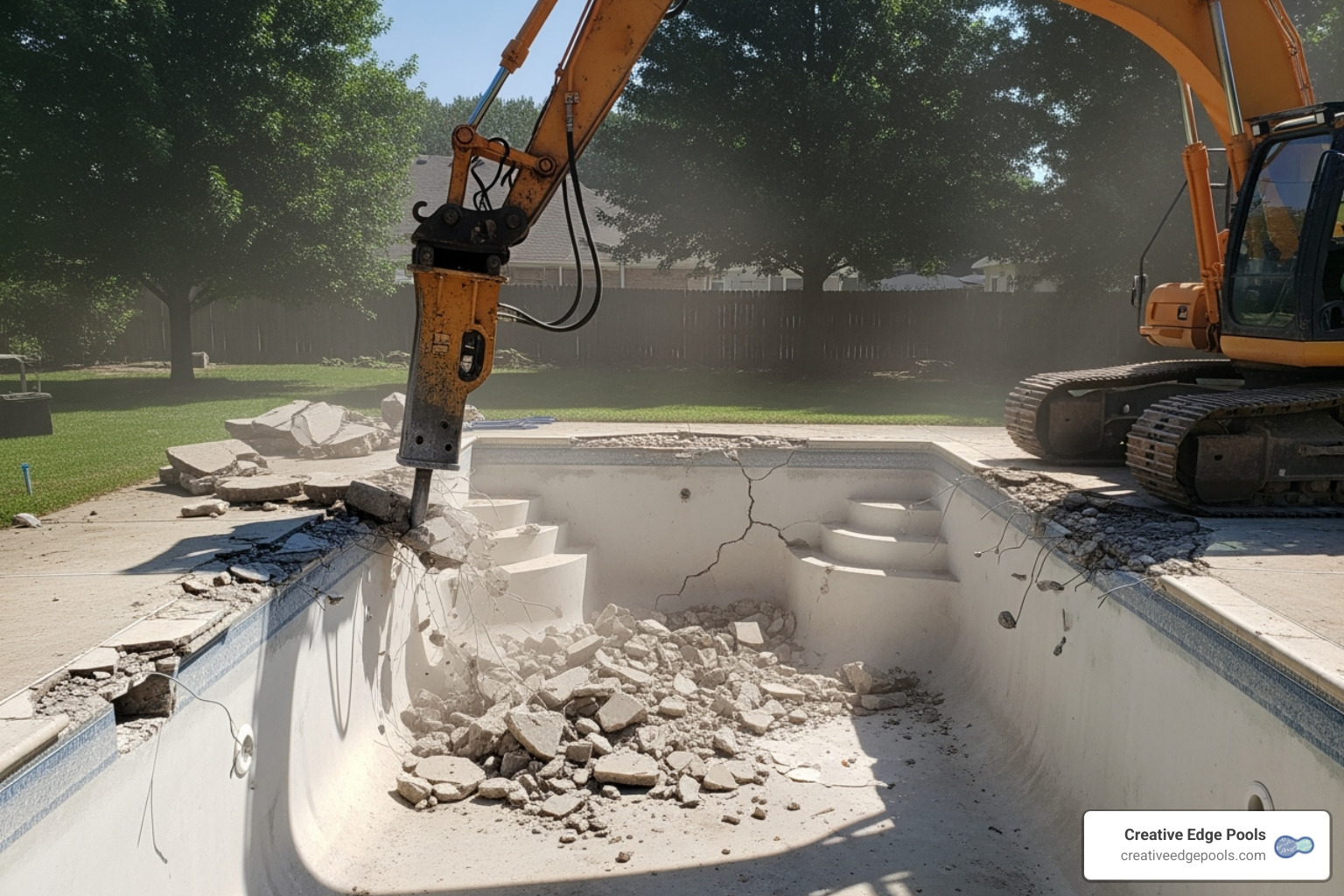
When you’re considering how much it will cost to fill a pool with dirt, you’ll face a crucial decision: partial removal or full removal. This choice dramatically affects both your upfront costs and what you can do with the land afterward.
Partial removal typically costs between $2,000 and $10,000, making it the more budget-friendly option upfront. With this approach, contractors demolish only the top portion of your pool structure—usually the top 18 to 24 inches. They’ll drill drainage holes in the bottom to prevent water buildup, then backfill the cavity with dirt and demolition debris, topped with clean fill.
Here’s the catch: partial removal creates non-buildable land. You won’t be able to construct any permanent structures like house additions, garages, or even large sheds on this area. The ground simply isn’t stable enough for heavy loads, and future settling could cause serious problems. This option works well if you’re planning a garden, lawn, or basic landscaping.
Full removal is more comprehensive and expensive, ranging from $4,000 to $16,000. Contractors completely demolish and remove the entire pool structure—bottom, sides, everything. The excavation is then filled with engineered backfill, compacted in layers to meet specific density requirements. Most municipalities require 90% to 95% compaction, and you’ll often need a structural engineer to oversee and certify the work.
The payoff? Full removal creates buildable land. When properly executed with engineered backfill and compaction, the area can support new construction. This makes it valuable for future property development and can actually increase your home’s value and flexibility.
Your choice depends entirely on your long-term plans. If you might want to build something on the site later, full removal is worth the extra investment.
What factors determine how much it will cost to fill a pool with dirt?
Several key factors influence how much it will cost to fill a pool with dirt, and understanding these can help you budget more accurately.
Pool size is the biggest cost driver. Larger pools require more demolition work, more debris removal, and significantly more fill material. A small 12×24 pool will be on the lower end of the cost spectrum, while a massive custom pool will push you toward the higher end. For perspective, a pool measuring 12 feet by 24 feet by 6 feet would require between $512 and $768 just for the structural fill dirt.
Pool material plays a major role in demolition difficulty and cost. Concrete and gunite pools are incredibly durable, making them the most challenging and expensive to demolish. They require heavy-duty equipment and more labor hours, with complete removal ranging from $3,000 to $15,000. Vinyl liner pools are easier to work with since the liner removes easily, but the underlying structure still needs demolition, typically costing $3,000 to $10,000. Fiberglass pools present unique challenges—they’re often removed in one piece if possible, or cut into sections. They’re lighter than concrete but require specialized handling, with complete removal usually costing $5,000 to $15,000.
Site accessibility can dramatically impact your costs. Can heavy machinery like excavators and dump trucks easily reach your pool area? If your pool is tucked away in a tight backyard with narrow gates or obstructions, contractors will need smaller, more specialized equipment and additional labor hours. This accessibility challenge can add thousands to your project cost.
Labor costs represent a substantial portion of your total expense. For inground pools, professional labor alone can range from $2,000 to $16,400, reflecting the complexity and physical demands of demolition, debris hauling, and careful backfilling with proper compaction.
Breaking Down the Additional Expenses
Beyond the core demolition and fill work, several other expenses contribute to your total project cost.
Permit costs typically range from $50 to $500, depending on your local municipality. Most areas require permits for demolition work to ensure safety and compliance with local regulations. Skipping permits might seem like a cost-saver, but it can lead to fines and project delays that cost far more in the long run.
Pool drainage is your first step—the pool must be completely drained before demolition begins. If your existing pump isn’t working or you need faster drainage, renting a water pump costs between $40 and $70.
Debris removal is a significant expense since all that demolished concrete, steel, or fiberglass needs to go somewhere. Dumpster rental typically costs $220 to $500 per week, plus disposal fees for concrete debris ranging from $150 to $380.
Fill material costs vary depending on what you’re using. Structural fill dirt is essential for proper compaction and stability, costing $8 to $12 per cubic yard. Gravel can serve as a base layer for drainage at $5 to $8 per cubic yard. Topsoil for the final layer costs $12 to $55 per cubic yard if you’re planning to plant grass or create a garden.
Post-removal landscaping helps restore your backyard’s appeal. Planting grass costs $50 to $100, installing a garden runs $4 to $12 per square foot, and building a patio ranges from $5 to $15 per square foot.
Hiring a structural engineer is highly recommended for full pool removal, especially if you plan to build on the site later. They ensure proper backfill compaction and drainage, preventing future settling or drainage problems. Their expertise is crucial for certifying the land as buildable, making this investment worthwhile for the long-term value of your property.
Frequently Asked Questions About Filling a Pool
Over the years, we’ve helped countless homeowners steer the decision of how much will it cost to fill a pool – whether they’re looking to enjoy their first swim or saying goodbye to their backyard oasis. Here are the questions we hear most often:
How long does it take to fill a pool?
The timeline for filling your pool depends entirely on what you’re putting in it!
Filling with Water:
If you’re using a standard garden hose connected to your municipal water supply, plan on waiting 12 to 24 hours for an average-sized pool. This can vary based on your water pressure and whether you’re using multiple hoses. I always tell homeowners to start this process on a weekend when they can keep an eye on it.
For those who want instant gratification, a water delivery service can fill your pool in just 1 to 3 hours. It’s like ordering takeout instead of cooking – you pay more, but you get results fast.
Filling with Dirt (Pool Removal):
Pool removal is a completely different beast. The demolition and backfill process typically takes 2 to 7 days. This includes breaking up the pool structure, hauling away debris, bringing in fill material, and carefully compacting everything in layers.
The timeline depends on several factors – pool size, what it’s made of, how easily our equipment can access your backyard, and the size of our crew. Weather can also play a role, especially if we hit a rainy stretch during the project.
Can I build on the land after filling in a pool?
This is one of the most important questions you can ask, and the answer depends entirely on how the pool removal was done.
Partial removal creates what we call non-buildable land. When only the top portion of the pool is demolished and the rest is backfilled, the remaining structure can create unstable ground. This area is perfect for a beautiful garden, lawn, or landscaping, but you can’t put a deck, shed, or addition on it. The ground simply won’t support the weight reliably.
Full removal with engineered backfill is a different story entirely. When the entire pool structure is demolished and removed, and the excavation is filled with properly compacted material, you get buildable land. This process requires compacting the fill material in layers to achieve 90% to 95% compaction, which most municipalities require.
For full removal projects, I always recommend consulting with a structural engineer. They oversee the compaction process and provide certification that the land is suitable for future construction. It’s like getting a stamp of approval that protects your investment and gives you peace of mind for any future projects.
Is it cheaper to fill a pool with a hose or get water delivered?
When it comes to filling your pool with water, using a garden hose from your city water supply is almost always the most affordable option.
Garden hose filling typically costs $4 to $10 per 1,000 gallons. For an average 17,000-gallon pool, you’re looking at $68 to $170 total. This method takes advantage of your existing utility service, keeping costs low. Many municipalities even offer wastewater credits since the water used to fill your pool doesn’t go into the sewer system.
Water delivery services are convenient but significantly more expensive, charging $30 to $100 per 1,000 gallons. That same 17,000-gallon pool could cost you $500 to $1,700 or more, depending on your location and the delivery company.
It’s really a trade-off between cost and speed. If you have the time and reasonable municipal water rates, the garden hose is the clear winner for your wallet. But if you need your pool filled quickly – maybe for a pool party or because you’re working with a tight schedule – then water delivery might be worth the extra investment for the convenience.
Making the Right Choice for Your Backyard

When you’re weighing how much will it cost to fill a pool, you’re really making a decision about your family’s future. It’s not just about the money – though that’s certainly important – it’s about what you want your backyard to become.
If you’re dreaming of summer barbecues with friends splashing in crystal-clear water, or quiet evenings floating under the stars, then filling your pool with water is calling your name. There’s something magical about having your own private oasis just steps from your back door. The relatively modest cost of $90 to $270 to fill a pool with water opens up years of memories, relaxation, and pure enjoyment.
But maybe you’re in a different season of life. Perhaps the kids have grown up and moved away, or you’re tired of the endless maintenance, or you have grand plans for a beautiful garden or patio space. Filling your pool with dirt for removal – while a much larger investment at around $5,000 – can completely transform your property and give you that fresh start you’re craving.
The beauty of full removal with engineered backfill is that it doesn’t just eliminate your pool; it creates buildable land that opens up exciting possibilities. Want to add a home office? Dream of a spacious deck for entertaining? With proper compaction and engineering, that former pool area becomes a blank canvas for whatever comes next.
Even partial removal has its place, especially if you’re looking to create a stunning landscape feature or garden space. While you won’t be able to build structures on it, you’ll have reclaimed valuable square footage for outdoor living at a lower cost.
At Creative Edge Pools, we understand that every family’s situation is unique. We’ve helped countless homeowners in Eastern Massachusetts and Southern New Hampshire steer this exact decision. Whether you’re ready to dive into the joy of a custom gunite pool or you’re ready to say goodbye to your current one, we’re here to guide you through the process with honesty and expertise.
The key is thinking about your long-term value – both financial and personal. A well-designed pool can become the heart of your home, while a thoughtfully filled and landscaped area can boost your property’s appeal and functionality in entirely new ways.
Ready to explore your options? Whether you’re envisioning sparkling water or rich garden soil, we’re here to help you make the right choice for your family and your budget. Explore your options with our professional pool removal services and let’s create the backyard you’ve always wanted.
