
Why Homeowners Choose Swimming Pool Removal
Swimming pool removal is becoming an increasingly common choice for homeowners across the United States. With roughly 10.4 million residential swimming pools nationwide, many families find themselves overwhelmed by maintenance costs, safety concerns, or simply changing lifestyle needs.
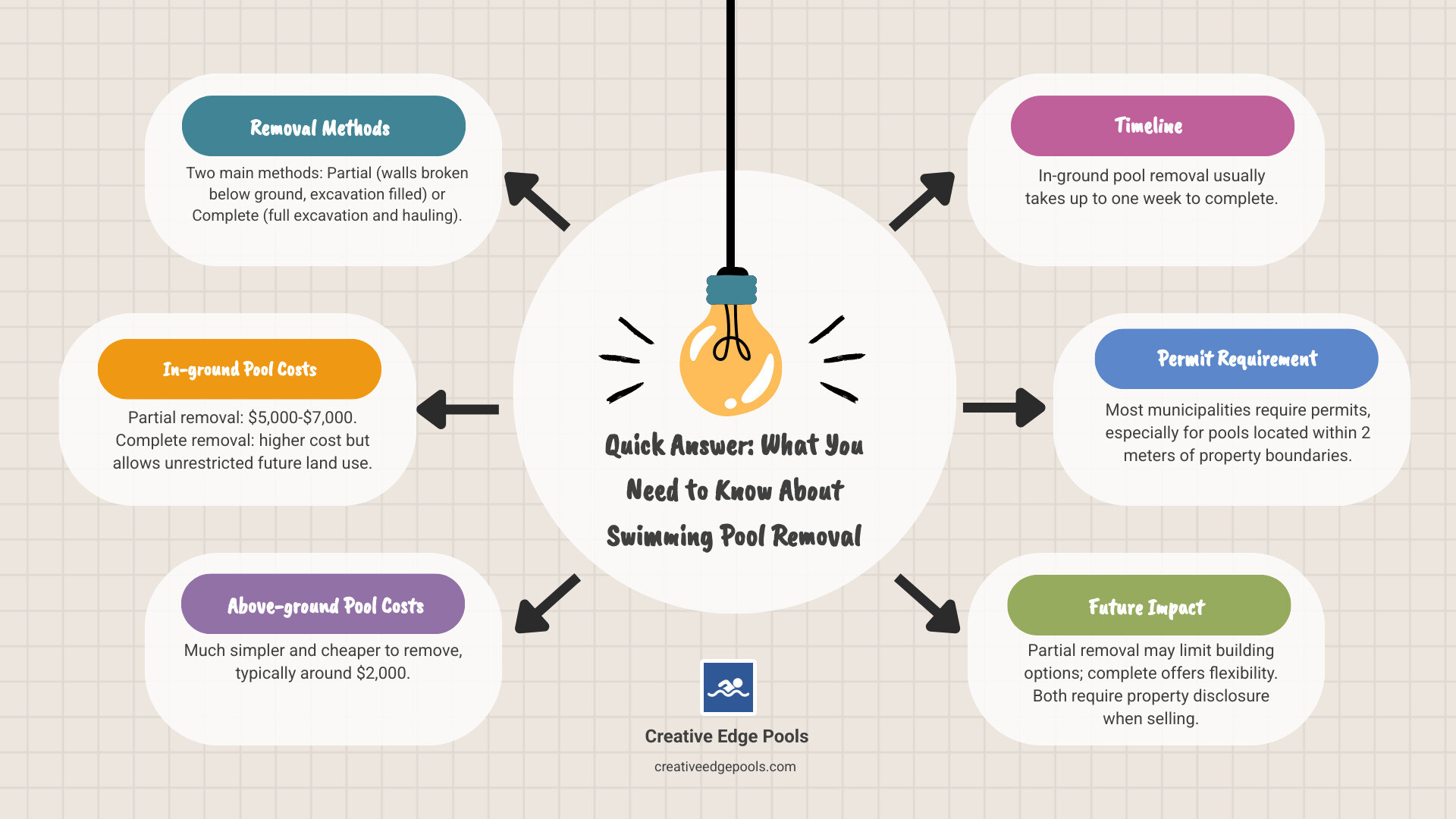
Quick Answer: What You Need to Know About Swimming Pool Removal
- Two main methods: Partial removal (breaking walls below ground, filling excavation) costs $5,000-$7,000 for in-ground pools; complete removal (full excavation and hauling) costs more but allows unrestricted future land use
- Above-ground pools: Much simpler and cheaper to remove at roughly $2,000
- Timeline: In-ground pool removal takes up to a week to complete
- Key requirement: Most municipalities require permits, especially for pools within 2m of boundaries
- Future impact: Partial removal may limit building options; complete removal offers more flexibility but both require property disclosure when selling
There are occasions where a pool that once brought joy becomes a burden. Perhaps your children have grown and moved out. Maybe the cost to resurface and renovate—often $10,000 or more—feels overwhelming compared to removal. Or you simply want to reclaim your backyard for a garden, patio, or other outdoor living space.
The decision to remove a pool isn’t just about demolition. It involves understanding your options, navigating permits, managing structural risks, and planning for future land use. Whether you’re considering partial removal to save costs or complete excavation for maximum flexibility, knowing the process helps you make informed choices.
Understanding the Methods of Swimming Pool Removal
When considering swimming pool removal, it’s crucial to understand that it’s not a one-size-fits-all process. There are distinct methods, each with its own implications for cost, effort, and future use of your property. We offer comprehensive solutions custom to your specific needs, whether you’re in Eastern MA or Southern NH.
| Method | Description | Pros | Cons | Cost & Future Use |
|---|---|---|---|---|
| Partial Removal (Fill-In) | The top portion of the pool walls (e.g., 18 inches to 2 feet) is broken down, and the remaining shell is punctured for drainage before being filled with soil and debris. | More cost-effective; faster process. | May cause sinkage; limits future construction (no livable structures); requires property disclosure. | Average $5,000-$7,000 for in-ground; land suitable for landscaping, sheds, trees. |
| Complete Removal (Full Excavation) | The entire pool structure, including the shell, decking, and surrounding materials, is demolished and hauled away from the property. | Allows for unrestricted future land use; eliminates sinkage risks; generally preferred for resale. | Higher cost due to extensive demolition and debris removal; more time-consuming. | Higher than partial removal; land suitable for any future construction, including additions. |
| Decommissioning (No Removal) | Making the pool permanently unusable by removing filtration, access ladders, and ensuring it cannot hold water above a certain depth (e.g., 300mm), without necessarily filling the excavation. | May be cheaper than removal if allowed by local regulations. | Pool remains on property; often still requires fencing; may not be recognized as “removed” by authorities or buyers. | Varies greatly by local regulations; not always an option for full property reclamation. |
More info about concrete pool removal
Partial vs. Complete Demolition
The choice between partial and complete demolition largely hinges on your budget, future plans for the space, and local regulations.
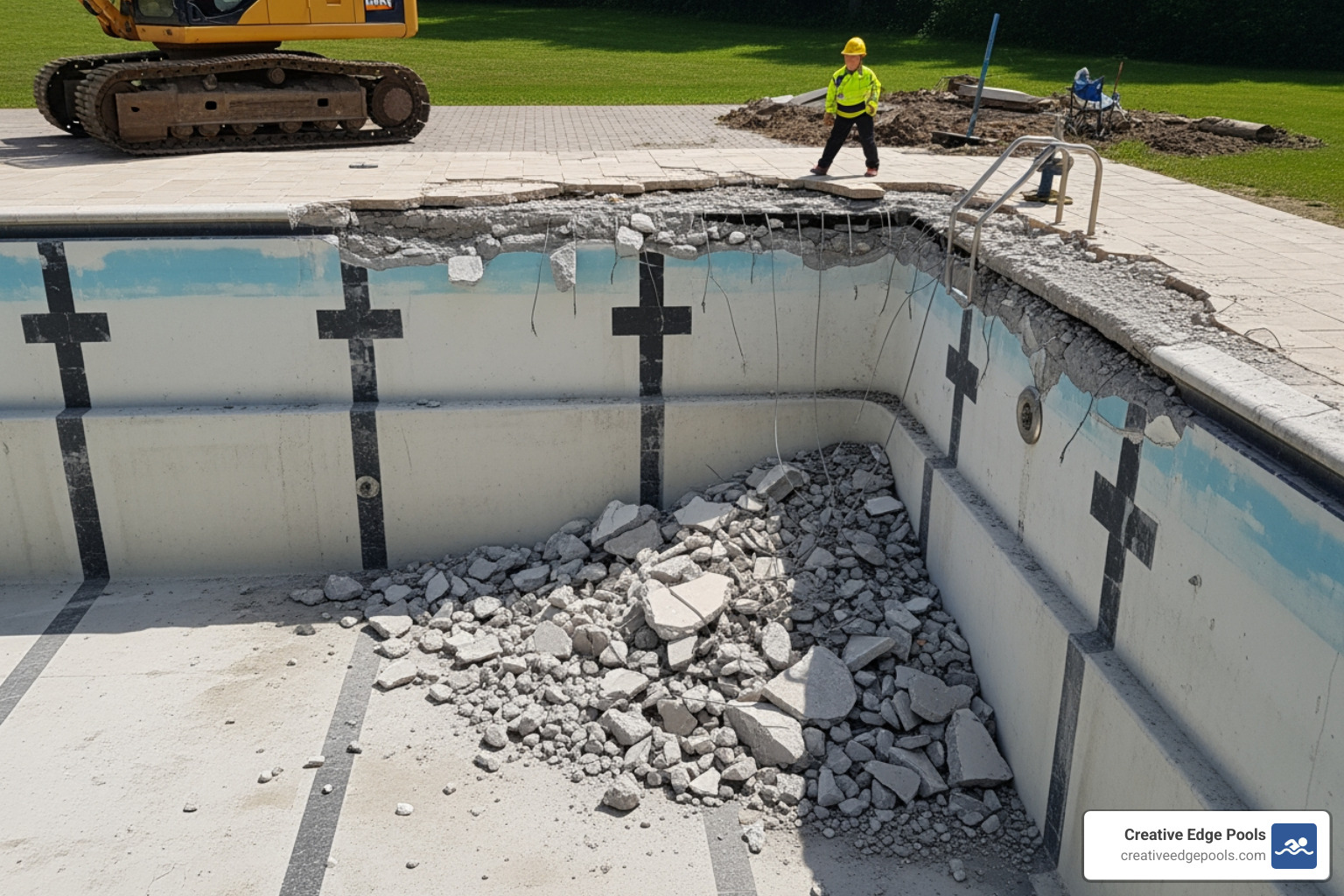
Partial Demolition, often referred to as the “fill-in” method or “shell burial,” involves breaking down a portion of the pool’s walls—typically 18 inches to 2 feet below ground level. The remaining pool shell is then punctured to allow for drainage, preventing future water accumulation. After this, the pool is filled with appropriate backfill material, such as sand and dirt, and compacted. This method is often the most cost-efficient solution for homeowners, as it requires less labor and hauling of debris. However, it’s important to note that most cities still consider the site unsuitable for building livable structures, though sheds, trees, and landscaping are usually permissible. You must also disclose this method when selling your property, as sinkage, swelling, or seepage can occur if not done correctly.
Complete Demolition, or “full excavation,” is the most thorough approach. With this method, the entire pool structure, including the shell, decking, and any surrounding concrete, is demolished and hauled away from your property. This leaves a clean slate, allowing for unrestricted future use of the land. While more expensive due to the extensive demolition and debris removal, it eliminates potential issues associated with a buried shell and is generally preferred if you plan to build an addition or another structure on the site. For many homeowners, especially those in Eastern MA and Southern NH looking to maximize their property’s value and utility, this is the preferred option.
More info about in-ground pool removal
Decommissioning Standards
Beyond physical removal, some municipalities recognize “decommissioning” as a way to render a pool unusable. This typically involves removing key components that make the structure a functional swimming pool. For instance, some regulations specify that a pool is decommissioned if it can no longer contain water to a depth greater than 300mm (approximately 12 inches), and if its filtration system and access ladders are removed. The intent is to ensure the pool is no longer a safety hazard or a recreational facility.
While this might sound like an easier route, it’s critical to check your local zoning and building department requirements in Eastern MA and Southern NH. Decommissioning often still requires council approval and may not result in the removal of the pool from official registers without further steps, or remove the need for fencing. Structural modifications, such as core-drilling large openings in the pool floor for drainage, might also be required even if the pool is not fully excavated. Our team can help you understand these specific requirements for your area.
Decommissioning a swimming pool or spa
The Demolition Process: Step-by-Step
Removing a swimming pool is a complex project that requires careful planning and execution. We ensure every step is handled professionally, from initial assessment to final site preparation.
The process typically begins with a thorough site assessment to evaluate the pool’s type, size, and location, as well as access for heavy machinery. Once we have a clear understanding, we move into the preparation phase, which includes obtaining necessary permits and disconnecting utilities.
More info about how to remove a pool
Preparing for Swimming Pool Removal
Preparation is key to a smooth swimming pool removal. Here’s what we typically handle:
- Permits: This is often the first and most critical step. Depending on your specific town or city in Eastern MA or Southern NH, a permit may be required for pool removal. Professional pool removal companies, like ours, typically manage this process, ensuring all local regulations are met. For example, some jurisdictions require a demolition permit if the pool is located within a certain distance (e.g., 2 meters) of a boundary or another building.
- Disconnecting Utilities: Before any demolition begins, all utilities connected to the pool must be safely disconnected and capped. This includes electrical wiring, gas lines (for heaters), and water lines. This is a crucial safety measure to prevent accidents during the demolition process.
- Draining the Pool: The pool must be completely drained. We use submersible pumps to efficiently remove all water from the pool.
- Site Safety: We establish safety protocols, including securing the area to prevent unauthorized access during the demolition.
How do I decommission my pool or spa?
Structural Integrity and Backfilling
Once the pool is drained and utilities are disconnected, the physical demolition begins.
- Punching Holes: For partial removals or even some decommissioning processes, punch holes in the bottom of the pool shell. This prevents hydrostatic pressure from building up underneath the shell after it’s buried, which could cause the shell to “pop” out of the ground. These holes, often around 2 feet in radius, are typically filled with gravel (about 8 inches deep) to ensure easy and effective drainage, protecting the area from excessive moisture.
- Demolishing the Structure: For in-ground pools, we use heavy machinery like jackhammers to break apart concrete or fiberglass walls. For partial removal, this means breaking them down to the specified depth below grade. For complete removal, the entire shell is demolished and hauled away.
- Backfilling and Compaction: This is perhaps the most critical step for ensuring the long-term stability of your reclaimed yard. We use tons of clean, appropriate fill material—often a mix of sand and dirt—to fill the excavation. This material is added in layers, typically no more than 12 inches (300mm) deep, and thoroughly compacted after each layer. Proper compaction is vital to prevent future settling or sinkage of the ground. In some cases, especially with challenging soil types or high water tables, we may recommend consulting with an engineer to determine the best fill material and compaction methods for your specific site.
- Adding Topsoil: Once the backfill is complete and compacted, we add a layer of topsoil suitable for your landscaping plans. Approximately five inches of topsoil are needed for a new lawn, ten inches for growing vegetables, and fifteen inches for raising plants.
More info about the cost to fill a pool
Cost Analysis: Above-Ground vs. In-Ground
One of the first questions homeowners ask us is, “How much does swimming pool removal cost?” The answer largely depends on the type of pool you have and the method of removal chosen.
Above-ground pool removal is significantly less complex and, therefore, less expensive. The average cost to remove an above-ground pool is roughly $2,000. This typically involves dismantling the structure, removing the liner, and hauling away the materials.
In-ground pool removal is a more substantial undertaking. The average cost for partial removal of an in-ground pool, which includes breaking down a portion of the walls and backfilling, ranges from $5,000 to $7,000. Complete removal, where the entire pool shell and decking are excavated and hauled away, will cost more due to the increased labor, equipment, and disposal fees. To put this in perspective, it can cost $10,000 or more to resurface and makeover a swimming pool in need of TLC, making removal an attractive alternative for many.
More info about pool demolition costs
Factors Influencing Your Estimate
Several key factors will influence the final cost of your swimming pool removal project:
- Pool Size and Depth: Larger and deeper pools require more demolition, more backfill material, and more time, all contributing to higher costs.
- Material Type: Concrete (gunite) pools are generally more difficult to demolish than fiberglass or vinyl liner pools, impacting labor and equipment needs.
- Site Access: If heavy machinery cannot easily access the pool area, manual labor may be required, increasing costs.
- Location and Terrain: Steep slopes, rocky soil, or a high water table can add complexity and expense.
- Permit Fees: The cost of permits varies by municipality in Eastern MA and Southern NH. We handle the permitting process for you, and these fees will be included in your estimate.
- Decking and Landscaping: The extent of surrounding concrete decking, patios, or landscaping that also needs to be removed will affect the overall cost.
- Method of Removal: As discussed, complete removal is more expensive than partial removal.
- Hauling and Disposal: The volume of debris to be hauled away and disposed of at approved sites will be a significant cost component.
When we provide an estimate, we ensure it’s comprehensive, detailing the scope of work, equipment to be used, start and completion dates, payment schedule, and contact information. We believe in transparency, so you know exactly what to expect.
More info about the cost to remove a pool
Long-Term Land Use After Swimming Pool Removal
The method of swimming pool removal you choose has significant implications for how you can use your land in the future and how it impacts your property’s value.
For partial removal, while it’s more budget-friendly, most municipalities will not allow you to build a livable structure (like a home addition) over the filled area. However, it’s generally suitable for landscaping, planting trees, or installing non-permanent structures like sheds or patios. A key consideration here is property disclosure; you must inform future buyers that a pool was partially removed and buried on the property. Failing to do so can lead to legal issues down the line. There’s also a slight risk of future sinkage if the backfill isn’t compacted perfectly, which could cause depressions in your yard.
With complete removal, the land is returned to its natural state, free of any buried pool components. This means there are typically no restrictions on future building, allowing you to construct anything from a new home addition to a garage. This method often adds more value to your property in the long run and simplifies property disclosure, as there’s no buried structure to explain. It also virtually eliminates the risk of sinkage or other issues associated with a buried shell. While the upfront cost is higher, the long-term flexibility and peace of mind can be well worth the investment.
More info about pool filling service costs
Structural Risks and Environmental Impact
Swimming pool removal isn’t just about demolition; it’s about managing potential structural risks and ensuring environmental responsibility. Our team is committed to safe practices and minimizing our ecological footprint.
One of the significant concerns homeowners have is how the removal will affect their yard long-term. Improper removal can lead to drainage issues, soil instability, or even problems with the water table. We address these concerns proactively, ensuring proper drainage modifications and compaction.
Environmentally, we strive to recycle and repurpose as much of the demolition debris as possible. Concrete can often be crushed and reused as aggregate, and other materials can be diverted from landfills. We work with approved disposal sites to ensure all waste is handled responsibly.
Decommissioning or removal of swimming pools and spas
Managing Hydrostatic Pressure
Hydrostatic pressure is a critical factor we consider, especially when dealing with in-ground pools. This pressure occurs when the water table surrounding the pool is higher than the water level inside the pool. If a pool is drained too quickly or left empty for too long in an area with a high water table, the external pressure can cause the pool shell to crack, shift, or even “pop” out of the ground. This is a severe structural consequence of removing water from a pool without proper precautions.
To mitigate this risk, especially in partial removals where the shell remains, we ensure the pool shell is properly “vented” by core drilling large holes in the bottom. These holes, combined with a layer of gravel during backfilling, allow groundwater to flow freely, preventing pressure buildup and ensuring stability. In areas with particularly challenging soil conditions or high water tables, we may recommend an engineer’s consultation to advise on the best approach for managing hydrostatic pressure and selecting appropriate fill materials.
Alternative Backyard Uses
If the idea of completely removing your pool feels too drastic, or if the costs are a concern, there are several creative alternatives to transform your unused pool into a functional and beautiful space:
- Koi or Wildlife Pond: Convert your pool into a vibrant aquatic ecosystem. This involves ensuring proper drainage, lining the pool, and installing filtration suitable for a pond environment.
- Deck Conversion: Cover the pool with a custom-built deck. This creates a large, flat surface for entertaining, lounging, or dining. This option can be a few thousand dollars less than full pool removal, offering a new usable space without the extensive demolition.
- Garden Space: Transform the pool into a sunken garden or a raised garden bed. With proper drainage and soil layers, you can create a unique horticultural feature. If you want to grow vegetables, you’ll need about 10 inches of topsoil, and for plants, around 15 inches.
- Patio Expansion: Fill the pool and create an expanded patio area, ideal for outdoor living rooms, fire pits, or dining areas.
- Sports Court: For larger pools, you might consider converting the space into a small basketball court, pickleball court, or other recreational area.
These alternatives can breathe new life into your backyard, turning a liability into an asset without the full commitment of a complete swimming pool removal.
Frequently Asked Questions
Do I need a permit for swimming pool removal?
Yes, in most cases, you will need a permit for swimming pool removal in Eastern MA and Southern NH. The specific requirements can vary significantly by town or city. Generally, a demolition permit is required, especially for in-ground pools. If your pool is located within a certain distance (e.g., 2 meters in some regions) of your property line or another building, additional considerations or permits might be necessary. We handle the entire permitting process for our clients, ensuring all local regulations are met before any work begins. It’s a crucial step to avoid fines and ensure the project is compliant.
How long does the pool removal process take?
The duration of swimming pool removal depends primarily on the type and size of the pool, as well as the chosen removal method. Removing an above-ground pool is relatively quick, often taking just a day or two. For an in-ground pool, the process is more involved. A partial removal (breaking down walls and backfilling) can typically be completed within a few days to a week. A complete removal (full excavation and hauling away the entire structure) usually takes longer, often up to a week or more, due to the extensive demolition, debris removal, and careful backfilling and compaction required. Factors like site access, weather, and the need for engineer consultation can also influence the timeline.
Can I build a structure over a removed pool site?
This depends entirely on the method of swimming pool removal you choose.
If you opt for partial removal (where a portion of the pool shell is buried), most municipalities will not permit the construction of a livable structure, such as a home addition, over the filled area. The ground might not be considered stable enough for a foundation, and potential future settling or drainage issues could arise. However, you can typically build non-livable structures like sheds, gazebos, or patios, and plant landscaping or trees. It’s crucial to disclose this type of removal when selling your property.
If you choose complete removal (full excavation and hauling away of the entire pool structure), the land is restored to its original state. This method usually allows for unrestricted future building, meaning you can construct any structure, including a house addition or a new garage, on the site. This offers the most flexibility and often adds the most value to your property in the long term. Regardless of the method, always consult with your local building department and a structural engineer if you plan any significant construction on the site of a removed pool.
Conclusion
Deciding to proceed with swimming pool removal is a significant step, representing a change of your outdoor living space. Whether driven by maintenance costs, changing needs, or a desire for a new backyard aesthetic, understanding the various methods, processes, and implications is paramount. From partial and complete demolition to navigating permits and ensuring proper backfilling, each stage requires expertise and meticulous attention to detail.
At Creative Edge Pools, we bring over 100 years of combined experience to every project. As a family-owned business specializing in gunite pools and spas, we understand the nuances of backyard development in Eastern MA and Southern NH. We’re here to guide you through the entire swimming pool removal process, changing your vision into a reality. Reclaim your backyard and open up its full potential with a team you can trust.