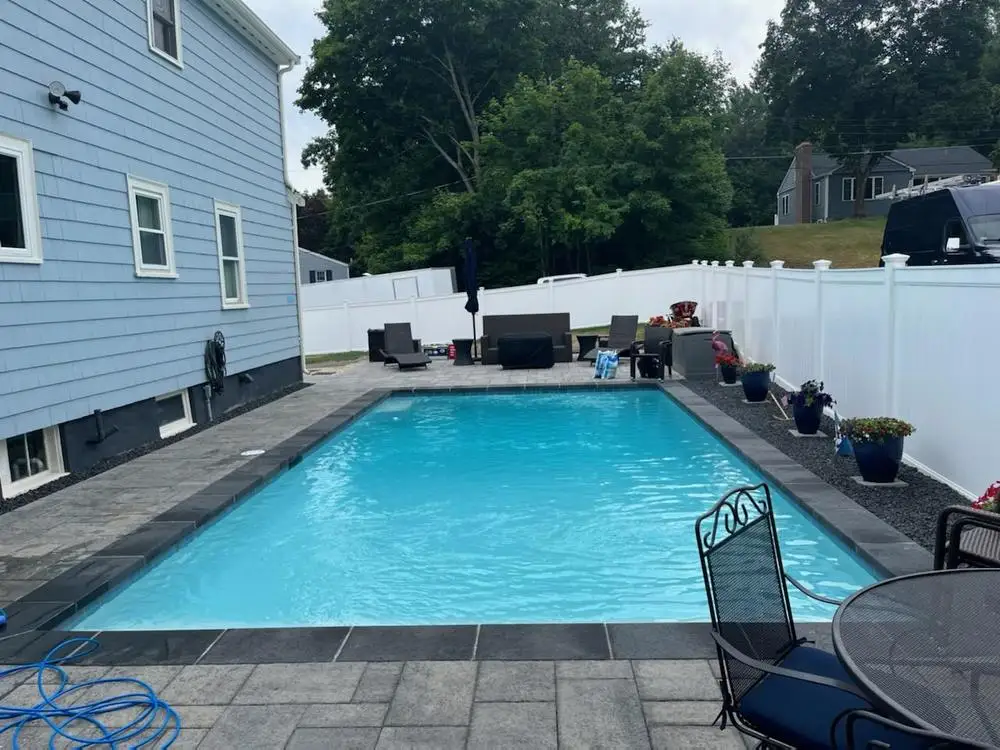
Is Replacing Your Pool Liner With Gunite Worth the Cost?
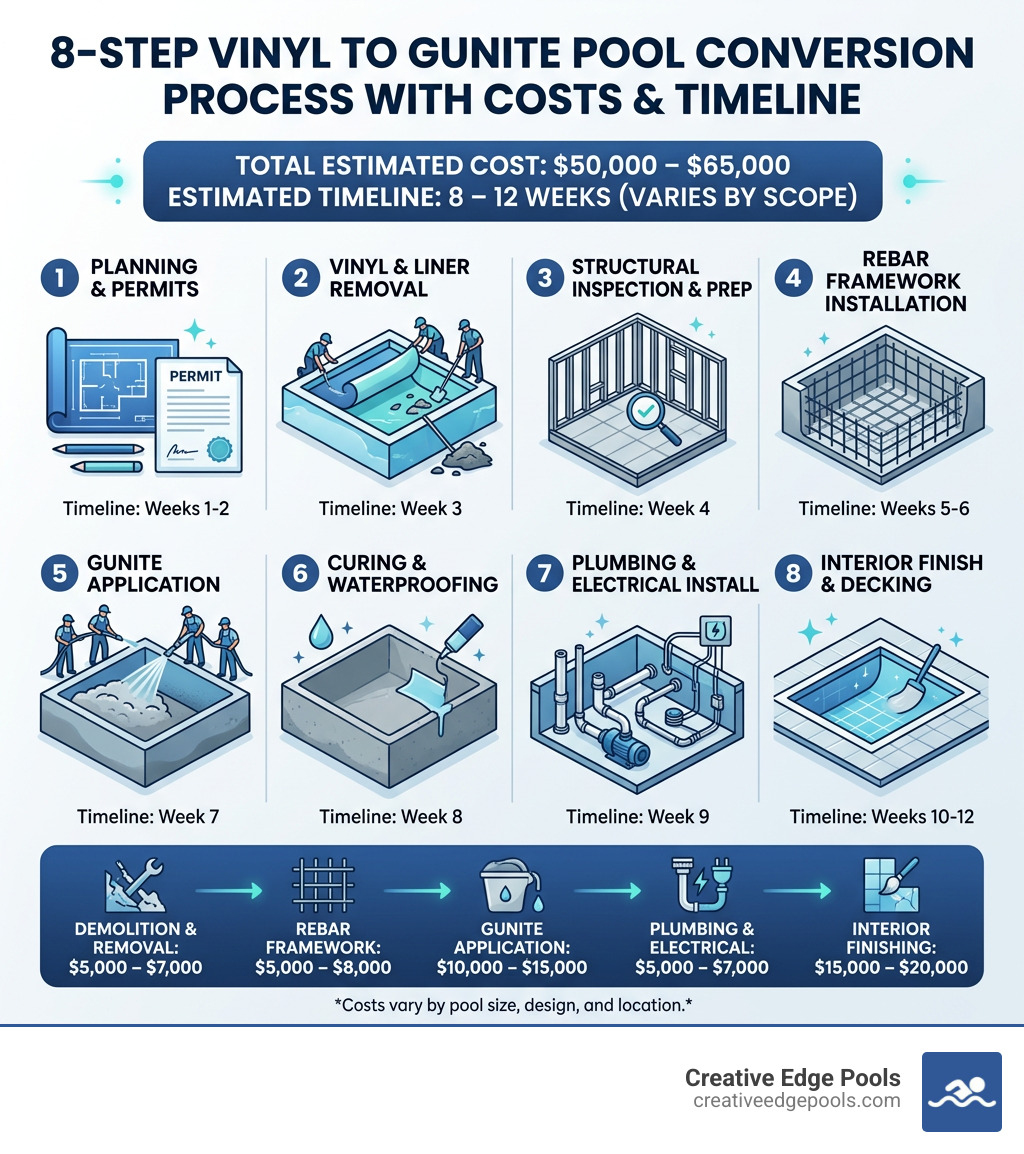
The cost to replace pool liner with gunite typically runs $50,000 to $65,000 for an average-sized inground pool. Here’s a fast breakdown:
| Cost Component | Typical Range |
|---|---|
| Demolition & Removal | $5,000 – $7,000 |
| Rebar Framework | $5,000 – $8,000 |
| Gunite Application | $10,000 – $15,000 |
| Plumbing & Electrical | $5,000 – $7,000 |
| Interior Finishing | $15,000 – $20,000 |
| Total Conversion | $50,000 – $65,000 |
That’s roughly the same price as building a brand-new gunite pool from scratch. The only real savings comes from the existing excavation — typically $3,000 to $5,000 less than new construction.
So why do homeowners in Eastern Massachusetts and Southern New Hampshire still make the switch?
Because vinyl liners need replacing every 5 to 9 years at $2,500 to $4,500 each time. Over 20 years, those repeated costs add up to $60,000 to $68,000+ — before accounting for routine maintenance. A gunite shell, by contrast, can last 50+ years.
One pattern comes up again and again: homeowners who replace their liner two or three times before finally converting to gunite, wishing they had made the move sooner.
This guide breaks down every cost, the full conversion process, and exactly when it makes financial sense to stop patching vinyl and go permanent.
Breaking Down the Cost to Replace Pool Liner with Gunite
When we talk about the cost to replace pool liner with gunite, we are essentially talking about building a new pool inside the footprint of your old one. Many homeowners are surprised to learn that a conversion costs nearly as much as a fresh install. However, when you factor in the rising prices of materials and labor in areas like Lexington, MA or Nashua, NH, the investment starts to make sense as a long-term property play.
The price of a brand-new gunite pool in the Northeast often starts at $65,000 and goes up based on features. With a conversion, you are looking at a similar $50,000 to $65,000 range. The primary difference is that we don’t have to dig a giant hole in your yard from scratch. You save roughly $3,000 to $5,000 on excavation, and in some towns, you might face fewer permitting hurdles because the “footprint” of the pool already exists.
The durability of the finished product is where the value lies. Gunite is a specialized form of shotcrete, which involves spraying a dry mix of cement and sand through a hose and mixing it with water at the nozzle. This creates a monolithic, incredibly strong concrete shell. At Creative Edge Pools, we specialize in this gunite pool installation process because it is the only way to ensure a pool survives the harsh freeze-thaw cycles of a New England winter. If you are looking for a gunite pool builder who understands the local geology from Andover to Portsmouth, experience is the most important factor in your budget.
Core Components of the Cost to Replace Pool Liner with Gunite
To understand the bill, you have to look at the labor-intensive stages of a conversion. It isn’t just “spraying concrete.”
- Demolition and Removal ($5,000 – $7,000): We have to strip out the old vinyl liner and, more importantly, remove the existing wall panels. Whether they are steel, plastic, or wood, they cannot support the weight of a gunite shell.
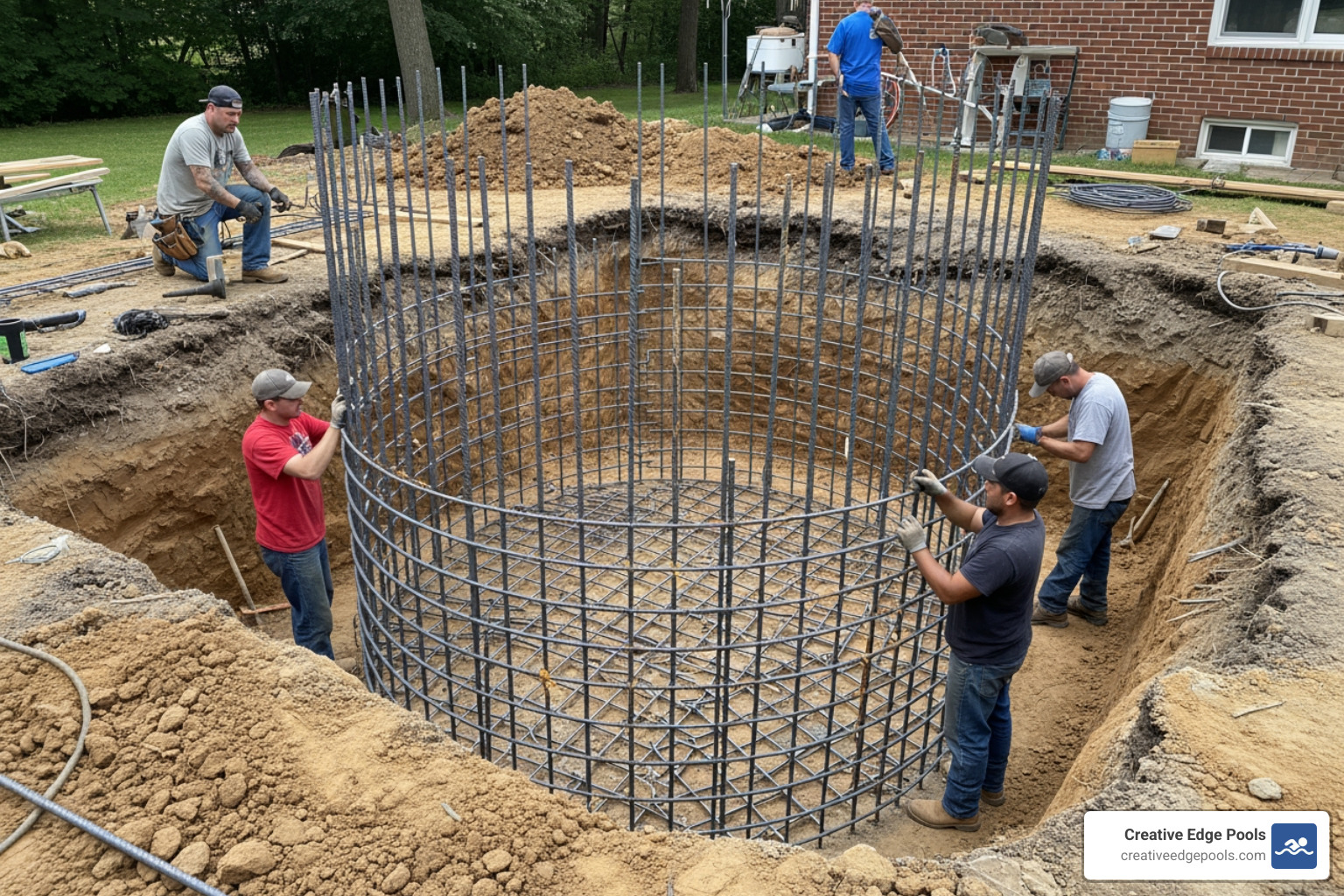
- Rebar Framework ($5,000 – $8,000): We build a “cage” of steel reinforcement bars. This is the skeleton of your pool that gives the concrete its structural tension.
- Plumbing and Electrical ($5,000 – $7,000): Most vinyl pools have thin plumbing lines that aren’t meant to be encased in 8 inches of concrete. We replace these with heavy-duty rigid PVC and update the electrical to meet modern safety codes.
- Gunite Application ($10,000 – $15,000): This is the “big day” where the shell is shot. It requires a large crew and specialized machinery.
- Interior Finishing ($15,000 – $20,000): This covers the “jewelry” of the pool—the waterline tile, the coping (the edge around the top), and the plaster or pebble finish.
Hidden Expenses in the Cost to Replace Pool Liner with Gunite
Beyond the visible construction, there are “soft costs” that can impact your final invoice.
- Permits and Zoning ($500 – $2,000): Every town from Newton to Derry has different rules. Some require engineered drawings and specific drainage plans.
- Soil Testing ($1,000 – $1,500): In New England, we often run into “ledge” (solid rock) or high water tables. Understanding what is under your pool floor is vital to prevent future cracking.
- Vermiculite Floor Repair: If your old vinyl pool had a vermiculite floor that has shifted or cracked, it may need to be completely excavated before the new shell can be placed.
- Deck Removal and Replacement ($10,000 – $30,000+): You can’t usually convert a pool without damaging the surrounding concrete or pavers. This is often the biggest “hidden” cost, but it’s also the best time to upgrade to a beautiful stone patio.
- Water Fill and Startup ($300 – $1,000): Filling a 20,000-gallon pool isn’t free, and the initial chemical balancing for a new gunite surface is more intensive than a vinyl one.
According to the Bureau of Labor Statistics, labor costs for specialized trades in the Northeast are significantly higher than the national average. This reflects the high level of expertise required to build structures that can withstand -10°F winters and 95°F summers.
Vinyl vs. Gunite: A 20-Year Financial Comparison
Many homeowners look at the $5,000 price tag for a high-end inground pool liner replacement cost and think it’s the cheaper route. In the short term, it is. But let’s look at the long-term math.
A vinyl liner typically lasts 5 to 9 years. Even if you are meticulously careful with your chemicals, the sun and the cold eventually make the vinyl brittle. You can read more about how long does a vinyl pool liner last to see the factors involved, but the reality is you will likely replace that liner three to four times over a 20-year period.
When you add up the cost to replace vinyl pool liner over two decades, including the water costs and the inevitable floor repairs, you are often looking at over $60,000 in “maintenance” that leaves you with… another vinyl pool.
A gunite shell has a 50-year lifespan. While the interior plaster might need a refresh every 10–15 years, the structural “bowl” is permanent. Furthermore, gunite pools are more chemically efficient. Because the surface is less prone to the “osmotic” issues sometimes seen with older vinyl, and because modern finishes are designed to be algae-resistant, many of our clients find they spend about 30% less on chlorine after converting.
The Conversion Process: Timeline and Structural Requirements
Converting a pool is a marathon, not a sprint. While a liner swap takes a day or two, a conversion takes 8 to 12 weeks.
- Preparation and Demolition (Week 1-2): We pump the water, pull the liner, and remove the old walls. We also modify the excavation if you want to change the pool’s shape or depth.
- Plumbing and Steel (Week 3-4): We install new, heavy-duty plumbing and tie the rebar cage. This is a great time for replacing inground pool liner logic with permanent features like built-in steps.
- The Gunite Shoot (Week 5): The shell is formed.
- The Curing Period (Weeks 6-9): This is the part that tests your patience. The gunite needs 28 to 30 days to “cure” and reach its full strength. During this time, you (or we) will need to spray the shell with water daily to keep it from drying too fast and cracking.
- Tile, Coping, and Finish (Week 10-12): Once cured, we add the decorative elements and the final interior surface.
Throughout this process, we perform rigorous pressure testing on the plumbing. Unlike vinyl, where a leak might be a simple patch, a leak under a gunite pools shell is a major headache. We do it right the first time so you never have to worry about it again.
Design Upgrades and Impact on Home Resale Value
One of the most exciting reasons to spend the cost to replace pool liner with gunite is the freedom of design. Vinyl pools are essentially “Lego sets”—you are limited to the shapes the manufacturer provides.
With gunite, if you can dream it, we can build it. During a conversion, we can add:
- Tanning Ledges (Sun Shelves): Shallow areas for lounge chairs ($3,000 – $5,000).
- Integrated Spas: A hot tub that spills over into the pool ($12,000 – $20,000).
- Beach Entries: A sloped entry that mimics the ocean.
- Custom Benches and Swim-outs: Perfect for relaxing without leaving the water.
Beyond your own enjoyment, there is the “resale factor.” In upscale neighborhoods in Massachusetts and New Hampshire, a gunite pool is considered a permanent luxury asset. Real estate data shows that a gunite pool can add 5% to 8% to a home’s value, whereas a vinyl liner pool often adds only 3% to 5%. In a $750,000 home, that difference can be $20,000 or more.
While a pool liner install is a maintenance task, a gunite conversion is a capital improvement. When you work with gunite pool installers in massachusetts, you are investing in an asset that will still be there for the next generation.
Frequently Asked Questions About Pool Conversions
Can I reuse my existing vinyl pool walls for a gunite shell?
The short answer is: No. We get asked this a lot, but vinyl pool walls (usually 14-gauge steel or polymer) are designed to hold the weight of the water pushing against the dirt. They are not engineered to support the weight of several tons of concrete. To ensure structural integrity, we almost always remove the old walls and build the gunite shell from the ground up within the existing hole. If you try to “skin” old walls with concrete, you risk major structural failure within a few seasons. You can see more about the standard installing a pool liner process to understand how different those wall structures really are.
When does it make the most financial sense to convert?
Conversion makes the most sense if:
- You plan to stay in your home for 10+ years: You will recoup the cost by avoiding 2-3 liner replacements.
- You have pets: Large dogs can easily puncture a vinyl liner with their claws, but they can’t hurt gunite.
- The “Bones” are failing: If your vinyl pool walls are rusting or collapsing, you have to rebuild anyway.
- You want to increase home value: If you are in a neighborhood where every other home has a custom stone-scaped pool, a average-cost-of-inground-pool-with-liner setup might actually hold your home’s value back.
How do I choose a qualified contractor for a liner-to-gunite conversion?
Conversion is much more complex than building a new pool because we are working within the constraints of an existing backyard and existing utilities. You need a contractor with:
- Specific Conversion Experience: Ask to see photos of before, during, and after for conversions, not just new builds.
- Local Knowledge: A builder who knows the soil in Acton, MA is better than one coming from out of state.
- Full Licensing and Insurance: Never settle for a “handyman” price on a project this large.
If you are looking for pool liner replacement massachusetts expertise that has evolved into master-level gunite craftsmanship, you’ve found the right team.
Conclusion
The cost to replace pool liner with gunite is a significant investment, often ranging from $50,000 to $65,000. While the upfront price is higher than a simple liner swap, the long-term benefits—increased home value, lower maintenance costs, and a 50-year lifespan—make it the smarter financial choice for many New England families.
At Creative Edge Pools, we don’t just “build pools.” We are a family-owned business with over 100 years of combined experience, and we take pride in transforming tired backyards into permanent vacation spots. We’ve seen every soil type from the rocky hills of New Hampshire to the sandy soils of the South Shore, and we know how to build a pool that lasts.
Stop throwing money away on temporary fixes. If you’re ready to upgrade to the durability and beauty of gunite, we’re here to help.