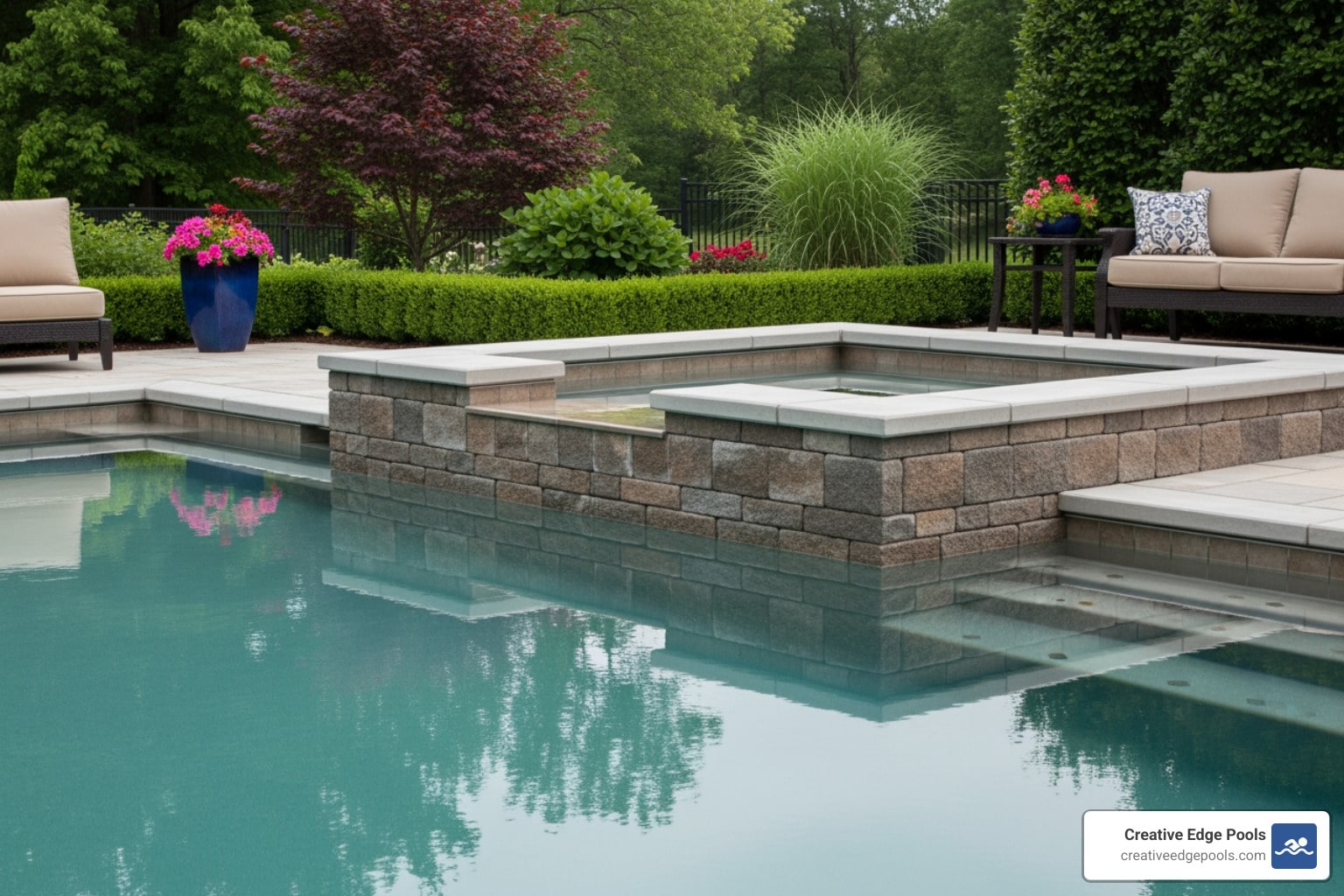
Why Concrete Pool Retaining Walls Matter for Your Backyard Project
A concrete pool retaining wall is a structural element built to hold back soil on sloped properties, creating a level area for your pool installation while managing water drainage and preventing erosion. These walls are essential when your yard has significant grade changes, typically over 2 feet of elevation difference.
Quick Overview: What You Need to Know
- Purpose: Holds back soil, prevents water runoff onto pool deck, maintains structural integrity
- When Needed: Sloped yards with 2+ feet elevation change; flat yards rarely require them
- Materials: Masonry (poured concrete, concrete block) or segmental (pre-cast blocks)
- Cost Range: $7,000-$20,000+ depending on height, materials, and design features
- Engineering: Walls over 2 feet typically require professional engineering
- Design Options: Can integrate water features, seating areas, and decorative finishes
Few yards are perfectly flat. If you’re planning a pool installation on sloped property in Eastern Massachusetts or Southern New Hampshire, you’ve likely heard about retaining walls from your pool designer. But what exactly are they, and why do they matter?
Retaining walls solve a critical problem: they let you build a beautiful pool on property that slopes, while keeping water from running onto your pool deck and compromising your investment. They hold back soil on the high side of your yard and create a stable, level foundation for your pool area.
Beyond their structural role, these walls offer design opportunities. You can incorporate cascading water features, create built-in seating, or add stone veneers that complement your home’s architecture. The key is understanding when you need one, what materials work best, and how to design a wall that improves both function and beauty.
Purpose, Necessity, and Materials for Pool Retaining Walls
When we talk about a concrete pool retaining wall, we’re discussing a fundamental component for many backyard pool projects, especially in areas like Eastern MA and Southern NH where diverse topography is common. Its primary purpose is quite straightforward: to hold back earth. However, the implications of this simple task are vast, encompassing critical aspects of structural integrity, safety, and aesthetic appeal.
The necessity for a retaining wall often arises from the natural topography of a yard. Few yards are perfectly flat, and even a slight slope can pose challenges for pool installation. We often encounter situations where properties have been built up with fill dirt to meet flood levels, creating artificial slopes that then require retention. Without a properly designed retaining wall, a sloped yard can lead to significant problems:
- Runoff Management: A retaining wall acts as a barrier, diverting rainwater and other runoff water flow away from your pool and home. This is crucial for preventing debris from entering your pool and protecting your home’s foundation from water damage.
- Soil Retention and Erosion Control: On the higher side of a slope, a retaining wall prevents soil from eroding and sliding into your pool area or undermining your pool’s foundation. On the lower side, it can create a level pad for the pool structure itself. This maintains the structural integrity of the entire pool, patio, and surrounding yard space.
- Creating Usable Space: Perhaps one of the most exciting aspects is how a retaining wall transforms unusable sloped land into valuable, level space for your pool, patio, and landscaping. It allows us to build an inground pool on properties that might otherwise be deemed unsuitable.
When considering materials for your concrete pool retaining wall, you generally have two main categories: masonry walls and segmental retaining walls. Both use concrete as their base, offering durability and strength, but differ significantly in their construction and aesthetic potential.
| Feature | Masonry Retaining Wall (Concrete) | Segmental Retaining Wall (Concrete Blocks) |
|---|---|---|
| Construction | Poured concrete or concrete blocks, often faced with other materials | Pre-cast concrete blocks, dry-stacked without mortar |
| Reinforcement | Steel rebar, often tied into a concrete footer | Interlocking blocks, sometimes with geogrid for taller walls |
| Durability | Extremely durable, long-lasting, highly resistant to weather | Very durable, good for freeze-thaw cycles |
| Aesthetics | Highly customizable with stone veneers, stucco, paint | Varied block styles, colors, and textures; more modular look |
| Cost | Can be higher due to labor-intensive construction and finishes | Generally more budget-friendly, especially for DIY (though not for pool walls) |
| Height Limit | Virtually unlimited with proper engineering | Typically limited, taller walls require significant engineering/geogrid |
| Water Features | Easily integrated into custom poured concrete | Can be integrated, but may require custom block fabrication or overlays |
For more inspiration on how different design elements, including retaining walls, can solve common backyard challenges, we always recommend exploring online Discussions on pool design dilemmas. These forums often showcase real-world solutions and creative approaches to complex landscapes.
Benefits of a Masonry Concrete Pool Retaining Wall
At Creative Edge Pools, we specialize in building custom gunite pools, and the principles of concrete construction are at the heart of what we do. A masonry concrete pool retaining wall often involves poured concrete or concrete blocks, heavily reinforced with steel rebar. This construction method offers unparalleled strength and durability, making it ideal for the demanding environment of a pool area in New England, where structures must withstand punishing winters.
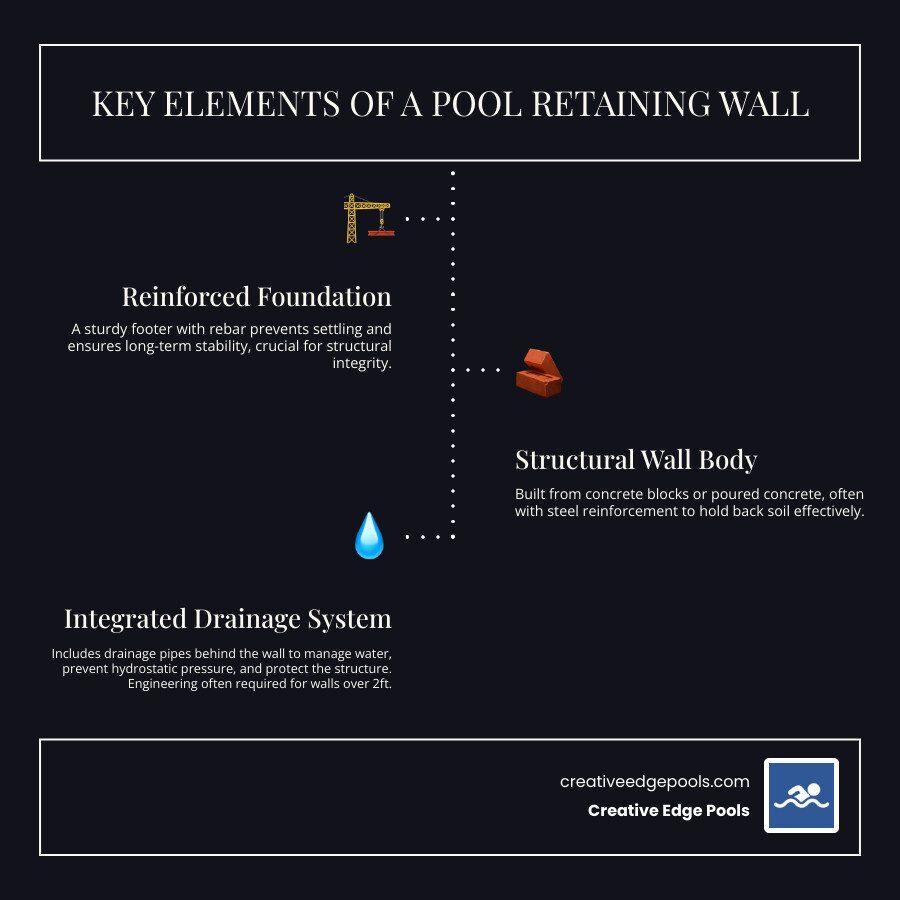
Our masonry walls are typically built with 10-inch steel-reinforced concrete, ensuring they are robust enough to handle the immense pressure of retained soil and water. The process usually begins with a concrete footer poured with rebar, followed by stacking blocks (if using block construction) or pouring concrete into forms. Each layer is filled with mortar and rebar, tying the entire structure together from the footer up.
The true beauty of a masonry concrete wall lies in its versatility. Once the structural concrete is in place, it can be faced with a wide array of materials, from natural stone veneers to stucco, brick, or even custom tiles. This allows for seamless integration with your home’s architecture and your desired backyard aesthetic. We can create custom finishes that lift your pool area from merely functional to truly breathtaking. The strength of concrete also allows for complex curves and custom shapes, perfectly complementing the freeform designs often chosen for gunite pools.
Segmental Retaining Walls for Pool Areas
Segmental retaining walls (SRWs) offer another popular option for concrete pool retaining wall construction. These walls are composed of pre-cast concrete blocks that interlock, often without the need for mortar. They are dry-stacked, relying on their weight and interconnections for stability.
One of the primary advantages of segmental blocks is their cost-effectiveness and relatively simpler installation process compared to poured concrete. This can make them a more budget-friendly option for certain applications. The modular nature of SRWs also provides a wide variety of aesthetic options, with blocks available in different colors, textures, and shapes that can mimic natural stone or blend into various landscape designs.
While segmental blocks can be used for pool retaining walls, especially for lower-height applications or as decorative elements around the pool, it’s crucial to understand their limitations in a pool environment. For walls directly supporting the pool structure or retaining significant soil pressure, particularly those over a couple of feet high, professional engineering and robust internal reinforcement (such as geogrid) are absolutely essential. While some segmental walls are marketed as DIY-friendly, for a pool-adjacent application, we strongly advise professional installation to ensure the structural integrity and longevity of your investment.
Design, Engineering, and Custom Features
Designing a concrete pool retaining wall is far more than just stacking blocks or pouring concrete; it’s an intricate process that blends structural engineering with aesthetic vision. The goal is to create a wall that is not only robust enough to do its job but also improves the overall beauty and functionality of your pool area.
The height of a retaining wall is a critical design consideration, directly impacting its structural requirements and, consequently, its cost. For instance, a slight slope of 2 feet or less might only require regrading the soil, which could cost between $1,000–$4,000. However, once a wall exceeds 2 feet in height, the complexity increases significantly. This is where the expertise of a Professional Engineer (PE) becomes indispensable. In Eastern MA and Southern NH, local codes typically mandate that walls over a certain height (often 2 feet, but always check local regulations) must be designed and certified by an engineer.
An engineer will carefully calculate the forces acting on the wall, including the equivalent fluid pressure (EFP) of the soil, which can be around 30 to 35 pounds per cubic foot (pcf) for typical earth, but much higher if the soil becomes saturated. Saturated soil, especially in our region’s climate, can exert significant additional pressure, and an engineer will account for this, as well as the potential for hydrostatic pressure and even ice pressure if the wall is exposed to freezing temperatures. Proper drainage pipes behind the wall are also crucial to prevent water buildup and reduce pressure.
Beyond the structural necessities, the design phase is where your vision truly comes to life. We work closely with you to integrate the retaining wall seamlessly into your backyard oasis. For inspiration on how transformative these structures can be, looking at Before & After design inspiration can spark incredible ideas for your own property.
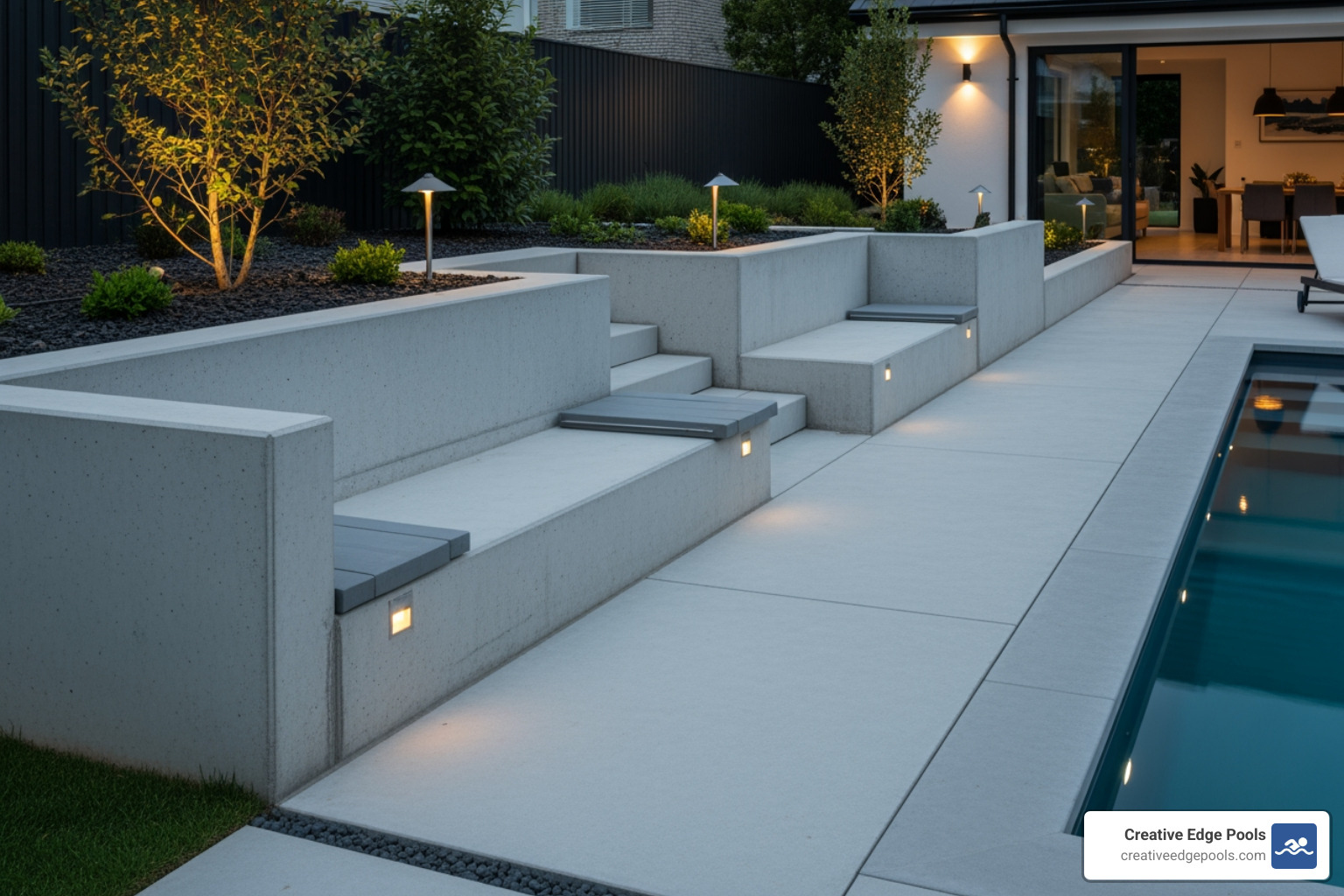
A well-designed retaining wall can double as an architectural feature. Imagine a wall that incorporates built-in seating (typically 12-24 inches tall), creating cozy gathering spots around your pool. Or perhaps an liftd patio, providing a stunning vantage point over your pool and backyard. These elements not only add aesthetic appeal but also maximize the utility of your outdoor living space.
Integrating Water Features into Your Concrete Pool Retaining Wall
One of the most captivating ways to improve your concrete pool retaining wall is by integrating water features. Cascades and sheer descents can transform a simple wall into a dynamic focal point, adding soothing sounds and visual interest to your pool area.
Imagine a subtle slot in the top of your retaining wall, from which a continuous sheet of water gracefully falls into your pool. This can create a serene, resort-like ambiance. We can also incorporate natural waterfalls that mimic rock formations, or even deck jets that shoot arching streams of water. The possibilities are vast, and with strategic lighting, these water features can create a magical atmosphere long after the sun sets.
When designing water features, we consider not only the visual appeal but also the sound they produce and how they contribute to the overall functional aesthetics of your pool. A sitting wall, for example, could have small bubblers or spouts integrated, offering both a place to relax and a playful water element. With our expertise in custom gunite pools, we have the flexibility to integrate these features directly into the concrete structure, ensuring durability and a seamless look.
Structural Considerations for Integrated Pool Walls
A particularly complex, yet innovative, application for a concrete pool retaining wall involves using its back as a form for a shotcrete pool wall. This is a highly technical approach that requires meticulous engineering and precise execution.
In such a scenario, the question of load transfer becomes paramount. If the retaining wall is acting as a form, how much of the pool’s water pressure and surrounding soil load does it bear, versus the pool wall itself? Our expert engineers would typically design the 12-inch gunite pool wall as the primary structural element, ensuring it’s adequately reinforced with flexural and crack control reinforcement to prevent leakage. Gunite, being a dry-mix concrete applied pneumatically, allows for superior density and control of the water-cement ratio, making it an excellent choice for a strong, water-retaining structure.
However, the interaction between the two structures must be carefully managed. Some engineers might even recommend a crushable material between the retaining wall and the pool wall to accommodate any potential wall deflection over time, preventing undue stress. The potential for shotcrete to crack, though minimized with proper application and reinforcement, is always a consideration. This is why having an experienced pool builder like Creative Edge Pools, with a deep understanding of gunite and structural engineering, is absolutely critical for such integrated designs. We ensure that every component, from the initial footer to the final finishes, meets the highest standards of safety and durability.
Understanding the Costs of a Concrete Pool Retaining Wall
Understanding the cost of a concrete pool retaining wall is a major factor for any homeowner in Eastern MA and Southern NH considering a new pool. It’s not just a single price tag; it’s a combination of several elements, and these costs can vary significantly based on your specific project.
On average, pool owners in our service areas might spend anywhere from $7,000 to $20,000+ on a retaining wall. This broad range highlights the impact of various factors:
- Square Footage: Naturally, the larger and longer the wall, the more materials and labor will be required, increasing the overall cost.
- Excavation: If significant earthmoving is needed to prepare the site for the wall, this will add to the expenses.
- Labor: Skilled labor is essential for proper construction, especially for masonry concrete walls and any complex designs or integrated features.
- Engineering Fees: As we’ve discussed, walls over 2 feet high almost always require professional engineering, which incurs additional costs for design and permitting.
- Material Impact: This is one of the biggest differentiators.
- Poured Concrete/Block Walls: While the structural concrete itself has a base cost, the chosen facing material can drastically change the final price. Natural stone veneers, custom brick, or high-end stucco will be more expensive than a simpler finish.
- Segmental Retaining Walls: The cost here depends on the specific type of pre-cast block, its size, shape, and aesthetic qualities. While generally more budget-friendly than custom masonry, premium blocks can still add up.
To give you a perspective, adjusting the patio and fill dirt on a very slight slope (2 feet or less) might only cost $1,000–$4,000, as it may not require a full retaining wall. However, for more substantial slopes that truly demand a concrete pool retaining wall, the investment is justified by the long-term structural integrity, improved functionality, and increased property value it provides.
When we provide a quote for your pool project, we break down these costs transparently, ensuring you understand exactly what goes into your custom concrete pool retaining wall. Our focus is always on delivering exceptional value and a durable, beautiful result that stands the test of time.
Frequently Asked Questions about Pool Retaining Walls
We often get a lot of questions about concrete pool retaining walls from homeowners starting on their pool journey. Here are some of the most common inquiries we address:
When is a retaining wall necessary for a swimming pool installation?
A retaining wall is necessary for a swimming pool installation primarily when your yard has a significant slope. While a perfectly flat yard might not need one, most properties, especially those that have been built up with fill dirt to meet specific flood levels, will have some degree of slope. If this slope is more than a minor grade (typically considered 2 feet or less), a retaining wall becomes crucial.
Its necessity stems from several factors:
- Structural Support: It holds back the soil, preventing it from collapsing into the pool excavation or undermining the pool’s foundation. This ensures the long-term stability and safety of your pool structure.
- Runoff Prevention: A properly designed wall prevents rainwater runoff from flowing directly into your pool or onto your pool deck, which can cause erosion, introduce debris, and potentially damage your deck or home’s foundation.
- Creating Level Space: Retaining walls allow us to create a perfectly level and stable area for your pool and surrounding patio, even on challenging terrain. This transforms an otherwise unusable sloped space into a functional and beautiful outdoor living area.
Can a retaining wall be used as a shotcrete form for a pool?
Yes, a masonry retaining wall can technically be used as a shotcrete form for a pool, but this is a highly specialized and structurally complex application that demands expert engineering. We’ve seen discussions among professionals on this very topic, highlighting the critical nuances involved.
The main concern revolves around load transfer and ensuring the structural integrity of both the retaining wall and the pool wall. In theory, a properly reinforced 12-inch gunite (dry-mix shotcrete) pool wall should be the primary structural element retaining the water. However, if the retaining wall is used as a form, there’s an interaction where some load might be transferred.
Key considerations include:
- Structural Element: The pool wall itself must be designed as a robust structural element, with adequate flexural and crack control reinforcement to prevent leakage and handle water pressure.
- Load Transfer: Engineers must carefully calculate how much load, if any, the retaining wall will bear from the pool. Some suggest that a 12-inch pool wall, if built correctly, should handle the water load independently.
- Wall Deflection: There’s a potential for subtle deflection over time. Some experts even recommend crushable material between the retaining wall and the pool wall to accommodate this, preventing undue stress.
Given the complexities and the critical importance of preventing leaks and structural failure, this approach absolutely requires a Professional Engineer’s design and oversight. At Creative Edge Pools, our expertise in gunite construction allows us to understand and execute such intricate designs, always prioritizing safety and longevity.
How do retaining walls help manage water runoff around a pool?
Retaining walls are excellent allies in managing water runoff, which is a significant concern around any pool area in Eastern MA and Southern NH. Here’s how they perform this vital function:
- Diverting Flow: By creating a physical barrier, a retaining wall effectively diverts surface water runoff away from your pool and its surrounding deck. Instead of water rushing down a slope and into your pool, the wall directs it along its length to designated drainage points.
- Protecting Pool Deck: This diversion protects your pool deck from erosion and the accumulation of debris, dirt, and mud that can be carried by runoff. It also prevents potential damage to your decking materials from excessive moisture.
- Integrated Drainage Systems: A well-designed concrete pool retaining wall often incorporates internal drainage systems, such as gravel backfill and perforated pipes (French drains) behind the wall. These systems collect groundwater and hydrostatic pressure, channeling it away from the wall’s face and the pool area, preventing water buildup that could compromise the wall’s stability or seep into the pool structure.
- Hydrostatic Pressure Relief: Without proper drainage, water can build up behind a retaining wall, creating immense hydrostatic pressure that can crack or bow the wall. The integrated drainage systems actively relieve this pressure, maintaining the wall’s structural integrity.
By effectively managing water, retaining walls contribute significantly to the cleanliness of your pool, the longevity of your pool deck, and the overall health of your backyard landscape.
Conclusion
Choosing to install a pool is a journey, and for many homeowners in Eastern Massachusetts and Southern New Hampshire, that journey includes navigating the nuances of a concrete pool retaining wall. As we’ve explored, these walls are far more than just functional barriers; they are integral to the structural integrity, drainage management, and aesthetic appeal of your entire pool area. From holding back the earth on a sloped yard to creating liftd patios or integrating captivating water features, a well-designed retaining wall is a cornerstone of a successful pool project.
At Creative Edge Pools, we understand that your backyard is an extension of your home and your vision. With over 100 years of combined experience, our family-owned business specializes in designing, installing, and renovating custom gunite pools and spas. We pride ourselves on bringing homeowner visions to life, ensuring that every detail, including your concrete pool retaining wall, is crafted with precision, durability, and beauty in mind.
We know that building a pool is a significant investment, and we’re here to guide you through every step, from initial design considerations to the final splash. If you’re ready to transform your backyard into the oasis you’ve always dreamed of, complete with expertly designed hardscaping that complements your custom pool, we invite you to explore the possibilities.