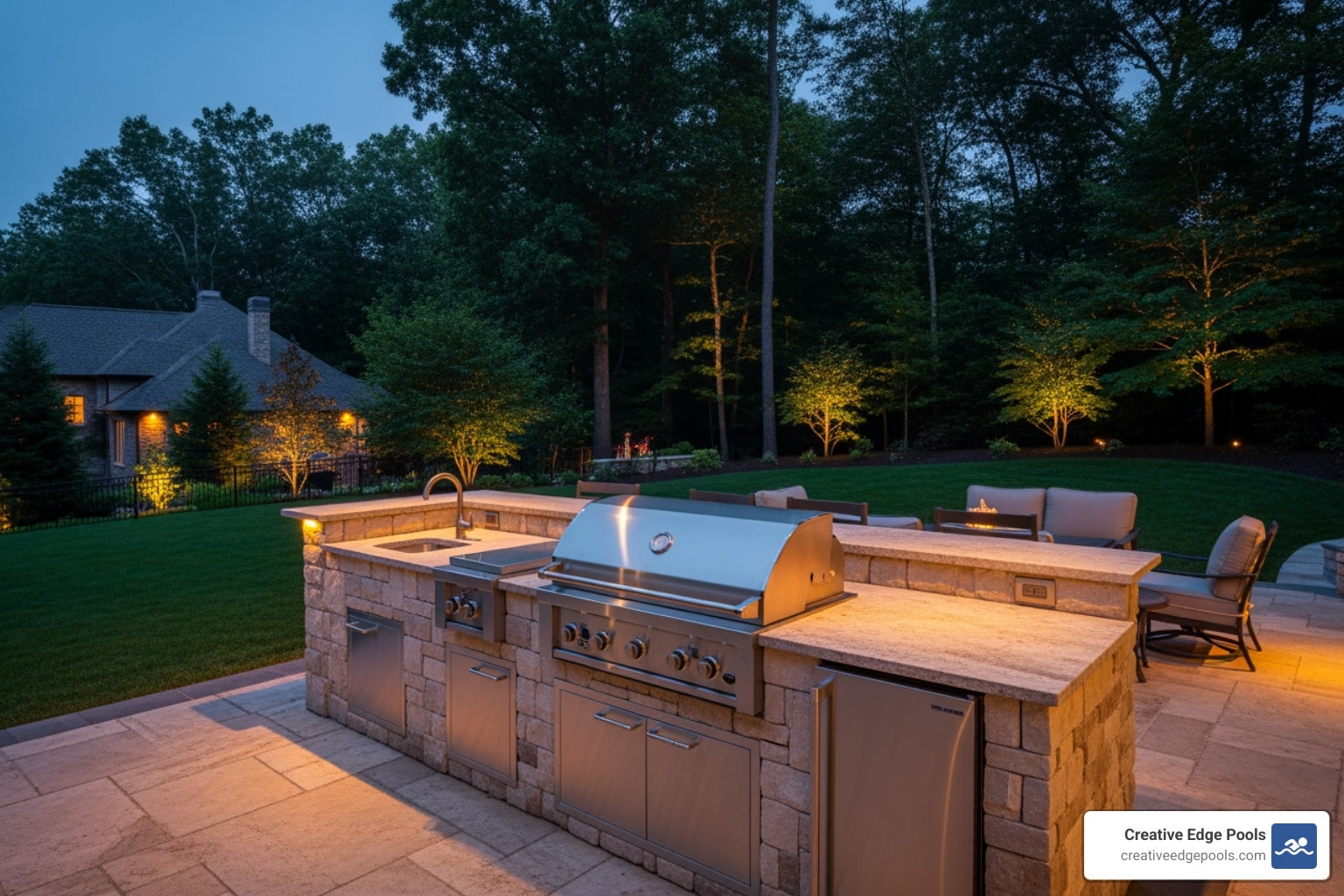
Transform Your Backyard with a Custom Outdoor Kitchen
Outdoor kitchen installation turns your backyard into an entertainment hub where cooking, dining, and gathering happen under the open sky. Instead of running back and forth to your indoor kitchen during summer parties, you’ll have everything you need right where your guests are.
Here’s what you need to know about installing an outdoor kitchen:
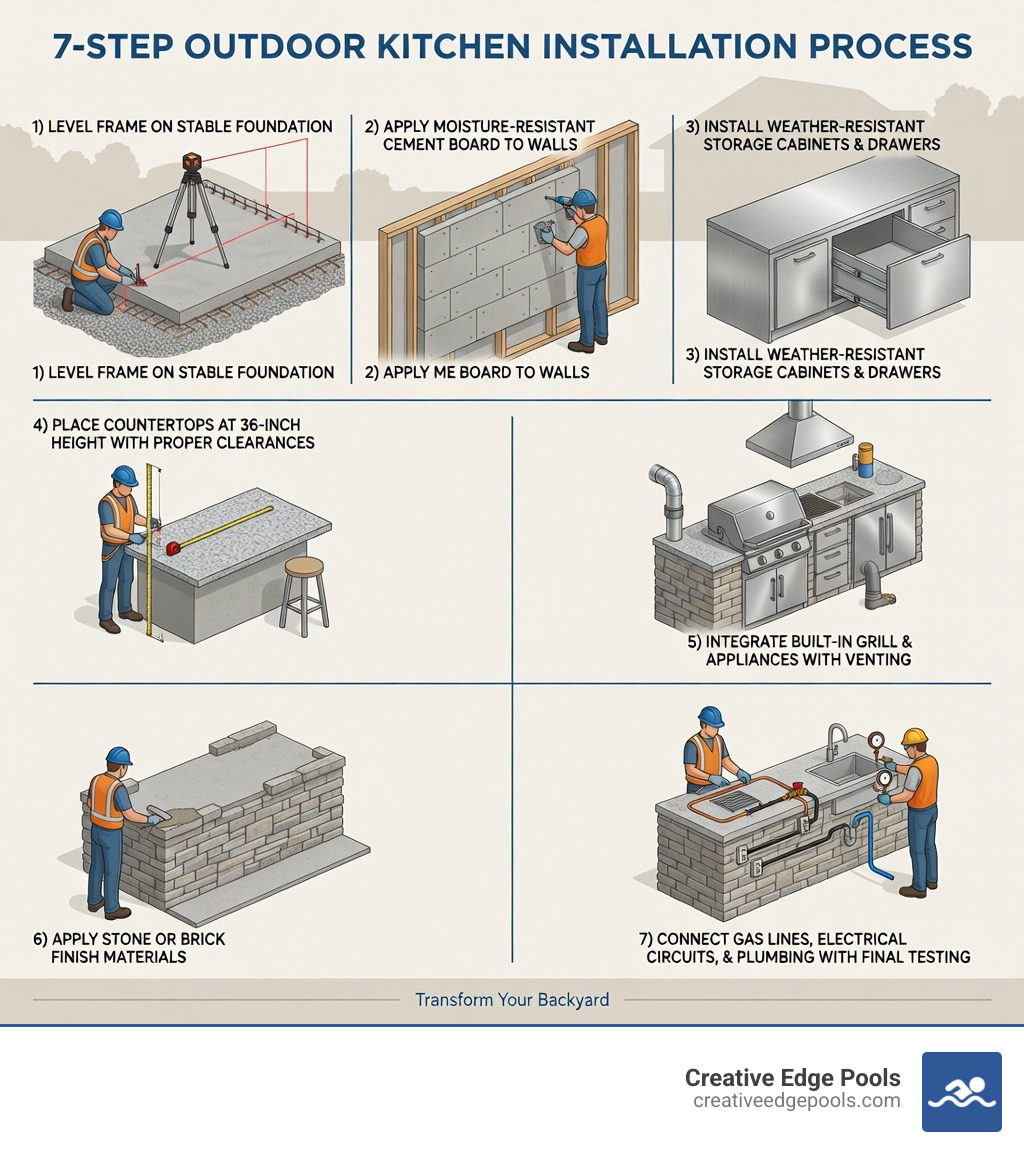
The 7 Essential Steps:
- Level the frame – Start with a stable, properly graded foundation
- Apply cement board – Create moisture-resistant walls for your structure
- Install storage components – Add cabinets, doors, and drawers
- Place countertops – Set durable surfaces at the correct height
- Integrate appliances – Install your grill and other cooking equipment
- Apply finish materials – Add stone, brick, or other exterior finishes
- Complete connections – Hook up gas, electrical, and plumbing utilities
The research shows that a professionally built outdoor kitchen costing $20,000 can be completed for $12,000-$16,000 if you do it yourself, saving 20-40% in labor fees. However, the process requires careful planning around permits (typically $250-$2,000), utility connections, and local building codes.
Who can resist the aroma of food cooking on the grill as it wafts through the neighborhood? An outdoor kitchen doesn’t just add convenience – it transforms how you use your backyard space and can significantly boost your home’s value.
For homeowners in Eastern Massachusetts and Southern New Hampshire, the challenge goes beyond just installation. You need materials that withstand freeze-thaw cycles, proper winterization for plumbing lines, and compliance with regional building codes. The key is balancing durability with design while ensuring every component works together as a cohesive outdoor living space.
Planning Your Outdoor Kitchen Installation
Before you pick up a single tool, you need a roadmap. Some considerations will help you get outdoor kitchen ideas that actually fit your lifestyle. Planning is the most critical phase, especially when integrating the kitchen with existing hardscaping-masonry features like a pool deck or patio.
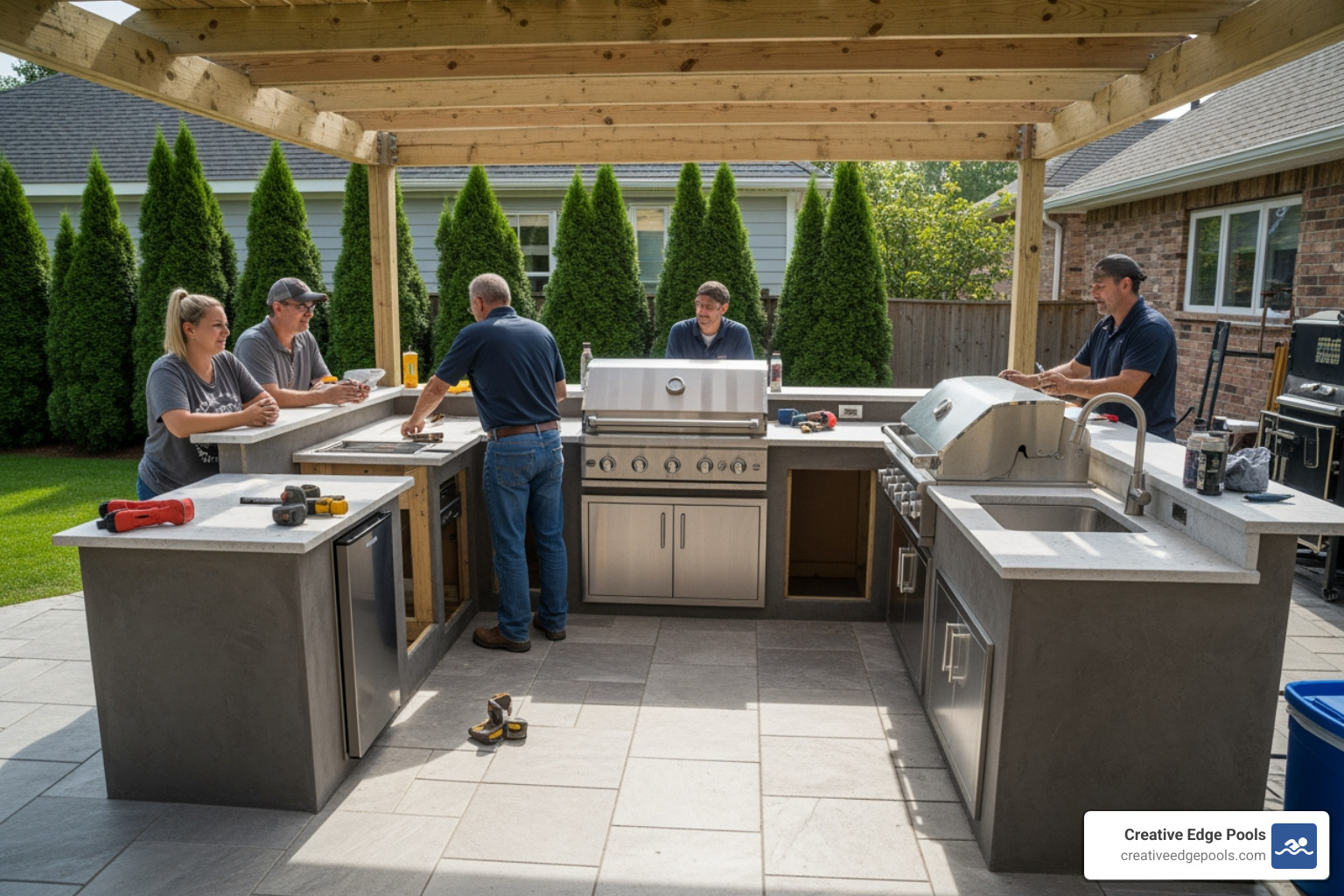
A thorough space assessment involves looking at your entire backyard. Where does the sun set? Which way does the wind blow? You don’t want your grill smoke blowing directly into your guests’ faces or back into your house. We also need to consider site grading. If your patio isn’t perfectly level, we have to account for that in the frame adjustments.
Budget planning is where many homeowners get surprised. According to Angi permit cost data, permits alone can add $250 to $2,000 to your project. Specifically, a deck or patio permit in areas like Lexington or Andover might cost between $220 and $500, while plumbing permits range from $50 to $500.
Designing an Efficient Outdoor Kitchen Installation Layout
Efficiency in an outdoor kitchen follows the same “Golden Triangle” rule used indoors. Any kitchen, whether outside or inside, needs a triangular arrangement. You want to create a flow between your refrigerator (cold zone), your grill (hot zone), and your sink (wet zone).
For the best workflow, maintain a distance of 4 to 9 feet between these three points. If they are too close, you’ll feel cramped; too far, and you’ll spend the whole party walking instead of cooking. We also recommend providing at least 24 inches of uninterrupted counter space on either side of the grill and sink for safe food handling.
Common layouts include:
- Linear Island: Perfect for smaller spaces or alongside a house.
- U-Shaped Design: Great for creating a “chef’s zone” that keeps guests on the outside.
- Double Galley: Two parallel islands with approximately 3 feet of space between them—ideal for multiple cooks.
Essential Utilities and Safety Compliance
Planning your utilities is like laying the nervous system for your kitchen. You’ll need gas (natural or propane), electricity for lights and refrigeration, and plumbing if you want a sink.
Gas lines require specific pressures to operate safely. For natural gas, the pressure must be 7 inches of water column, while bulk propane requires 11 inches. Most high-end grills use a 1/2-inch NPT connection, but if you’re installing a pizza oven or side burner, those often use a 3/8-inch NPT connection.
Electrical work is another area where safety is paramount. You must use GFCI-protected, weather-resistant outlets. We often suggest using GFI breakers in the main home panel rather than individual outdoor outlets, as they are easier to reset if they trip during a New England rainstorm. All wiring should be housed in weather-resistant conduits and typically requires a dedicated 20-amp circuit.
When it comes to water, plumbing with the right insulation is non-negotiable in Massachusetts and New Hampshire. We always include winterization shut-off valves inside the home so you can drain the lines before the first hard freeze. For more on how we integrate these utilities into larger projects, check out our hardscape-services.
Safety Standards for Outdoor Kitchen Installation
Safety isn’t just a suggestion; it’s a matter of code. The International Residential Code (IRC) dictates that gas pipe stubs must extend high enough to expose at least 2 inches of unthreaded pipe for wrench access.
Fire codes are even stricter. You generally need a 10-foot clearance between an open-flame cooking device and any combustible construction, such as vinyl siding or wood decks. If you are building a propane tank into a cabinet, never store the tank directly under the grill. You must include a non-combustible barrier (like a plenum wall) and ensure proper ventilation. Enclosures typically require two vents of at least 20 square inches each—one placed high and one low—to prevent gas buildup.
Step-by-Step Guide to Building Your Kitchen
Once the planning and utility rough-ins are done, it’s time to build. A Comprehensive Guide to Building an Outdoor Kitchen often emphasizes the choice of framing. While some prefer wood, we find that galvanized steel or masonry blocks offer the best longevity in our climate.
If you’re looking for hardscaping-near-me, you’ll find that the frame material dictates the rest of the build.
| Framing Material | Pros | Cons |
|---|---|---|
| Galvanized Steel | Fireproof, won’t rot, lightweight | Requires specific tools (impact driver) |
| Concrete Block | Extremely durable, classic look | Heavy, requires masonry skills |
| Wood (Pressure Treated) | Easy to work with, affordable | Risk of rot/fire, requires “insulator jackets” |
Step 1: Leveling the Frame
Start by positioning your frame at the highest point of your patio or deck. The maximum leveling adjustment for most outdoor kitchen cabinets is 1.5 inches. If your slope is steeper than that for drainage, you may need to pour a level concrete pad. We recommend starting the frame about 1/2-inch off the ground to allow for water drainage and the thickness of your finish materials.
Step 2: Applying Cement Board
Once the frame is level and the nuts are tightened, apply 1/2-inch cement board (like Durock) to the sides. Use 1-inch self-drilling lath screws spaced about 10 inches apart. Before you screw the boards down, trace the openings for your grill, doors, and drawers. It’s much easier to cut these out with an angle grinder while the board is on the ground!
Step 3: Installing Under-Counter Storage
Now, slide in your stainless steel doors and drawers. Use composite shims to ensure everything is perfectly plumb. If the drawers aren’t level, they won’t slide correctly, especially as the temperature changes. Secure them to the frame on all sides.
Step 4: Countertop Placement
Standard outdoor counters sit at 36 inches tall. Before applying any adhesive, “dry fit” the countertops to ensure the overhang is consistent—usually 1 to 1.5 inches. Remember to allow a 1/8-inch clearance between the bottom of the grill flange and the top of the finished counter. Once satisfied, apply a bead of outdoor-rated silicone and set the tops.
Step 5: Appliance Integration
This is the exciting part! Slide your built-in grill into place. The face of the grill should sit about 1 inch forward of the cabinet doors to allow for proper heat venting and door clearance. Double-check your manufacturer’s manual for specific venting requirements; some grills require specific air gaps to function safely.
Step 6: Applying Finish Materials
Whether you’re using brick or stone veneer, the process starts with a “scratch coat” of mortar. After that cures, “back-butter” each stone with a 1-inch layer of mortar and press it firmly into place. Start at the corners and work your way in. Make sure the mortar is a “peanut butter” consistency—too thin and the stones will slide; too thick and they won’t bond.
Step 7: Final Connections and Testing
With the stones set and the protective laser film removed from the appliances, have your licensed plumber and electrician make the final hookups. Always perform a leak test on gas lines using soapy water before firing up the grill for the first time. Finally, install your toe kicks and apply a high-quality sealer to any natural stone.
Choosing Durable Materials for New England Climates
In Massachusetts and New Hampshire, our kitchens face everything from 95-degree humidity to sub-zero blizzards. Choosing the right materials is the difference between a kitchen that lasts 20 years and one that falls apart in five. For more on integrated design, see our page on hardscaping-and-landscaping.
- Countertops: We recommend mid-range colored granite. It’s UV-stable and won’t get as hot as dark stones in the summer sun. Avoid quartz outdoors, as the resins can yellow and crack under UV exposure.
- Cabinetry: Stainless steel is the gold standard for durability. However, marine-grade HDPE (High-Density Polyethylene) is a fantastic alternative that won’t rust, rot, or swell, and it comes in various colors.
- Wood Accents: If you love the look of wood, stick to rot-resistant species like Cedar or Teak. Even then, they require annual sealing to maintain their appearance.
Don’t forget the importance of winterizing your space. Beyond just shutting off the water, use high-quality protective covers for your grill and refrigeration units to keep road salt and heavy snow from damaging the finishes.
DIY vs. Professional Installation Costs
Is it worth doing it yourself? Angi DIY savings data suggests you can save 20% to 40% on labor, which translates to roughly $1,500 to $6,000 for a mid-range project.
However, DIY isn’t just about the money; it’s about the technical skill required. If you’re looking for hardscape-companies-near-me, you’re paying for more than just labor. Professionals bring:
- Code Compliance: We know the specific setback requirements for towns like Nashua, NH, or Concord, MA.
- Warranty Protection: Most manufacturers only honor warranties if appliances are installed by licensed professionals.
- Precision: Achieving a perfectly level 20-foot run of stone and granite is harder than it looks on YouTube.
If you choose to DIY, we strongly recommend still hiring a licensed professional for the gas and electrical portions. A mistake there isn’t just expensive—it’s dangerous.
Frequently Asked Questions about Outdoor Kitchens
Do I need a permit for an outdoor kitchen?
Yes, in almost all cases in MA and NH. You will likely need a building permit for the structure, an electrical permit for the wiring, and a plumbing/gas permit. Total permit costs generally range from $250 to $2,000 depending on your town’s fee schedule and the complexity of the project.
What is the best countertop material for outdoors?
Granite is the most popular choice because it is natural, heat-resistant, and UV-stable. Concrete is a stylish alternative but requires more frequent sealing to prevent staining. Stainless steel is incredibly hygienic and durable but can be noisy and prone to scratching.
How do I maintain my outdoor kitchen in winter?
The most important step is using your winterization valves to drain all water lines. You should also clean your stainless steel surfaces with a specialized polish before the snow flies to create a protective barrier. Use breathable covers for appliances to prevent moisture buildup, which can lead to mold or corrosion.
Conclusion
At Creative Edge Pools, we know that a great backyard is more than just a place to swim—it’s a place to live. Whether you are in Acton, MA, or Salem, NH, an outdoor kitchen is the ultimate way to complete your backyard development. Our family-owned team has over 100 years of combined experience bringing these visions to life.
If you’re ready to stop dreaming and start grilling, explore our hardscaping-services to see how we can help you design and install the perfect outdoor culinary oasis. Let’s build something beautiful together!