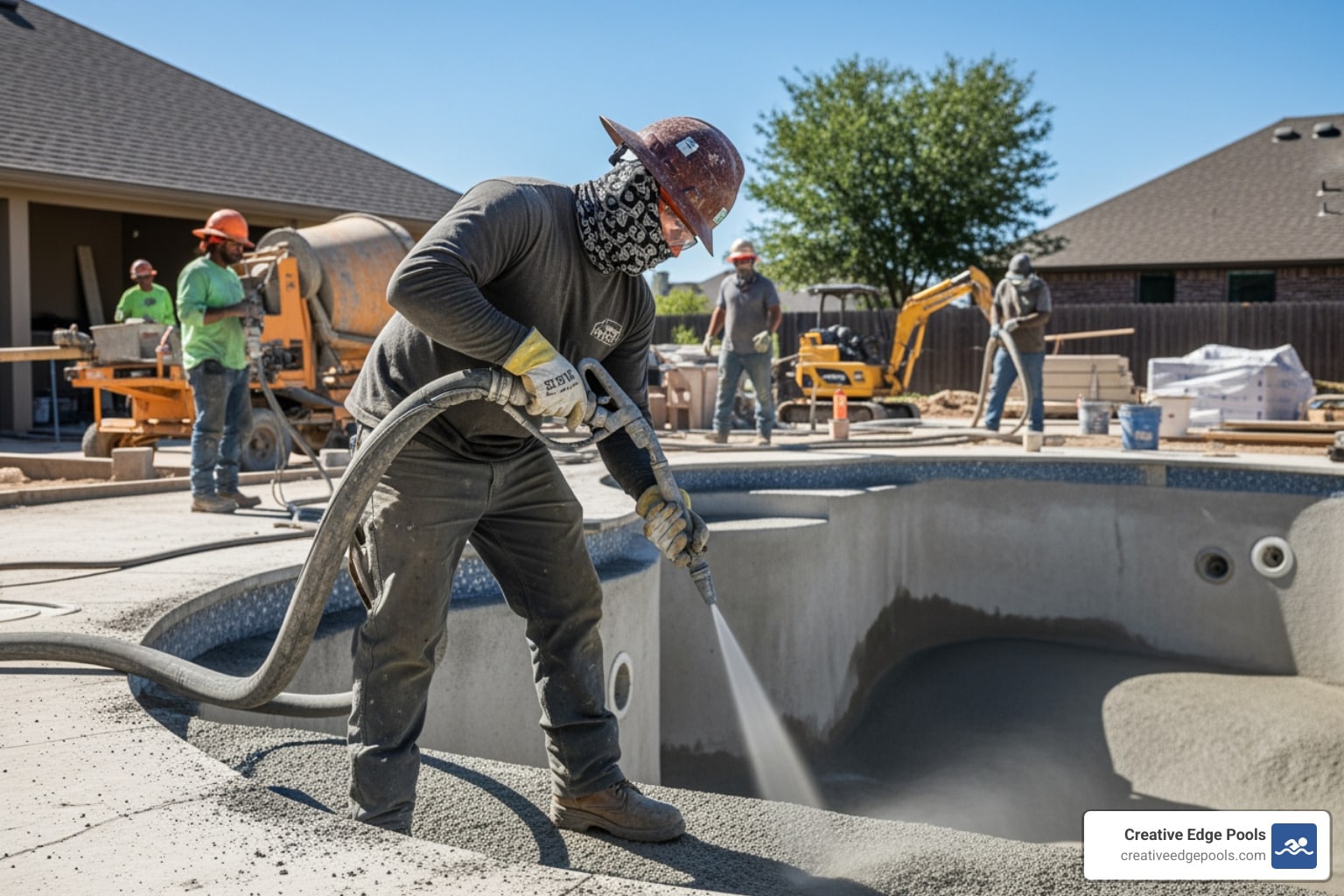
Why Local Gunite Contractors Matter for Your Dream Backyard
Finding local gunite contractors doesn’t have to mean settling for the biggest names in the phone book. In fact, the best outcomes often come from teams that work in your region every day and understand the details that are easy to miss on a sales call.
In Eastern Massachusetts and Southern New Hampshire, a backyard build has a few realities that directly affect gunite quality: changing soil conditions from town to town, strict local permitting, and weather patterns that punish shortcuts. A project that looks great in July still has to survive years of freeze-thaw cycles, groundwater shifts, and seasonal settling. That is why the contractor’s process matters as much as the materials.
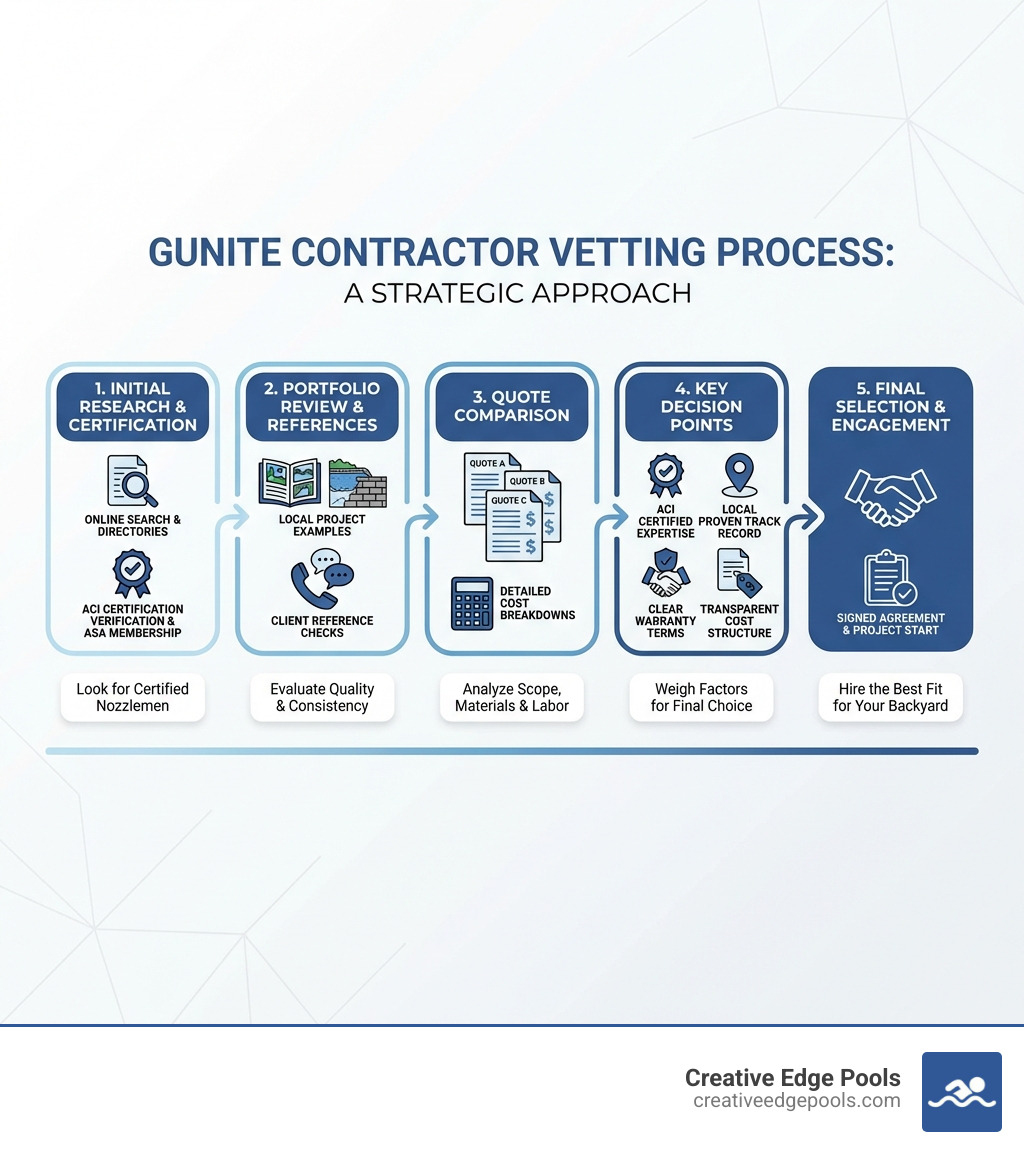
Quick Guide to Finding Local Gunite Contractors:
- Verify Certification – Look for ACI-certified nozzlemen and ASA membership
- Check Local Experience – Prioritize contractors with 5+ years in your specific region
- Review Their Portfolio – Ask to see completed gunite pools and structural projects
- Confirm Insurance – Ensure they carry liability coverage and workers’ comp
- Get Multiple Quotes – Compare at least 3 detailed written estimates
- Ask About Warranties – Quality contractors offer warranties on their gunite work
If you’re planning a custom pool, outdoor kitchen, retaining wall, or major backyard change in Eastern Massachusetts or Southern New Hampshire, understanding gunite is essential. Gunite is a dry-mix concrete applied using compressed air, creating incredibly strong and versatile structures that can last 25+ years when properly installed.
The difference between a pool that develops cracks after one winter and one that becomes a family legacy often comes down to one thing: the skill of your gunite contractor. According to research and guidance shared by the American Shotcrete Association, properly applied gunite by certified nozzlemen results in superior density and reduced cracking compared to other concrete methods.
But here’s the challenge: Not all concrete contractors are gunite specialists. The high-velocity application process requires specific training, certification, and specialized equipment. A general concrete company might pour a great driveway but lack the nozzle control, rebound management, and curing discipline needed for a complex gunite pool shell.
What “local” really means for gunite quality
A truly local specialist brings practical, jobsite-level advantages that directly impact durability and schedule:
- Better planning around weather windows: In New England, shooting and curing plans should account for temperature swings, wind, and sudden storms.
- Familiarity with local inspectors and permitting expectations: This helps reduce delays and last-minute design changes.
- Experience with regional soil and drainage: Groundwater, ledge, and expansive soils can change excavation, steel, and drainage decisions.
- Access and logistics know-how: Tight neighborhoods, mature landscaping, and limited staging areas are common in MA and NH. Local crews tend to anticipate the equipment and access needs earlier.
The decision that protects your budget
Gunite work is hard to “patch” later without visible compromises. If the shell is shot poorly, the fix is usually not cosmetic. It can mean structural repair, leak investigation, and expensive rework that delays plastering and finishes.
That is why your vetting checklist should focus on details like:
- Who is actually shooting the shell (and whether they are certified)
- How the crew controls water at the nozzle and manages rebound
- What curing instructions are provided, and who is responsible for following them
- Whether the estimate includes a clear scope (steel, plumbing coordination, steps/benches, thickness, cleanup, and timeline)
Your backyard project deserves contractors who understand the nuances of pneumatic concrete application, the importance of water-cement ratios, and how New England’s freeze-thaw cycles affect structural integrity. The good news? Plenty of highly qualified local specialists fly under the radar of the big marketing machines.
Tip for homeowners: When you request quotes, ask each contractor to explain their shooting-day crew (who does what), their curing plan, and what they do if weather interrupts the schedule. The clarity of their answers often tells you as much as the number on the proposal.
Understanding Gunite: Why Its the Gold Standard for Local Projects
When we talk about creating the backyard oasis of your dreams – think a custom-shaped pool, a robust retaining wall, or even intricate water features – gunite often emerges as the material of choice. But what exactly is gunite, and how does it differ from the concrete you might be picturing?
Gunite is essentially concrete, but it is applied using a unique “dry-mix” process. Unlike traditional concrete, where all the water is mixed in beforehand, gunite involves a dry blend of cement and sand that is pneumatically conveyed through a hose. Water is added at the nozzle just before the material is sprayed onto a surface. This high-velocity application allows the mixture to be “shot” into place, compacting it and creating an incredibly dense, strong, and durable structure. This method allows for a superior density and reduced cracking, especially in custom residential pools. Industry standards emphasize the importance of employing ACI Certified Shotcrete Nozzlemen to ensure quality application.
The dry-mix process of gunite contrasts with “shotcrete,” which uses a wet-mix process where water is added to the concrete mixture before it enters the hose. While both are sprayed concrete, gunite’s dry application allows for greater control over the water-cement ratio at the nozzle, which can lead to superior strength and crack resistance, particularly for intricate or custom designs. For us, this precision makes gunite the gold standard for projects where structural integrity and design versatility are paramount.
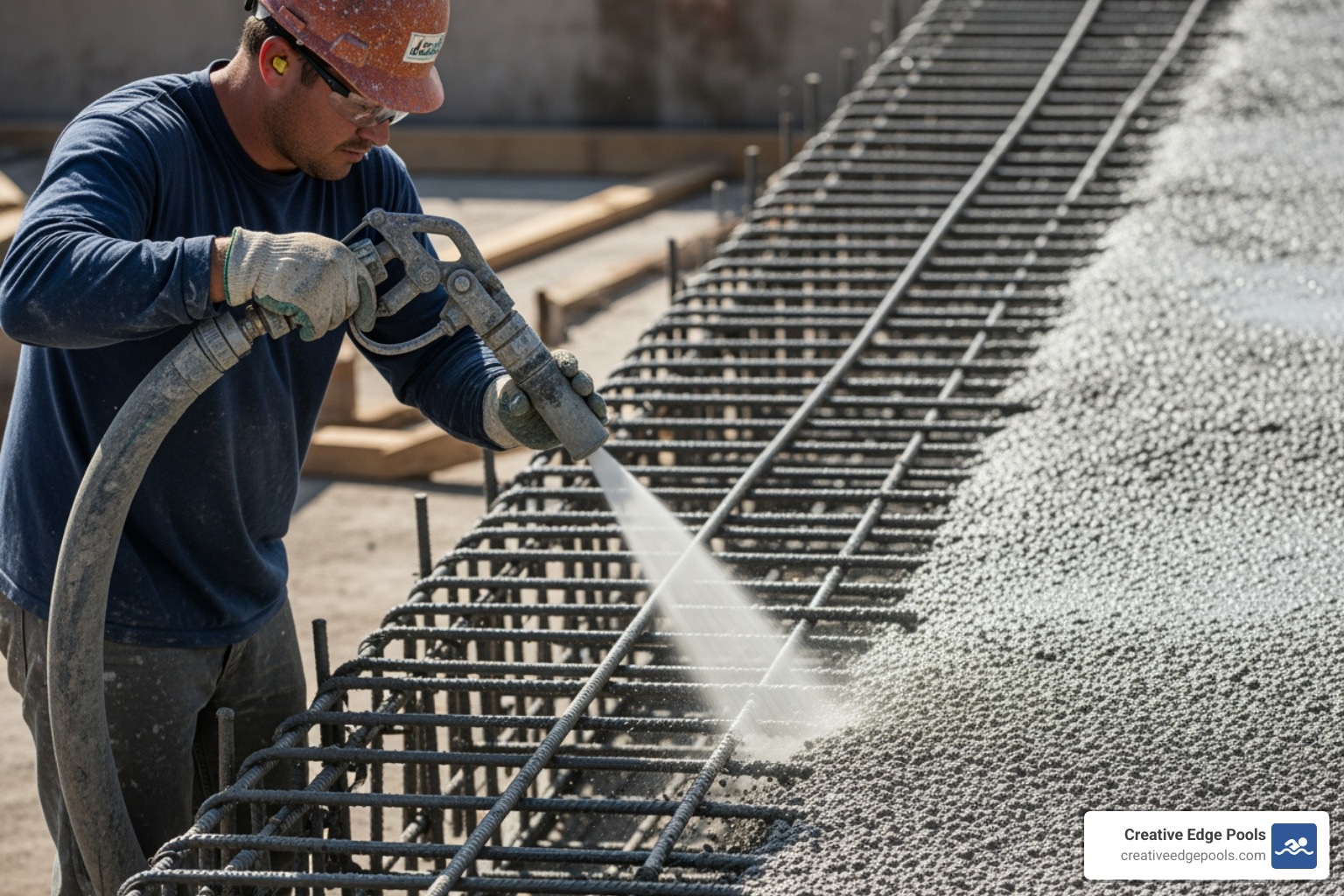
This unique application method is what gives gunite its incredible structural integrity and design versatility. Imagine a pool with tanning ledges, built-in seating, or custom curves that flow seamlessly with your landscape – gunite makes this possible without the extensive, restrictive formwork required by traditional concrete. The material adheres strongly to the steel rebar framework, creating a monolithic structure that is exceptionally robust. The American Shotcrete Association provides certifications that underscore the importance of proper application techniques for these benefits.
Primary Applications for Gunite Construction
Gunite is best known for residential pool shells, but local gunite contractors also use the same core skills to build and restore other structures where strength and shaping ability matter.
- Inground gunite pools and spas: Freeform designs, deep ends, benches, stairs, tanning ledges, and vanishing edges depend on a material that can be shaped without rigid forms.
- Custom water features: Waterfalls, grottos, streams, raised bond beams, and spillover spas often need complex curves and tight tolerances.
- Structural pool repairs and renovations: When a pool needs significant rebuilding (for example, steps, bond beam repairs, or structural modifications), gunite is commonly used as part of the restoration.
- Backyard improvements that require high strength: Certain retaining walls, equipment pads, and specialty concrete structures may also use shotcrete or gunite methods when site conditions call for it.
The Benefits of Choosing Gunite for Your Project
For homeowners comparing construction options, gunite stands out because its installation method creates a dense, reinforced structure that can handle real-world conditions.
- High-pressure placement and compaction: The spraying process packs material tightly around steel, which supports strength and durability.
- Excellent adhesion to rebar: Gunite is applied directly onto a rebar cage, helping form a single, continuous shell.
- Reduced cracking when properly applied and cured: No concrete is crack-proof, but proper mix control, application technique, reinforcement, and curing practices reduce the risk of problematic cracking.
- Minimal formwork for complex shapes: Less formwork can mean fewer limitations in design and smoother transitions in curves, benches, and details.
- Long-term value: Gunite pools are often chosen for longevity and customization. A well-designed backyard can also contribute to perceived home value, though the exact increase varies widely by market, property, and finish choices.
Here is a quick look at why gunite stands out:
| Feature | Durability | Cost | Versatility |
|---|---|---|---|
| Gunite | Exceptionally strong, dense, and resistant to cracking when properly applied. Forms a monolithic structure. | Can have a higher upfront cost due to specialized equipment and labor, but offers better long-term value due to superior durability and customization. | Unparalleled design freedom for custom shapes, depths, tanning ledges, and water features. Ideal for complex, intricate designs. |
| Traditional Concrete | Durable, but requires extensive formwork, which can limit design flexibility and may be prone to cracking if not properly installed and cured. | Generally lower upfront cost for simpler, rectilinear designs. | Limited to simpler shapes and designs due to the need for rigid forms. Less suitable for highly customized or freeform structures. |
| Shotcrete (Wet-Mix) | Strong and durable, often used in large-scale commercial projects where speed is a priority. | Generally comparable to gunite, though costs vary based on project scale and accessibility. | High versatility, though the wet-mix process offers slightly less control over the water-cement ratio at the point of application compared to gunite. |
In other words, gunite is not just a material choice – it is a craftsmanship choice. The method rewards skilled crews, good planning, and strict quality control, which is exactly why vetting local gunite contractors is such a critical part of building a backyard that lasts.