Gunite: Top 10 Stunning Benefits in 2023
The Foundation of Premium Pool Construction
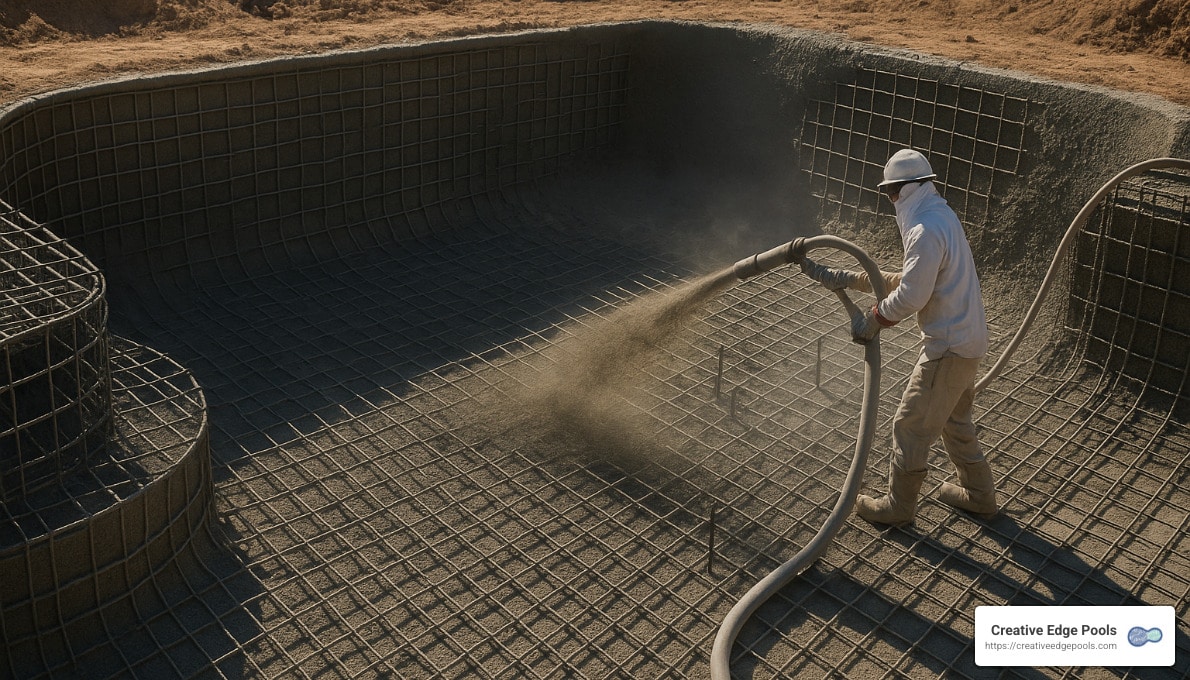
Gunite is a specialized form of concrete that’s pneumatically applied (sprayed) through a hose onto a steel reinforcement framework, creating a seamless, durable structure. It’s the premium material of choice for custom swimming pools due to its exceptional strength and design flexibility.
What is Gunite?
- A mixture of cement, sand, and water applied through a high-pressure hose
- Sprayed as a dry mix with water added at the nozzle during application
- Creates a stronger, more durable structure than traditional poured concrete
- Allows for custom shapes and contours not possible with other materials
- Typically achieves compressive strengths of 3,000-5,000 PSI
Gunite pools are known for their exceptional strength and durability, making them less likely to crack than traditional concrete pools. The application method allows the material to adhere tightly to steel reinforcing bars, creating a structurally superior shell that can be formed into virtually any shape imaginable.
The process was invented in 1907 by Carl Akeley (originally called “shotcrete”) and has evolved to become the gold standard in premium pool construction. While the terms “gunite” and “shotcrete” are often used interchangeably, technically gunite refers specifically to the dry-mix process, where water is added at the nozzle during application.
I’m David Brabant, owner of Creative Edge Pools with over thirty years of experience specializing in custom gunite pool design and installation throughout Massachusetts and New Hampshire. My hands-on approach ensures every gunite pool we build combines superior structural integrity with personalized design that transforms ordinary backyards into extraordinary outdoor living spaces.
What is Gunite?
Gunite is like the superhero of building materials, swooping in with its unique power—being pneumatically applied. Made from a dry mix of Portland cement and fine-grade sand, gunite mixes with water at the nozzle, right before it sprays onto the surface. This spectacular method is what gives gunite its impressive properties and makes it a top choice for premium pool construction.
Despite sharing similar ingredients with traditional concrete, gunite stands out. The dry mix, boosted by compressed air, gets its splash of water at the very last moment, just before it hits the target surface. This approach results in a dense, compact material that grips onto the steel reinforcing framework below with superhero strength.
When applied by skilled technicians, gunite forms a seamless, monolithic structure. It’s significantly stronger than traditional poured concrete, as the pneumatic application forces the mix into every nook and cranny around each piece of steel. This creates an exceptionally strong bond and eliminates weak points, leading to a structure that doesn’t just stand tall but stands the test of time.
At Creative Edge Pools, we’ve honed our gunite skills over decades, ensuring every pool we craft not only looks stunning but also has the strength to last for generations.
History of Gunite
The tale of gunite begins with a surprising figure: Carl Akeley, a taxidermist at the Field Columbian Museum in Chicago. In 1907, when faced with the daunting task of repairing the museum’s deteriorating façade, Akeley stepped beyond conventional methods and invented a groundbreaking technique for applying cement.
In his ingenious approach, Akeley developed a device that used compressed air to spray a dry mixture of cement and sand onto building surfaces, with water added at the nozzle. This innovative method allowed the material to adhere snugly to the structure, forging a durable repair. He patented this invention in 1911, christening it “gunite” after the gun-like device used for the application.
Initially, gunite found its niche in repairs and thin coatings, but its potential for more substantial structures soon captured the construction industry’s imagination. During World War I, gunite was employed to rapidly build military bunkers and fortifications. As the 1920s and 1930s unfolded, it was used for lining tunnels, canals, and reservoirs, highlighting its versatility.
The post-World War II building boom of the 1940s and 1950s marked a pivotal period for the swimming pool industry, which finded gunite‘s myriad benefits. Before this era, pools were typically made using poured concrete, a method that constrained design possibilities and demanded extensive formwork. Gunite transformed pool building by enabling custom shapes and seamless structures.
By the 1960s, gunite had firmly established itself as the standard for quality pool construction, a reputation it proudly holds today. Originally a trademarked term for the dry-mix pneumatic cement application process, “gunite” has since evolved into a generic industry term.
Gunite vs. Shotcrete
In pool construction, the terms gunite and shotcrete often float around like interchangeable pieces of jargon. But, surprise—they’re not the same thing! These two techniques have unique processes and features that set them apart.
Gunite refers to the dry-mix method where dry ingredients like cement and sand are mixed and transported through a hose using compressed air. The magic happens at the nozzle, where water is added just before the mixture hits the surface. This method allows the nozzle operator to have significant control over the water content, ensuring the perfect consistency for each unique application.
Shotcrete, on the other hand, is a bit of a control freak. It’s the wet-mix process where all ingredients, including water, are mixed before being sent through the hose. This ready-mix concrete is then forcefully applied to the surface using pneumatic pressure.
Here’s a quick comparison to make things clearer:
| Feature | Gunite (Dry-Mix) | Shotcrete (Wet-Mix) |
|---|---|---|
| Mixing Process | Dry ingredients first, water added at nozzle | Pre-mixed with water |
| Water Control | Controlled by nozzle operator | Fixed at mixing |
| Compressive Strength | 2,500-3,000 PSI | Up to 8,900 PSI |
| Application Flexibility | Stop and start easily | Continuous use needed |
| Equipment | Portable hoses | Heavier, needs mix trucks |
| Rebound (Waste) | Usually higher | Usually lower |
| Crew Dependency | Needs skilled operator | Less skill-dependent |
An experienced builder once said, “Shotcrete is an adjective, not a noun.” This highlights that shotcrete is a method, not a standalone substance.
At Creative Edge Pools, we don’t just wing it. We assess each project to decide whether the nimble gunite or the steadfast shotcrete best suits your dream pool design and the conditions of your site.
Applications of Gunite in Construction
While swimming pools are perhaps the most well-known application of gunite, this versatile construction material has found use in a wide range of applications across various industries. Its ability to be applied to virtually any shape and its exceptional strength make it ideal for structures that require both durability and design flexibility.
Some of the most common applications of gunite include:
- Swimming pool construction: The primary application in residential settings, where gunite allows for custom shapes, depths, and features like beach entries, vanishing edges, and integrated spas.
- Tunnels and mining: Gunite is extensively used to line tunnel walls in transportation and mining applications, providing structural support and preventing water infiltration. In fact, gunite can be pumped over one mile underground using specialized equipment.
- Structural repairs: The ability to spray gunite onto existing structures makes it ideal for repairing damaged concrete or reinforced concrete structures, restoring their original strength.
- Slope stabilization: Gunite can be applied to unstable slopes and embankments to prevent erosion and collapse, often in combination with soil anchors or rock bolts.
- Water tanks and reservoirs: The water-resistant properties of properly applied gunite make it excellent for lining water storage facilities.
- Architectural features: From decorative walls to artificial rock formations in zoos and theme parks, gunite‘s moldability makes it perfect for creating unique structural elements.
- Skate parks: The smooth, durable surface and ability to form complex curves make gunite ideal for skateboarding facilities.
What makes gunite so versatile is its ability to be applied to complex shapes and its excellent adhesion to properly prepared surfaces. This allows it to conform to virtually any design, whether it’s a freeform swimming pool with organic curves or a precisely engineered tunnel lining.
At Creative Edge Pools, we’ve mastered the art of gunite application for swimming pools, enabling us to bring even the most ambitious pool designs to life with structural integrity that will stand the test of time.
Advantages of Gunite
The advantages of gunite extend far beyond its design flexibility, making it the preferred material for premium pool construction. Understanding these benefits helps explain why gunite pools remain the gold standard despite the emergence of alternative pool construction methods.
Strength and Durability Characteristics
Gunite pools are renowned for their exceptional structural integrity. The pneumatic application process creates a dense, compact material with compressive strength typically ranging from 3,000 to 5,000 PSI (pounds per square inch). This is significantly stronger than many other building materials and provides the foundation for a long-lasting pool structure.
The strength of gunite comes from several factors:
- The force of application compacts the material, eliminating voids and weak spots
- The material completely encases the steel reinforcing framework, creating a true composite structure
- The monolithic nature of the application eliminates cold joints that can be points of weakness
- The ability to create variable thickness allows for structural reinforcement where needed
Resistance to Cracking
One of the most significant advantages of gunite pools is their resistance to cracking. While no concrete structure is entirely immune to cracking, properly constructed gunite pools are significantly less prone to structural cracks than other types of concrete pools.
“Gunite pools are known for their exceptional strength and durability, making them less likely to crack than traditional concrete pools.”
This resistance comes from:
- The steel reinforcing framework that provides tensile strength to complement the compressive strength of the concrete
- The monolithic nature of the structure, which distributes stress more evenly
- The ability to create thicker sections in areas subject to greater stress
- The pneumatic application process that ensures complete bonding with the reinforcing steel
Water and Frost Resistance
Properly applied and finished gunite creates a structure with excellent water resistance. While the gunite itself is somewhat porous, the interior finishes applied to gunite pools (plaster, quartz, pebble, or tile) provide the waterproof barrier. The density of gunite helps prevent water migration through the shell, protecting the steel reinforcement from corrosion.
In terms of frost resistance, gunite pools perform exceptionally well when properly designed for cold climates. The strength and flexibility of the structure allow it to withstand the freeze-thaw cycles that can damage other types of pools. At Creative Edge Pools, we specialize in designing gunite pools for the New England climate, incorporating features like proper depth, equipment placement, and expansion joints to ensure year-round structural integrity.
Cost-Effectiveness
While gunite pools typically have a higher initial cost than some alternatives, they often prove more cost-effective over their lifespan for several reasons:
- Exceptional longevity, with properly maintained pools lasting 50+ years
- Lower repair costs due to superior structural integrity
- Ability to be renovated and updated rather than replaced
- Higher property value improvement compared to other pool types
- Customizability that ensures the pool perfectly meets the homeowner’s needs
The long-term value of a gunite pool makes it an investment that pays dividends in both enjoyment and property value for decades to come.
The Gunite Application Process
Building a gunite pool is like conducting a symphony—precision, expertise, and specialized equipment all work together harmoniously to create a masterpiece. Understanding this process gives insight into why gunite pools are known for their remarkable strength and longevity.
The journey begins with excavation and site preparation. This step involves carefully digging out the pool area to the exact shape and depth designed, ensuring proper drainage and soil stability. It’s like setting the stage for the orchestra.
Next, the plumbing and electrical rough-in takes place. Before the pool’s structure is built, all the necessary plumbing for water circulation and any electrical conduits for features are positioned. Think of this as laying down the sheet music for the performance.
The steel reinforcement installation follows. Here, a framework of steel rebar is constructed, forming the backbone of the pool’s structural integrity. This steel grid is crucial, providing the tensile strength that concrete itself cannot. It’s akin to the strong melody holding the symphony together.
Before moving forward, a ground bonding ensures all metal components are safely interconnected, creating a secure grounding system.
With everything in place, a pre-gunite inspection by local authorities ensures that all structural, plumbing, and electrical work meets required standards—imagine a conductor checking that every instrument is in tune.
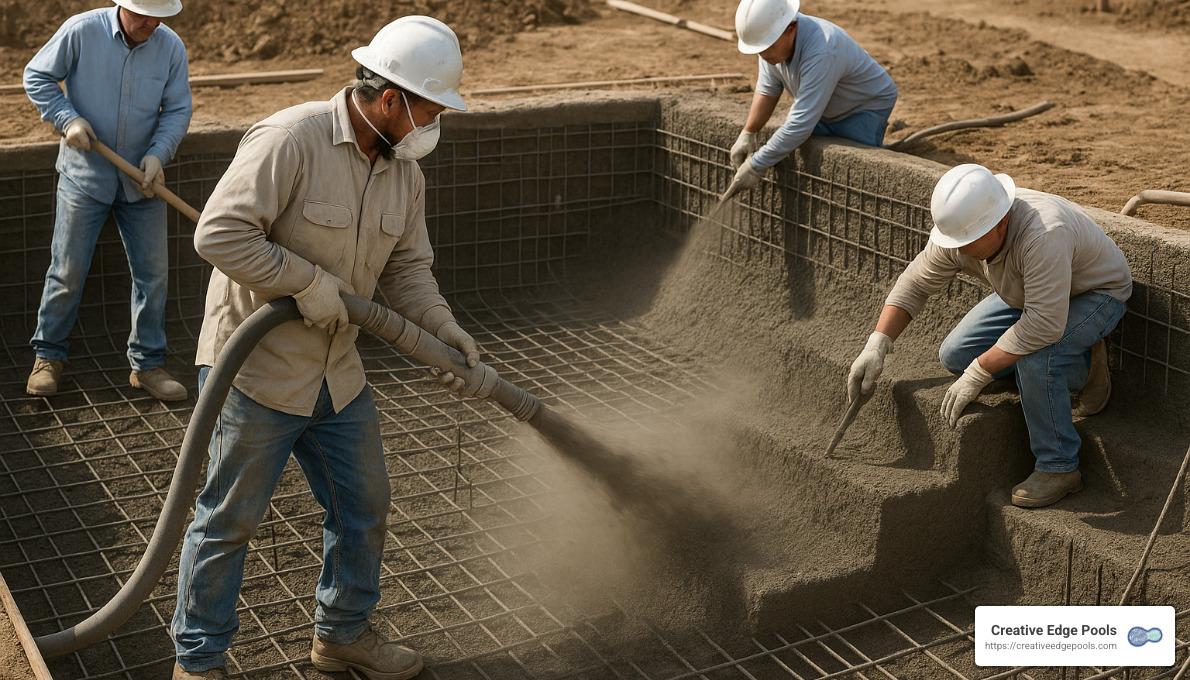
Now, the real show begins with the gunite application. The dry mix of cement and sand is pneumatically sprayed through a hose, with water added at the nozzle. Skilled technicians artfully apply the gunite in layers, building up the pool shell to a standard thickness of 6-8 inches for walls and 8-10 inches for the floor. This step is where the harmony of skill and material shines, creating a robust pool shell.
Once the gunite is in place, it’s shaped and finished. Technicians sculpt the material to create the designed contours and features, such as steps, benches, and swim-outs. It’s the crescendo of the process, where the pool’s unique personality emerges.
Finally, the curing phase ensures that the gunite shell develops its full strength. It requires keeping the surface moist for 7-10 days, much like letting the music resonate.
Equipment Needed for Gunite Application
To conduct this symphony, specialized equipment is essential. The gunite machine/hopper is where it all begins, feeding the dry mix into the delivery hose. The air compressor provides the force, propelling the mix through hoses designed to handle the abrasive material. At the heart of the process is the nozzle assembly, where water is introduced and mixed with the dry ingredients.
A reliable water supply system is critical, ensuring clean, consistent water flow. After the gunite is applied, various finishing tools shape and smooth the surface. And of course, all crew members wear proper safety equipment, ensuring a safe and efficient process.
Specialized Skills Required
The magic of a gunite pool lies in the hands of the skilled technicians. The nozzle operator plays a vital role, controlling the angle, distance, and pattern of application while maintaining the right water-to-cement ratio. It’s an art form, requiring precision and an eye for detail.
Mix management ensures the dry components are consistently mixed and fed into the system, while material preparation guarantees that the right proportions create a uniform mix.
Finishing the gunite surface demands a touch of finesse, with crew members quickly shaping and smoothing the material before it sets. Quality control is ever-present, with supervisors keeping a watchful eye, ensuring every detail is perfect.
This intricate dance of equipment, skill, and experience is why at Creative Edge Pools, we’re proud to have mastered the craft of gunite application, creating pools that stand the test of time.
Maintenance of Gunite Pools
Gunite pools are treasured for their durability and beauty, but like all masterpieces, they need a little care to keep them in tip-top shape. With the right maintenance, these pools can remain a sparkling centerpiece in your backyard for generations to come.
Routine Maintenance
Regular upkeep is key to preserving the elegance and integrity of your gunite pool. First on the list is water chemistry management. It’s crucial to keep the chemical balance just right to prevent damage to both the interior finish and the underlying gunite structure. This means testing your pool’s water at least once a week. Aim to keep the pH between 7.2 and 7.6, the alkalinity between 80 and 120 ppm, and ensure the calcium hardness matches your pool’s specific interior finish.
Next up is surface cleaning. Because many gunite finishes, like plaster and quartz, can be a bit porous, giving your pool a good brushing at least once a week helps keep algae at bay and prevents staining. Your walls and floor will thank you for it!
Filtration also plays a starring role in pool maintenance. Make sure your filter is running for about 8-12 hours daily during swimming season. Don’t forget regular tasks like backwashing, cleaning the filters, and emptying skimmer and pump baskets. These steps keep your pool water sparkling and your filtration system in fighting form.
In colder climates, winter protection is a must. Properly winterizing your pool helps prevent freeze damage. This involves tasks like lowering the water level below the skimmers, adding winterizing chemicals, safeguarding plumbing, and placing a sturdy winter cover over your pool.
Periodic Renovations
Even the most durable pools need a little refresh now and then. The interior finish of your gunite pool will eventually wear down and need replacement. The timeline varies: traditional plaster tends to last 7-10 years, while quartz finishes can stretch to 10-15 years. Pebble finishes might see you through 15-20+ years, and tile can impress for over 20 years.
Your pool’s tile and coping might need some TLC, too. Regrouting or replacing these as needed, especially in areas prone to freeze-thaw cycles, helps maintain the pool’s aesthetic and structure.
Don’t forget about your pool’s deck maintenance. Whether it’s concrete, stone, or pavers, maintaining the deck prevents water infiltration, which could eventually affect the pool’s structure.
Lastly, while the gunite shell is built to last, equipment updates are a necessary part of maintaining a fully functional pool. Pool equipment often has a shorter lifespan and will need replacing or upgrading over time.
At Creative Edge Pools, we provide detailed maintenance instructions and ongoing support to ensure your gunite pool remains a source of delight year after year.
Environmental Considerations
As environmental awareness takes center stage, it’s no surprise that many homeowners are thinking about how gunite pools fit into the sustainability puzzle. Let’s explore the eco-friendliness of these durable, custom pools.
Sustainability Aspects of Gunite
Gunite pools are primarily made from cement and sand. While these materials are readily available, the production of cement is known to be energy-intensive and a significant source of carbon emissions. However, some factors can help balance out this environmental impact.
Longevity is a major plus. The sturdy nature of gunite pools means you won’t be looking to replace them any time soon, which helps reduce the overall environmental footprint compared to other pool types that wear out more quickly.
Recyclability is another feather in the cap for gunite. When the pool does eventually reach the end of its life—possibly after 50 years or more—the material can be crushed and reused as aggregate for new concrete projects, cutting down on landfill waste.
Local materials also play a role. Since sand—one of the main ingredients—is often sourced locally, this reduces emissions associated with transportation.
And let’s not forget innovations in materials. The concrete industry is working hard to develop more sustainable cement mixes with lower carbon footprints. These eco-friendly options can be integrated into gunite mixes, helping to further reduce the environmental impact.
Energy Efficiency
When it comes to gunite pools, energy efficiency is all about smart choices. Opting for energy-efficient equipment and design can significantly cut down on energy use.
Variable-speed pumps are a game changer, potentially reducing energy consumption by up to 80% compared to the old-school single-speed pumps.
LED lighting is another savvy choice, as these lights use a fraction of the electricity needed by traditional incandescent bulbs.
For those looking to go green, solar heating is a fantastic option. The solid structure of gunite pools makes them perfect candidates for solar systems, which can eliminate the need for electric or gas heaters.
Finally, automated controls can optimize the operation of your pool equipment, ensuring that you’re not wasting energy when no one’s taking a dip.
At Creative Edge Pools, we’re not just about creating stunning swimming pools; we’re also committed to incorporating energy-efficient solutions that help you reduce your carbon footprint and keep your operating costs down.
Frequently Asked Questions about Gunite
What is the Lifespan of a Gunite Pool?
A gunite pool is like a fine wine—it just gets better with time. These pools are designed to last, and with proper care, they can age gracefully for up to 50 years or more. Imagine a pool outliving not just your kids’ childhoods, but possibly your mortgage, too!
The impressive longevity of a gunite pool comes down to its strong structure. The monolithic gunite shell, combined with steel reinforcement, creates an incredibly durable pool that stands up to the test of time. Even as the ground shifts or temperatures change, gunite pools remain resilient, adapting like seasoned pros to the freeze-thaw cycles of climate. If you’re worried about trends going out of style, don’t be—gunite pools can always be renovated, with finishes replaced or new features added, ensuring they remain both functional and fashionable.
While the pool’s structure can last for decades, interior finishes like plaster or pebble will need some attention. Plaster might call for a refresh every 7-10 years, quartz could last 10-15 years, and pebble finishes can shine on for 15-20+ years. Keeping up with regular maintenance, such as balancing water chemistry and fixing minor issues, is the secret to making your gunite pool a long-term backyard star.
How Does Gunite Perform in Cold Climates?
Living in a cold climate doesn’t mean you have to ice out your dreams of a beautiful gunite pool. These pools are built to handle the frosty challenges of winter with ease. At Creative Edge Pools, we’ve learned a thing or two about building pools that stand strong against New England’s harsh winters.
Gunite pools are excellent at shrugging off the cold, thanks in part to their flexible structure. The steel-reinforced shell can move just enough to accommodate ground shifts caused by freeze-thaw cycles. This, combined with its substantial thermal mass, means your pool won’t be caught off guard by sudden temperature changes.
Design tweaks can make your gunite pool even more winter-ready. Opt for deeper depths to minimize freezing risk and place expansion joints strategically to handle the cold gracefully. Properly winterizing your pool—lowering the water level, draining and blowing out plumbing lines, adding winter chemicals, and covering it securely—ensures your pool emerges from winter as ready to dive back into fun as you are.
Is Gunite More Expensive Than Other Pool Materials?
When eyeing the price tag of a gunite pool, you might notice it’s a bit heftier than some other pool types, like fiberglass or vinyl. But hold onto your floaties—there’s more to the story than sticker shock. The initial cost reflects the value of skilled labor, high-quality materials, and the opportunity for a truly custom design.
Building a gunite pool is a labor of love that takes time—around 8-12 weeks—but it’s worth it. The result is a pool that’s as unique as your fingerprint, designed exactly to your vision. While these pools cost more up front, they offer incredible value over time.
First, consider longevity: With a gunite pool, you’re investing in a structure that can delight your family for over half a century. Renovations are a breeze, compared to the total pool replacements often needed with other types. Not to mention the boost in property value a custom gunite pool can provide.
In short, while gunite pools come with a higher initial investment, they’re like the solid stock in your backyard portfolio, offering years of enjoyment and potential value appreciation. At Creative Edge Pools, we’re committed to helping you understand this investment, ensuring your pool is everything you dreamed and more.
Conclusion
Gunite has truly established itself as the cornerstone of modern pool construction, particularly for those seeking premium, custom designs with exceptional durability. As we’ve explored throughout this article, the unique properties of gunite—its strength, design flexibility, and longevity—make it the material of choice for discerning homeowners who want a pool that will stand the test of time.
The journey of gunite from its invention by Carl Akeley in 1907 to its current status as the gold standard in pool construction illustrates how truly this application method was. By pneumatically applying a dry mix of cement and sand with water added at the nozzle, builders can create seamless, monolithic structures that conform to virtually any design vision.
At Creative Edge Pools, we’ve dedicated ourselves to mastering the art and science of gunite pool construction. Our experienced teams handle every aspect of the process with precision and care, from the initial design and excavation through steel reinforcement installation, gunite application, and finishing. This comprehensive approach ensures that each pool we build achieves both structural excellence and aesthetic beauty.
The advantages of choosing a gunite pool extend far beyond the construction phase. With proper maintenance, your gunite pool will provide decades of enjoyment while requiring only periodic interior finish renewal. The ability to renovate and update a gunite pool also means it can evolve with your changing preferences and lifestyle.
Whether you’re envisioning a classic rectangular pool with clean lines or a freeform design that integrates seamlessly with your landscape, gunite provides the foundation for bringing that vision to life. The virtually unlimited design possibilities, combined with exceptional structural integrity, make gunite pools the ultimate expression of backyard luxury.
We invite you to explore the possibilities of a custom gunite pool for your home. Our design team at Creative Edge Pools is ready to help you create the perfect aquatic retreat that reflects your personal style and improves your property for generations to come. To learn more about our process and see examples of our work, visit our Gunite Pool Installation page.