
Transform Your Backyard with a Custom Pool Waterfall
Pool waterfall installation involves integrating a water feature into your swimming pool through careful planning, proper plumbing, and precise mounting. The process typically takes 1-3 days for simple kits and 1-2 weeks for custom rock formations, with costs ranging from $1,000 for basic sheet waterfalls to $20,000+ for elaborate natural stone designs.
Quick Overview:
| Waterfall Type | Cost Range | Installation Complexity | Flow Requirements |
|---|---|---|---|
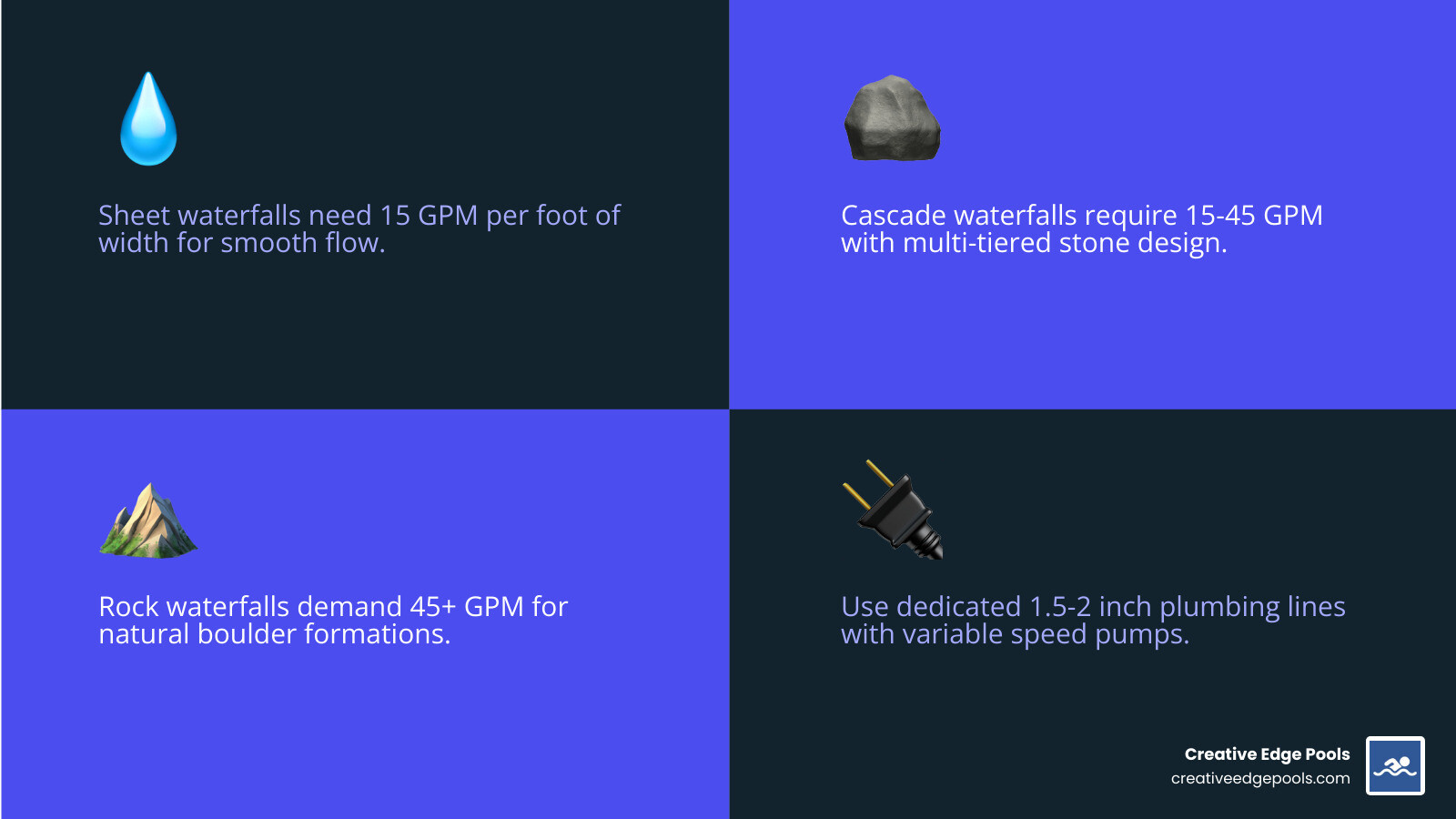
| Sheet Waterfall | $1,000-$5,000 | Low (DIY-friendly) | 15 GPM per foot |
| Cascade Waterfall | $3,000-$10,000 | Medium | 15-45 GPM |
| Rock Waterfall | $8,000-$20,000+ | High (professional) | 45+ GPM |
Want to transform your backyard into a tranquil oasis? A pool waterfall adds visual appeal, creates relaxing soundscapes, and improves water circulation for better filtration. Many homeowners underestimate the planning involved—from choosing the right pump size to understanding local building codes.
The good news is that modern waterfall systems are more accessible than ever. Self-contained kits work for simple projects, while custom rock formations require professional expertise. Either way, you’ll need to consider site suitability, plumbing capacity, and long-term maintenance before breaking ground.
This guide walks you through everything from selecting the right waterfall type to understanding flow rates and pump requirements. Whether you’re a confident DIYer or planning to hire professionals, you’ll learn how to make informed decisions that ensure your waterfall looks stunning and functions properly for years to come.
Types of Pool Waterfalls and Cost Factors
Choosing the right waterfall is like picking the right centerpiece for a dining table—it sets the tone for the entire room (or in this case, the entire backyard). In our experience serving homeowners from Andover, MA to Portsmouth, NH, we’ve seen that the choice usually boils down to the desired aesthetic and, of course, the budget.
Popular Waterfall Styles
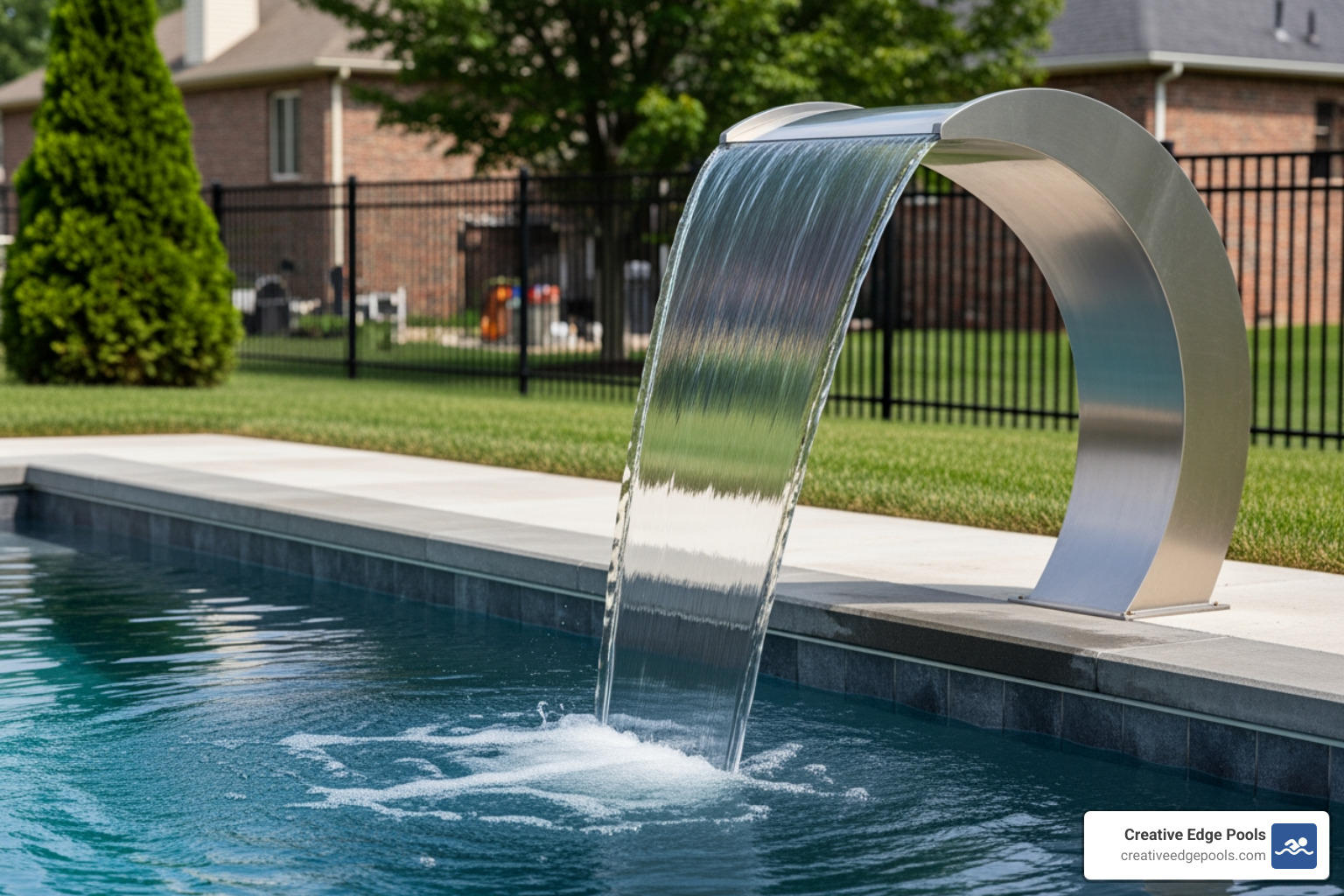
- Sheet Waterfalls: These are the sleek, modern favorites. They produce a thin, glass-like “sheet” of water that drops straight into the pool. They are typically the most affordable, with pool waterfall installation costs ranging from $1,000 to $5,000.
- Cascade Waterfalls: If you want that “babbling brook” vibe, cascades are for you. Water flows over several levels or tiers, creating a more textured sound and look. Expect to invest between $3,000 and $10,000.
- Rock Formations: For those who want a natural-looking-pool-waterfall, rock waterfalls are the gold standard. These can be built with real boulders or high-quality faux rock. These are the heavy hitters, often costing between $8,000 and $20,000+.
- Pond-less Waterfalls: These are unique because they recirculate water without a visible pond at the bottom, often used as a feature adjacent to the pool. Depending on the length of the stream, these can range from $4,100 to over $52,700.
What Influences the Price?
Several factors will wiggle the needle on your final quote:
- Materials: Natural stone is timeless but heavy and labor-intensive. Stainless steel or pre-cast concrete can offer a more modern look at different price points.
- Size and Scale: A 1-foot sheer descent is a weekend project; a 10-foot multi-tiered grotto is a major construction feat.
- Labor: In the Northeast, labor rates vary, and complex builds requiring masonry and specialized plumbing will naturally cost more.
- Existing vs. New Construction: Adding a waterfall to an existing pool (retrofitting) is almost always more expensive than including it in a new build because we have to work around existing decks and plumbing.
| Waterfall Type | Estimated Cost (Installed) | Key Aesthetic |
|---|---|---|
| Sheet | $1,000 – $5,000 | Modern, Glass-like |
| Cascade | $3,000 – $10,000 | Multi-tiered, Textured |
| Rock | $8,000 – $20,000+ | Natural, Tropical |
| Pond-less | $4,100 – $52,700+ | Stream-like, Recirculating |
Planning and Plumbing Requirements
Before you start digging up your yard in Nashua or Newton, we need to talk about the “boring” but vital stuff: infrastructure. A waterfall isn’t just a pretty face; it’s a hydraulic system that needs to work in harmony with your pool.
Site Suitability and Engineering
First, we look at the swimming-pool-waterfall-wall. Is the soil stable enough to hold several tons of rock? In many parts of Massachusetts and New Hampshire, we deal with rocky or clay-heavy soil that requires specific drainage planning. If the water doesn’t drain properly, it can undermine the pool’s bond beam or cause the deck to shift.
Safety and Permits
Safety isn’t just a suggestion; it’s the law. All pool waterfall installation projects must comply with the Virginia Graeme Baker (VGB) Pool & Spa Safety Act. This ensures that suction outlets are designed to prevent entrapment. Additionally, you’ll likely need a building permit from your local municipality (like Worcester or Manchester) to ensure the structural and electrical work meets code.
Height and Wind Considerations
According to the MagicFalls Installation Guide, there are physical limits to how water behaves:
- Sheet Effects: These are very sensitive to wind. We recommend a maximum mounting height of 3 feet. Any higher, and the wind will catch the “sheet,” breaking it apart and creating a messy splash rather than a clean look.
- Rain Effects: These are sturdier and can be mounted up to 6 feet high while still maintaining their visual appeal.
Plumbing and Pump Requirements for pool waterfall installation
This is where the math happens. To get that perfect “thump” or “shimmer,” you need the right flow rate.
- The 15 GPM Rule: A good rule of thumb is 15 Gallons Per Minute (GPM) per foot of waterfall width. So, a 3-foot waterfall needs a pump capable of delivering 45 GPM.
- Pipe Sizing: Don’t choke your waterfall. We recommend a minimum of 1.5-inch pipe for short runs, but for runs over 60 feet or falls over 5 feet, 2-inch pipe is mandatory to reduce “head loss” (friction that slows down the water).
- Dedicated Lines: We always suggest a dedicated plumbing line for the waterfall. This allows you to adjust the flow independently of the pool’s main filtration system.
- Filtration: Waterfalls have narrow openings that can clog easily. Using a 20-micron cartridge filter ensures the water reaching the waterfall is free of debris. We generally advise against DE or sand filters for dedicated waterfall lines because they can bypass fine particles that might clog the feature.
For more technical details on how these integrate with your system, check out our guide on inground-pool-waterfalls.
Step-by-Step Guide to DIY pool waterfall installation
If you’re a handy homeowner in Concord or Salem with a “can-do” attitude and a well-stocked garage, you might consider a DIY approach using a self-contained kit or faux rock unit. Here is how you can tackle it.
Phase 1: Preparation and Excavation
- Unpack and Assemble: Start by laying out your kit. Follow the manufacturer’s assembly instructions to the letter.
- Mark the Spot: Use chalk or a carpenter’s pencil to outline the waterfall’s footprint on the pool deck or bond beam.
- Digging: If you’re installing a self-contained unit next to the pool, you’ll need to excavate an area deep enough to house the basin and pump.
Phase 2: Mounting and Leveling
- Notching the Bond Beam: For inground-pool-waterfalls that sit on the edge, you may need to notch the concrete bond beam. The notch should be about 1 inch wider than the unit on each side.
- The Mortar Bed: Create a level mortar bed for the unit to sit on. Use shims to ensure the unit is perfectly level. If it’s even slightly tilted, the water will flow unevenly, ruining the effect.
- Securing: For faux rock units, we often use pressure-treated 2×4 blocks as mounting anchors. Drill 3/8-inch holes into the concrete, hammer in wedge anchors, and screw the blocks down. You then screw the rocks into these blocks for a rock-solid fit.
Phase 3: Plumbing and Electrical
- Solvent Welding: Connect your PVC pipes using appropriate PVC glue. If your waterfall unit is made of ABS plastic, you must use a special ABS-to-PVC transition glue (often green) to ensure a leak-proof bond.
- The Flex Pipe Loop: Inside the rock feature, use 2-inch spa flex pipe. Creating a small loop helps prevent kinks and makes it easier to position the rocks.
- Electrical Safety: This is non-negotiable. Use EMT plastic conduit for all wiring. Install a GFI (Ground Fault Interrupter) outlet and a wet-location-rated switch box. If you aren’t 100% confident with wiring near water, call an electrician. It’s not worth the risk.
Phase 4: The Finishing Touches
- Sealing: Apply silicone sealant around the edges and over any screw heads.
- Camouflage: Use touch-up paint or the coloring kit provided with your rocks to hide seams and screw heads.
- Landscaping: Surround the base with gravel and aquatic-friendly plants. This doesn’t just look good; it hides the mechanical components and the electrical conduit.
Essential Tools for pool waterfall installation
Before you start, make sure you have these on your workbench:
- Cutting Tools: PVC cutter or a Sawzall for those thicker pipes.
- Drilling: A heavy-duty concrete drill with a 3/8-inch bit.
- Hardware: 3-inch exterior deck screws and wedge anchors.
- Plumbing: 2-inch spa flex pipe and SCH 40 couplings.
- Cleanup: A shop vacuum to remove concrete dust from anchor holes (this is vital for the anchors to grip properly).
Professional vs. DIY: Making the Right Choice
We love a good DIY project, but pool waterfall installation can get complicated fast. Here is the honest breakdown:
The DIY Route
- Pros: You save on labor costs and get the satisfaction of building it yourself.
- Cons: It’s physically demanding. If you make a mistake in the plumbing or leveling, fixing it usually involves tearing out the work you just finished. There’s also no warranty on your own labor.
The Professional Route (The Creative Edge Advantage)
At Creative Edge Pools, we bring over 100 years of combined experience to every backyard in Eastern MA and Southern NH. As a family-owned business, we treat your pool like it’s our own.
- Expertise in Gunite: We specialize in gunite pools, which allow for much more complex and integrated waterfall designs than vinyl or fiberglass.
- Structural Integrity: We ensure the waterfall won’t cause your pool wall to crack or lean over time.
- Automation: We can integrate your waterfall into your pool’s smart system, allowing you to turn it on from your phone or set it to a schedule.
- Long-Term ROI: A professionally installed waterfall is a permanent upgrade that significantly boosts property value.
Money-Saving Tip: If you want a pro result on a budget, consider using manufactured faux rock materials rather than natural boulders. They look incredibly realistic, weigh much less, and require less labor to install. Also, try to bundle your waterfall installation with other services, like a pool renovation, to save on mobilization costs.
Maintenance and Long-Term Care
Once the water is flowing, you want to keep it that way. A neglected waterfall can quickly become a headache of clogs and algae.
Weekly Routine
- Debris Removal: Check the “lip” of the waterfall for leaves or twigs. Even a small pebble can cause a “gap” in a sheet waterfall’s flow.
- Strainer Baskets: Clean your pump’s strainer basket weekly. A clogged basket reduces flow and puts strain on the motor.
Water Chemistry
Maintaining proper water chemistry is vital for the longevity of your feature.
- pH Levels: Keep your pH between 7.2 and 7.8.
- Chlorine: Maintain levels between 1.0 and 3.0 ppm.
- Scale Prevention: In areas with hard water, calcium can build up on the waterfall’s edge. Regular cleaning with a mild descaler prevents those white crusty deposits.
Filter Maintenance
If you notice the water flow getting “lazy,” check your filter. When the pressure gauge on your cartridge filter rises 7-10 PSI above its “clean” reading, it’s time to take the cartridges out and spray them down.
Winterization
In our neck of the woods (looking at you, Manchester and Lowell), winterization is a must.
- Drain the Lines: Use gravity or a shop vac to blow all water out of the waterfall plumbing.
- Pump Protection: If the waterfall has a dedicated pump, drain it and, if possible, store it in a dry place.
- Leave the Plug Out: Keep the drain plugs unattached over the winter to prevent any trapped moisture from freezing and cracking the housing.
Frequently Asked Questions about Pool Waterfalls
How much does it cost to add a waterfall to an existing pool?
Retrofitting a waterfall to an existing pool typically costs between $2,000 and $15,000. The price is higher than a new build because we often have to remove sections of the pool deck, tap into existing plumbing, and ensure the new feature matches the current pool’s aesthetic.
Can I install a pool waterfall myself?
Yes, you can! Self-contained kits and faux rock units are very DIY-friendly for homeowners with basic plumbing and electrical knowledge. However, for large natural stone grottos or features that require structural changes to a gunite pool, we strongly recommend professional help to avoid leaks and structural failure.
How often should I clean my pool waterfall?
We recommend a quick visual check and debris removal once a week. A deeper inspection of the filter and pump should happen once a month. If you live in a heavily wooded area, you might need to check for leaves more frequently to prevent clogging.
Conclusion
A pool waterfall is more than just a home improvement project; it’s a lifestyle upgrade. It transforms a simple swimming area into a backyard retreat where the stresses of the day melt away to the sound of cascading water. Whether you choose a sleek modern sheet or a rugged natural rock formation, the key to a successful pool waterfall installation is in the details—the plumbing, the leveling, and the long-term care.
At Creative Edge Pools, we take pride in bringing homeowner visions to life across Massachusetts and New Hampshire. With our century of combined experience, we ensure that every stone is perfectly placed and every drop of water flows exactly where it should.
Ready to make a splash? More info about pool waterfall installation is just a click away. Let’s build something beautiful together.