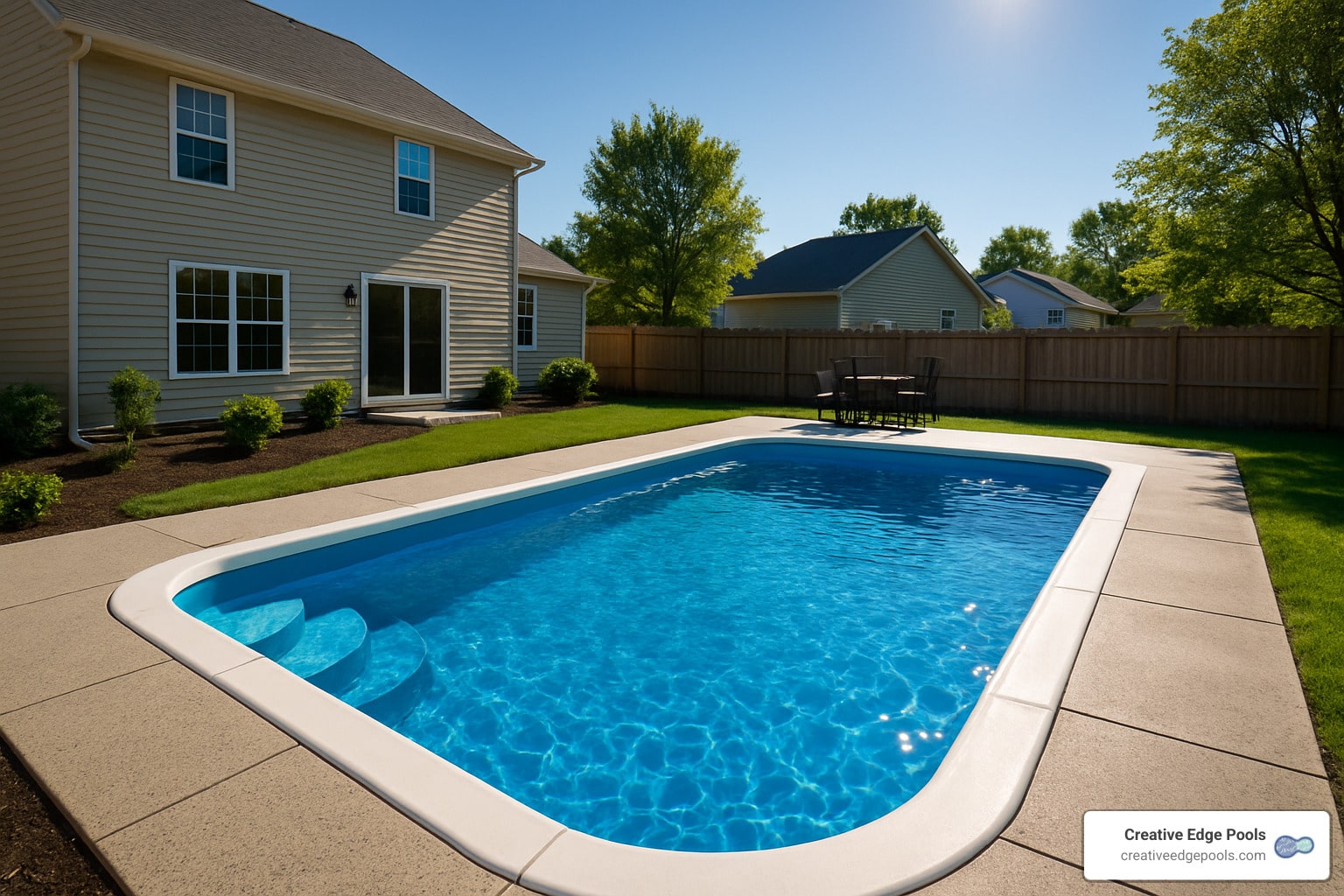
Fiberglass Pool Cost: 2025 Savings Unveiled
Understanding Fiberglass Pool Pricing: What You Need to Know
The fiberglass pool cost typically ranges from $30,000 to $85,000, with most homeowners paying between $45,000 and $65,000 for a complete installation. Here’s what drives these costs:
Quick Cost Breakdown:
- Pool Shell: $10,000 – $30,000
- Installation Labor: $10,000 – $20,000
- Site Preparation: $3,000 – $8,000
- Equipment Package: $3,000 – $7,000
- Permits & Fees: $500 – $2,000
- Basic Decking: $3,000 – $12,000
If you’re considering a fiberglass pool for your backyard, you’re probably wondering about the total investment. The truth is, fiberglass pool pricing involves more than just the shell itself. You’ll need to factor in installation, site preparation, equipment, and ongoing maintenance costs to get the complete picture.
Want to understand why fiberglass is such a popular material for pools? Take a quick look at the fiberglass overview on Wikipedia to see its unique properties and durability advantages.
Understanding these costs upfront helps you make an informed decision and avoid budget surprises. While fiberglass pools require a significant initial investment, they often provide better long-term value through lower maintenance costs and faster installation compared to other pool types.
I’m David Brabant, owner of Creative Edge Pools, and I’ve spent over thirty years in the swimming pool industry helping homeowners steer fiberglass pool cost decisions. My hands-on experience with pool installations across Massachusetts and New Hampshire has shown me how proper planning and realistic budgeting lead to successful projects that families enjoy for decades.

Breaking Down the Initial Fiberglass Pool Cost
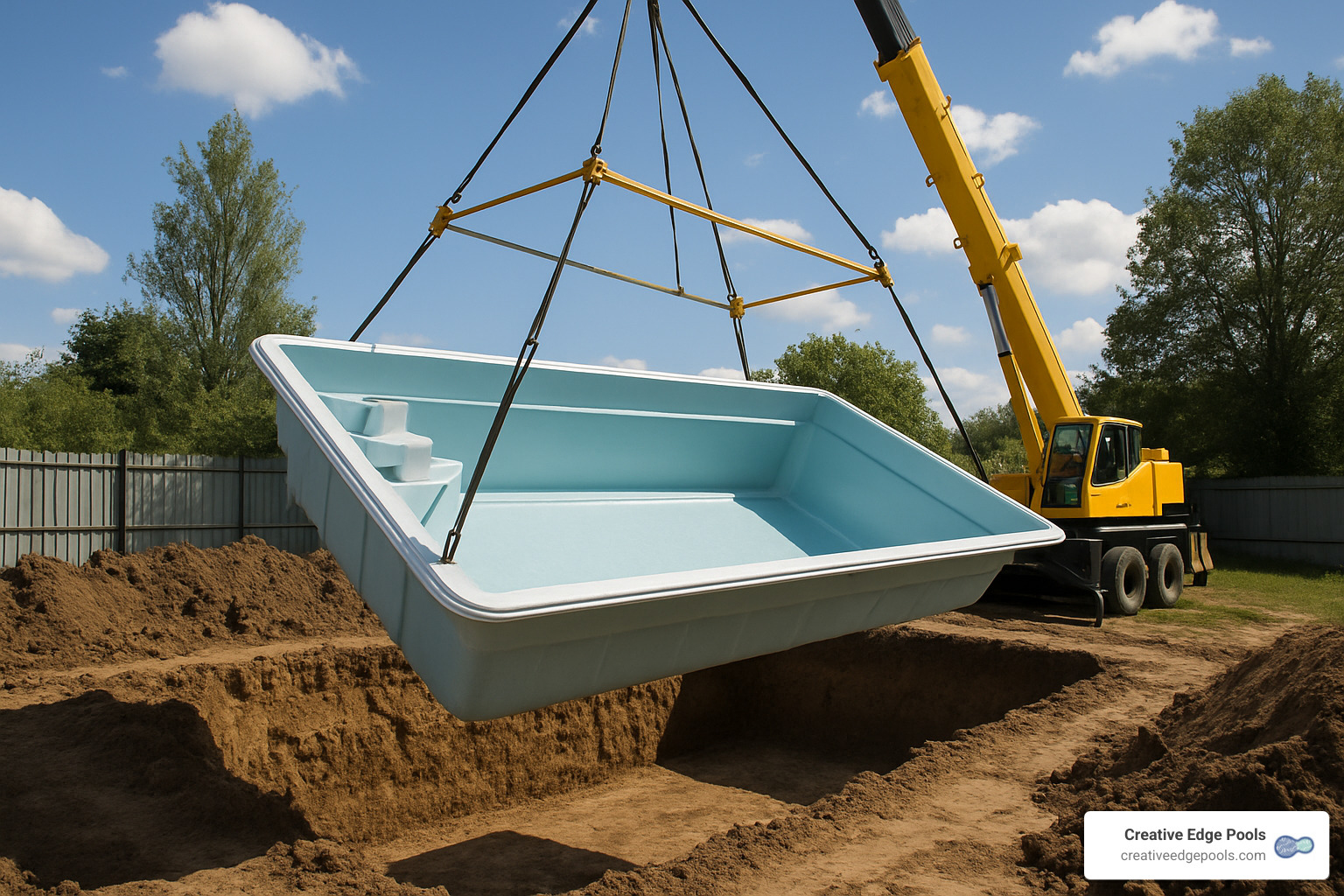
When you’re planning your dream pool, understanding the fiberglass pool cost breakdown helps you budget smartly. Think of it like buying a car – you want to know what you’re paying for beyond just the sticker price.
Most reputable pool companies offer turnkey packages that bundle everything together. This approach takes the guesswork out of budgeting and prevents those dreaded surprise costs that can pop up halfway through your project.
A typical base package covers all the essentials: the fiberglass shell, professional installation, excavation work, backfill materials, your basic equipment package, and necessary permits. It’s like getting a complete meal deal instead of ordering everything separately.
What is the Average Fiberglass Pool Cost for Installation?
Here’s the reality check you’re looking for. The fiberglass pool cost for installation typically runs between $33,270 and $48,995 nationwide, with most homeowners landing around $45,000 for a standard setup.
In our Massachusetts and New Hampshire markets, we see a broader range – usually $45,000 to $85,000 for complete installations. The difference comes down to what you’re after. A basic installation with standard features stays on the lower end, while high-end projects with custom features and extensive landscaping can push past $100,000.
Geography plays a bigger role than you might think. Areas with higher labor costs, stricter building codes, or challenging soil conditions will bump up your price. If you’re dealing with rocky soil or tight access to your backyard, expect to add $10,000 to $20,000 to your budget.
Urban installations often cost more due to limited access for equipment and stricter permitting requirements. Rural properties might save on permits but could face higher transportation costs.
More info about inground pool costs
The Pool Shell: The Heart of Your Investment
The fiberglass shell is your biggest single expense, typically running $10,000 to $30,000 depending on size and built-in features. This isn’t just a fancy bathtub – you’re paying for serious engineering and quality materials.
High-quality shells use multiple layers of fiberglass and resin, creating a rock-solid, non-porous surface that fights off algae naturally. The gelcoat finish gives you that smooth, attractive surface that feels great under your feet and looks stunning for decades.
Manufacturing quality matters more than you might think. Top manufacturers offer warranties ranging from 10 years to lifetime coverage on the shell structure. That peace of mind is worth paying for.
Don’t forget about transportation and delivery fees – they’ll add $1,000 to $3,000 to your shell cost. Larger pools over 14-15 feet wide need special permits and equipment for transport, which bumps up these costs even more.
Labor and Equipment Essentials
Your professional installation team is where the magic happens. This isn’t a DIY weekend project – you need skilled excavation specialists, licensed plumbers, and certified electricians. Labor typically runs $10,000 to $20,000, representing about 30-40% of your total investment.
The basic equipment package includes your pool pump, filtration system, and essential plumbing connections. A quality pump and filter system costs $1,200 to $4,500, depending on size and efficiency ratings. Trust me on this – investing in energy-efficient equipment saves you money every month on your electric bill.
Electrical work requires a licensed electrician and typically costs $3,000 to $7,000. This covers running power to your equipment, installing required GFCI protection, and any lighting circuits. Some homes need electrical panel upgrades, which can add to the total cost.
The beauty of working with experienced professionals is that they handle all the coordination. You don’t have to juggle multiple contractors or worry about whether the plumber and electrician are on the same page.
More info about excavation services
Key Factors That Drive Your Final Price Tag

Your fiberglass pool cost can swing dramatically based on factors that aren’t always obvious at first glance. I’ve seen identical pools cost $20,000 more simply because of what’s happening beneath the surface – literally.
The biggest surprise for most homeowners? Site accessibility. If we can’t get our crane truck within 50 feet of your pool location, everything changes. We might need to use smaller equipment, hand-dig sections, or even helicopter the shell in (yes, that’s a real thing, and yes, it’s expensive). Overhead power lines, mature trees, or narrow gates can turn a straightforward installation into a logistical puzzle.
Soil conditions are another game-changer here in New England. Hit ledge rock, and you’re looking at jackhammering or blasting that can add $10,000 to $15,000 to your project. High water tables require dewatering systems and special drainage. Clay soil needs engineered backfill materials to prevent settling.
Then there’s the regulatory side. Local regulations vary wildly from town to town. Some municipalities require extensive engineering drawings, soil percolation tests, or special safety features. While permits typically cost $500 to $2,000, complex projects might need additional engineering that can push costs higher.
How Size and Shape Affect the Fiberglass Pool Cost
Here’s where fiberglass pools show their smart side. Pool size directly impacts your investment, but the relationship isn’t always linear. Small pools around 10’x20′ typically run $45,000 to $65,000 installed. Medium pools at 14’x30′ jump to $65,000 to $85,000. Large pools over 16’x40′ can hit $85,000 to $120,000 or more.
What’s interesting is that shape doesn’t dramatically affect shell cost since fiberglass pools are pre-manufactured. Whether you choose a simple rectangle or an neat freeform design, the shell price stays similar. However, complex shapes might require more precise excavation and careful installation, potentially adding to labor costs.
The real value comes with integrated features. Tanning ledges, built-in spas, beach entries, and custom steps are molded right into the shell. These features that would cost thousands extra with other pool types come included in your fiberglass shell price.
Site Preparation and Landscaping
Excavation represents the wild card in pool pricing. Standard digging runs $3,000 to $8,000, but challenging conditions can double or triple this amount. Rock removal costs $50 to $200 per cubic yard, while hauling away excess dirt adds $8 to $25 per cubic yard.
Proper grading might seem like a minor detail, but it’s crucial for long-term success. This work typically costs $1,000 to $3,000 but prevents water from pooling around your pool and causing settling issues down the road.
Sloped lots often require retaining walls to create level areas and prevent erosion. These structures range from $40 to $300 per linear foot depending on height and materials. While the cost can be substantial, retaining walls often create beautiful terraced landscapes that add significant value to your property.
Don’t forget about fencing requirements. Most municipalities require pool fencing for safety, typically costing $15 to $30 per linear foot. This isn’t optional – it’s usually required before you can get your final inspection.
More info about hardscaping and masonry
Upgrades and Custom Add-Ons
This is where your fiberglass pool cost can really take off – but also where you can create something truly special. Water features like waterfalls ($3,000-$10,000) or deck jets ($500-$2,000) add both beauty and the soothing sound of moving water. LED lighting transforms your pool into an evening showcase, with basic systems costing $700-$1,800 and color-changing options running $1,500-$3,000.
Pool heaters extend your swimming season significantly. Heat pumps cost $2,100-$4,500 and offer excellent efficiency, while gas heaters run $3,000-$7,000 but heat faster. Saltwater systems at $2,000-$3,500 provide gentler water that’s easier on skin and eyes.
Automatic pool covers represent the premium upgrade at $8,000-$30,000, but they pay for themselves through reduced heating costs and chemical usage. Slides and diving boards range from simple models at $500 to elaborate custom installations at $10,000 or more.
My advice? Prioritize upgrades that improve safety and extend your swimming season first. Decorative features can always be added later, but structural elements like lighting and heating are much easier to install during construction.
More info about pool remodeling
Fiberglass Pool Cost & Value: How It Stacks Up
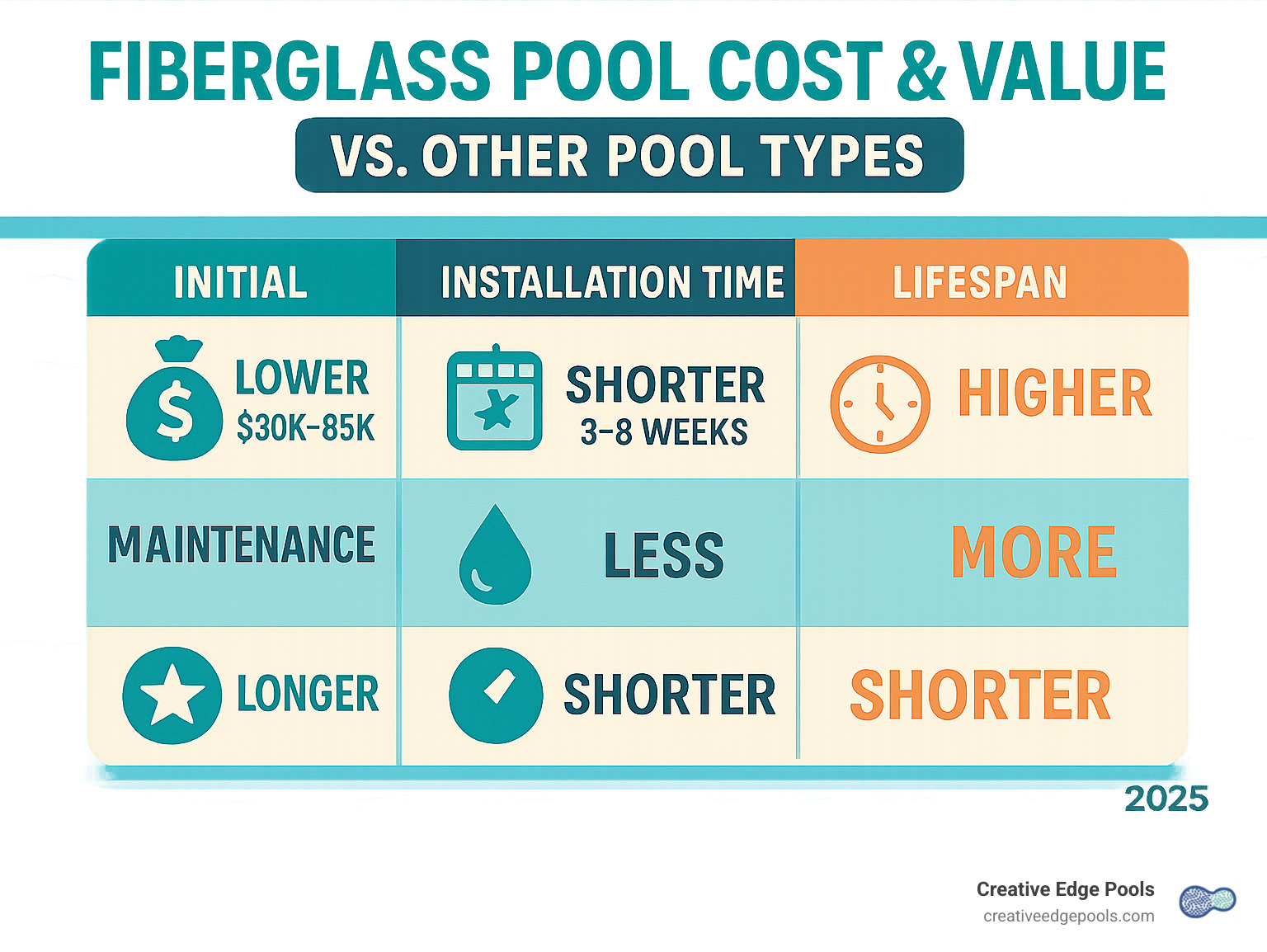
When evaluating fiberglass pool cost, it’s important to look beyond the initial price tag and consider the complete ownership experience. After three decades in the pool industry, I’ve seen how the right pool choice can provide decades of family enjoyment while the wrong choice leads to ongoing headaches and expenses.
Let me break down what you can expect from fiberglass pools across the key factors that matter most to homeowners:
| Factor | Fiberglass Pools |
|---|---|
| Initial Cost | $30,000 – $85,000 |
| Installation Time | 3-8 weeks |
| Annual Maintenance | $600 – $1,200 |
| Lifespan | 30-50 years |
| Customization | Moderate (pre-manufactured shapes) |
| Surface Feel | Smooth, non-porous |
Fiberglass Pools
The beauty of fiberglass pools lies in their mid-range initial cost combined with exceptional long-term value. While you’ll invest $30,000 to $85,000 upfront, this cost often pays dividends through reduced maintenance and faster installation.
Fast installation is where fiberglass pools really shine. Most installations take just 3-8 weeks from excavation to swimming. Compare this to other pool types that can take 3-6 months, and you’ll understand why busy families love this option. Less construction time means less disruption to your daily routine and less chance of weather delays.
The smooth, non-porous surface of fiberglass creates a naturally algae-resistant environment. This isn’t just about aesthetics – it directly impacts your wallet. With annual maintenance costs of just $600 to $1,200, fiberglass pools require fewer chemicals and less frequent cleaning than other surfaces.
Durability is another strong point. A quality fiberglass shell will last 30-50 years with proper care. The gelcoat finish typically maintains its appearance for 20-30 years before needing refinishing. This longevity makes fiberglass pools an excellent long-term investment.
The main trade-off is customization flexibility. Since fiberglass pools use pre-manufactured shapes, you’ll choose from available designs rather than creating completely custom shapes. However, modern manufacturers offer dozens of attractive options, including pools with built-in spas, tanning ledges, and beach entries.
Note: For information about other pool types, see our educational resources or contact us for a personalized comparison.
Long-Term Ownership: Beyond the Installation Bill
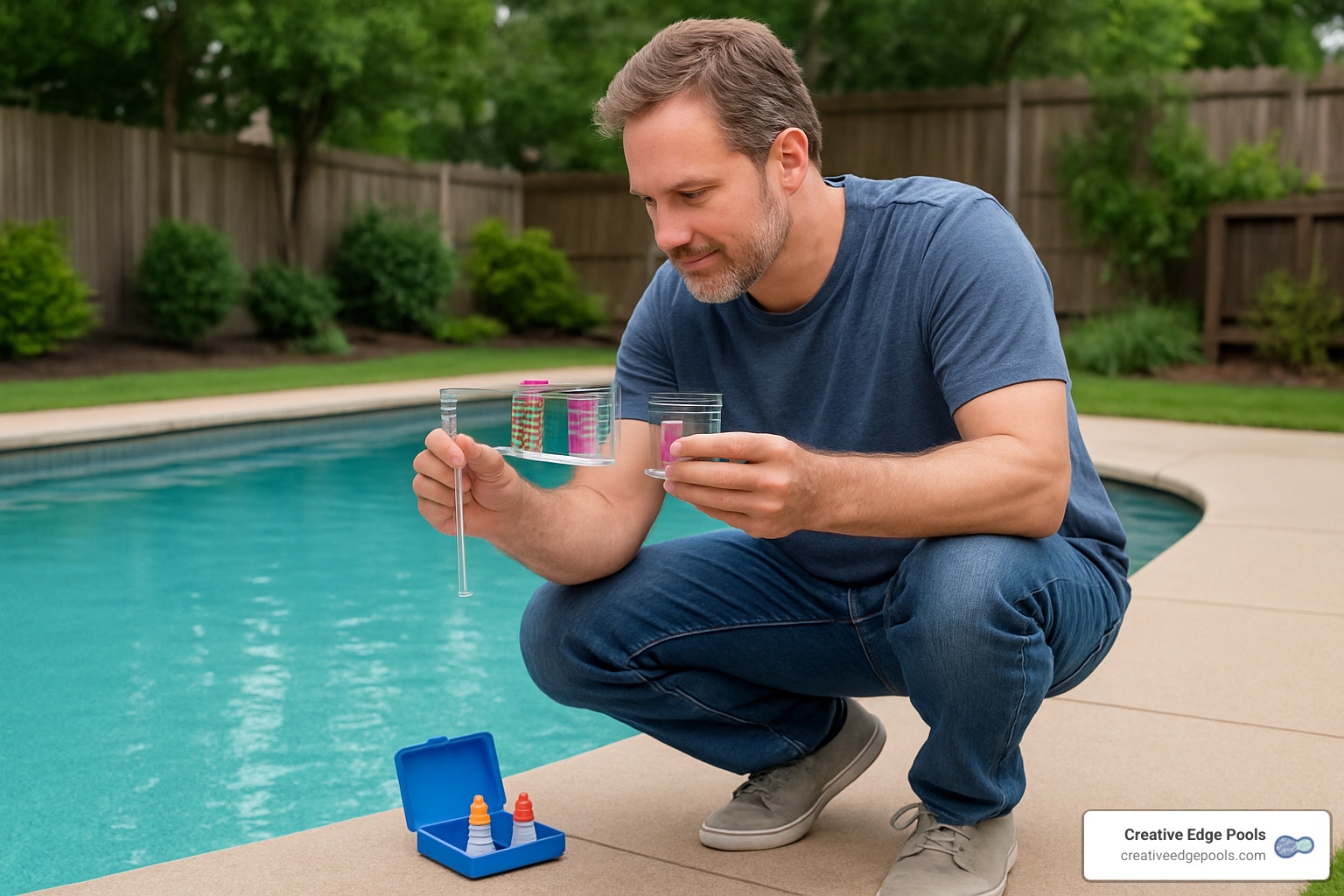
While the initial fiberglass pool cost gets most of the attention, smart pool owners plan for the ongoing expenses that come with backyard paradise. The good news? Fiberglass pools are remarkably budget-friendly when it comes to long-term ownership costs.
Think of your fiberglass pool like a reliable car – with proper care, it’ll serve you faithfully for decades without breaking the bank. The smooth, non-porous surface that makes fiberglass pools so pleasant to swim in also makes them incredibly easy to maintain.
Unlike other pool types that demand constant attention and expensive treatments, fiberglass pools practically take care of themselves. The gelcoat finish naturally resists algae growth, which means you’ll spend less time scrubbing and less money on chemicals.
Annual Maintenance and Operating Expenses
Your annual maintenance budget for a fiberglass pool typically runs $600 to $1,200 – that’s often less than many families spend on their monthly cable bill. This covers everything from basic chemical balancing to filter cleaning and routine upkeep.
Pool opening and closing services cost $300 to $700 annually in our Massachusetts and New Hampshire markets. Many of our clients enjoy handling basic maintenance themselves, which can cut these costs significantly. There’s something satisfying about testing your own water chemistry and keeping your pool crystal clear.
Your biggest ongoing expense will likely be electricity for the pump and filtration system. Most pool pumps consume 1,000 to 3,000 kWh annually, translating to $150 to $450 on your electric bill. Here’s where investing in a variable-speed pump during installation pays dividends – these efficient units can slash your energy costs by 50-70% and often qualify for utility rebates.
Water bills add another $300 to $800 annually, depending on your local rates and how often you need to top off the pool. Evaporation is your biggest water loss, especially during hot summer months.
If you choose to heat your pool, budget accordingly. Heat pumps typically cost $500 to $1,500 annually to operate, while gas heaters can run $1,000 to $3,000 for heavy use. A quality pool cover can cut these heating costs in half while also reducing chemical usage and water evaporation.
Repairs and Resurfacing
Here’s where fiberglass pools really shine in the long-term value department. The gelcoat finish lasts 20-30 years before showing any significant wear, and even then, it’s usually just minor fading rather than structural issues.
Minor crack repairs are rare but cost only $300 to $800 when needed. Most fiberglass pool “repairs” are actually cosmetic touch-ups that can be handled with simple gel coat applications. It’s like touching up a scratch on your car – straightforward and inexpensive.
When your pool eventually needs resurfacing after decades of use, expect to invest $6,000 to $15,000 depending on size and condition. That might sound like a lot, but spread over 20-30 years, it’s incredibly reasonable for maintaining your backyard oasis.
The structural integrity of a quality fiberglass shell means major repairs are virtually unheard of. You won’t face the expensive structural issues that can plague other pool types, or the frequent liner replacements that other systems require every 7-10 years.
Cost of fiberglass pool resurfacing
Frequently Asked Questions about Fiberglass Pools
How long does a fiberglass pool last?
When homeowners ask me about durability, I always tell them that fiberglass pools typically last 30 to 50 years with proper care. That’s a remarkable lifespan that makes the initial fiberglass pool cost much more reasonable when you spread it over decades of enjoyment.
The fiberglass shell structure itself is incredibly tough. Unlike other pool types that can crack or develop structural issues over time, quality fiberglass pools maintain their integrity for decades. The secret lies in the manufacturing process – multiple layers of fiberglass and resin create a flexible yet durable shell that moves with ground conditions rather than cracking.
Proper maintenance is absolutely key to reaching that 30-50 year lifespan. This means keeping your water chemistry balanced, cleaning your pool regularly, and addressing any minor issues before they become major problems. The good news is that fiberglass pools are much easier to maintain than other types.
Most quality manufacturers back up their durability claims with solid warranties. You’ll typically see 10-year warranties on the shell structure, with some manufacturers offering lifetime coverage. This gives you peace of mind that your investment is protected.
The gelcoat finish maintains its smooth, attractive appearance for 20-30 years before needing any refinishing work. That’s significantly longer than other pool surfaces, which often require resurfacing every 10-15 years.
How long does a fiberglass pool installation take?
One of the biggest advantages of choosing fiberglass is the installation timeline of just 3 to 8 weeks from start to finish. Compare that to other pool types that can take 3-6 months, and you’ll understand why busy families love this option.
Here’s what that timeline typically includes: permit approval, excavation, shell delivery and installation, plumbing and electrical work, backfilling, decking installation, and final startup. The actual shell installation is often completed in a single day, which always amazes homeowners.
Several factors can affect your installation timeline, and I always discuss these upfront with clients. Permit approval varies by municipality – some towns approve within days while others take 3-4 weeks. Weather plays a big role too, especially here in New England where spring rain can delay excavation work.
Complex sites require additional time. If your backyard has challenging access for our equipment, rocky soil conditions, or requires retaining walls, we’ll need extra time to handle these situations properly. I’d rather take the time to do things right than rush and create problems later.
The beauty of fiberglass installation is that most of the work happens off-site. While your shell is being manufactured, we handle permits and site preparation. This parallel approach keeps your project moving efficiently and minimizes disruption to your daily routine.
Does installing a fiberglass pool increase home value?
This is probably the question I get asked most often, and the honest answer is that pools can increase your home’s value, but the amount varies significantly based on your local market and specific circumstances.
In our Massachusetts and New Hampshire markets, pools are generally viewed as desirable amenities that improve property appeal. The value increase typically ranges from 5-15% of the pool’s installation cost, depending on your neighborhood and local market conditions.
Pools tend to be more valuable in certain situations: higher-end neighborhoods where pools are common, areas with longer swimming seasons, and markets with strong buyer demand. If you’re the only house in your neighborhood with a pool, it might not add as much value as you’d hope.
But here’s what I tell every client: the real value often goes beyond dollars and cents. A pool creates a private retreat for family enjoyment, provides a perfect space for entertaining friends, and offers a convenient way to exercise and stay healthy. Many of our clients tell us years later that the quality of life improvements were worth every penny.
The long-term investment aspect is important too. With fiberglass pools lasting 30-50 years and requiring minimal maintenance, you’re not just buying a pool – you’re investing in decades of family memories and enjoyment. That’s a value that’s hard to put a price tag on.
Conclusion: Is a Fiberglass Pool the Right Investment for You?
After exploring all aspects of fiberglass pool cost, you’re probably wondering if this investment makes sense for your family. The truth is, while that initial $30,000 to $85,000 price tag feels substantial, fiberglass pools often prove their worth through decades of reliable performance and surprisingly low ongoing costs.
What really matters is looking beyond that first check you’ll write. Think about it this way: you’re not just buying a pool – you’re investing in summer mornings with coffee by the water, birthday parties your kids will remember forever, and quiet evenings floating after long workdays. When you spread that initial investment over 30 to 50 years of use, the numbers start making more sense.
The beauty of fiberglass pools lies in their predictable costs. Unlike other pool types that might surprise you with expensive repairs or frequent resurfacing needs, fiberglass pools are refreshingly straightforward. That smooth, non-porous surface I mentioned earlier? It’s not just comfortable to swim in – it’s saving you money every month through reduced chemical usage and minimal maintenance requirements.
Here’s what I’ve learned after three decades in this business: professional installation isn’t optional – it’s essential. I’ve seen too many homeowners try to save money upfront only to face costly problems later. Proper excavation, quality equipment, and skilled installation are what separate pools that perform beautifully for decades from those that become expensive headaches.
Your specific situation matters more than any general advice. Maybe you have young children who’ll use the pool daily for years. Perhaps you’re empty nesters looking for a peaceful retreat. Or you might be planning to sell your home in five years. Each scenario affects whether a fiberglass pool makes financial sense for your family.
At Creative Edge Pools, we approach every project by understanding your unique needs first. Our comprehensive backyard development service means we’re thinking about how your pool fits into your overall outdoor living vision. Sometimes that means suggesting you wait a year to save more money. Other times, it means showing you how to phase your project to get swimming sooner while planning future upgrades.
The best pool investment is one that fits comfortably in your budget while delivering the experience you’re dreaming about. Fiberglass pools excel when you want reliable, low-maintenance enjoyment without the complexity of other pool types. They’re particularly smart choices for busy families who want to spend time swimming, not maintaining their pool.
If you’re still on the fence, consider this: every successful pool project I’ve completed started with homeowners who took time to understand their options and plan carefully. The families who are happiest with their pools five years later are usually the ones who invested in quality from the beginning.
Get a detailed estimate for your Massachusetts inground pool project