What Does an Inground Pool Actually Cost?
The cost for inground swimming pool installation in the US typically ranges from $25,000 to over $100,000, depending on materials, size, features, and location.
Here’s a quick breakdown to help you plan:
| Pool Type | Typical Cost Range |
|---|---|
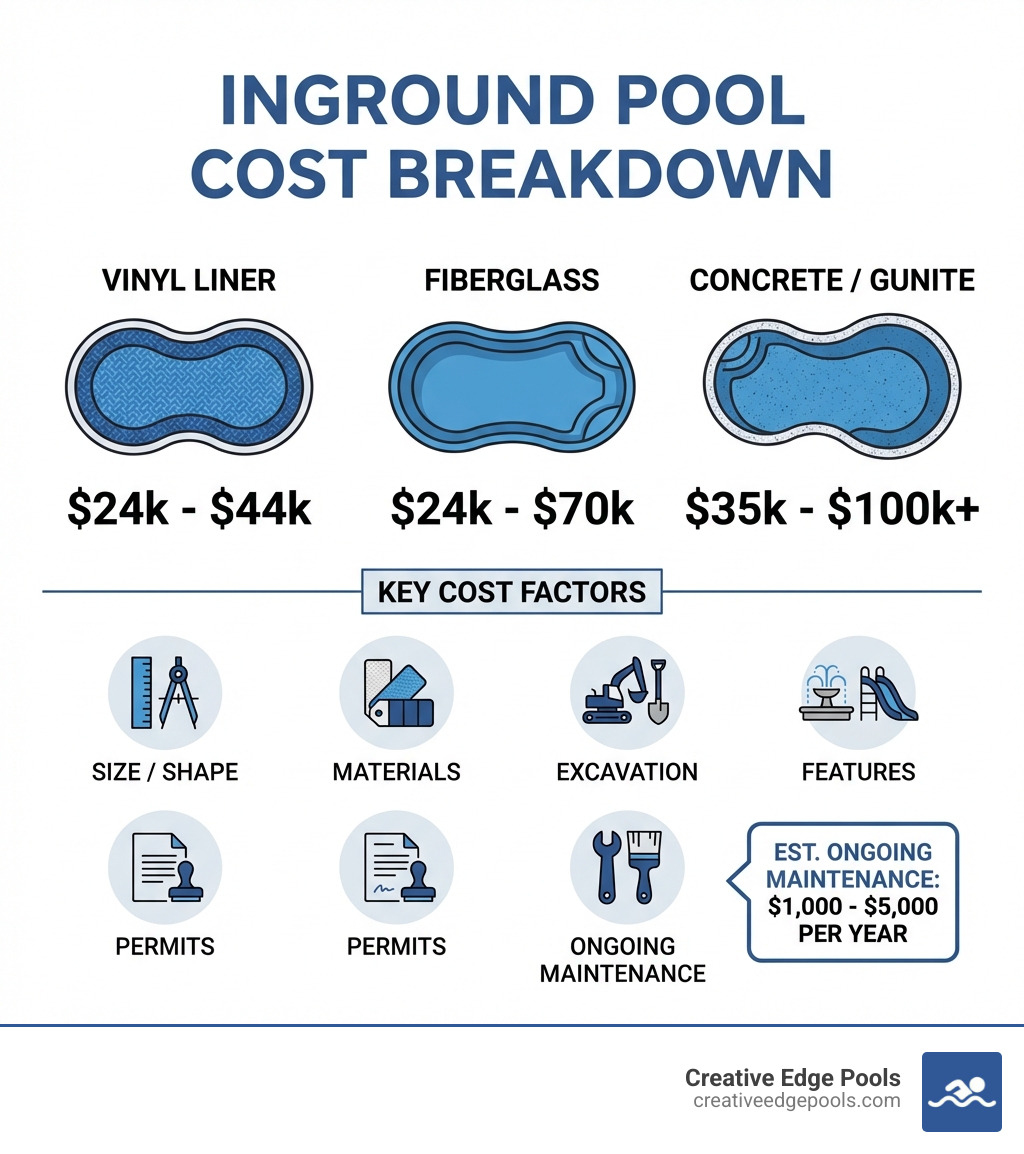
| Vinyl liner (inground) | $24,000 – $44,000 |
| Fiberglass (inground) | $24,000 – $70,000 |
| Concrete / Gunite (inground) | $35,000 – $100,000+ |
| Custom gunite (New England) | $90,000 – $180,000+ |
Note: In Eastern Massachusetts and Southern New Hampshire, expect to pay a 15-25% premium over national averages due to higher labor costs, site conditions, and permitting requirements.
For most homeowners, a backyard pool is one of the biggest investments they’ll make in their property. It’s not just a place to swim — it’s where summers happen, where kids grow up, and where the value of your home can climb.
But the price tag can feel like a puzzle. You’ll see numbers ranging from $25,000 to well over $150,000, and it’s hard to know what’s driving that gap.
The truth is, no two pools cost the same. The final number depends on a web of factors — the type of pool, your yard’s soil and slope, the features you choose, and who builds it.
This guide breaks all of that down clearly, so you can plan with confidence.
Factors Influencing the Total Cost for Inground Swimming Pool Projects
When we sit down with families in places like Andover, MA, or Nashua, NH, the first thing we look at isn’t just the pool itself, but the land it’s going into. The environment plays a massive role in your final quote.
Site Accessibility and Soil Conditions
If our excavators can’t easily get into your backyard, the cost for inground swimming pool installation goes up. Small side yards or steep slopes require specialized, smaller equipment that takes longer to move dirt. Furthermore, New England is famous for its “ledge” (giant underground rocks). If we hit a massive granite slab while digging in Bedford, NH, we might need to bring in blasting crews or hydraulic hammers, which can add thousands to the excavation budget.
Labor Rates and Local Permitting
In Eastern MA and Southern NH, labor rates are significantly higher than the national average. You are paying for skilled tradespeople who understand how to build structures that survive our freeze-thaw cycles. Additionally, permit fees vary wildly by town. A permit in a small NH town might be a few hundred dollars, while a complex project in a historic MA district could involve conservation commission meetings and thousands in fees. For a deeper dive into local specifics, check out our page on inground pool cost in Massachusetts.
Average Cost for Inground Swimming Pool Materials
The material you choose is the foundation of your budget. While vinyl and fiberglass are options, we specialize in gunite because it is the only material that offers a truly “lifetime” structure for our climate.
| Material | Upfront Cost | Lifespan | Maintenance Needs |
|---|---|---|---|
| Gunite (Concrete) | High ($50k – $150k+) | 50+ Years | Resurfacing every 7-10 years |
| Fiberglass | Mid ($45k – $85k) | 25-30 Years | Low maintenance, but size-limited |
| Vinyl Liner | Low ($35k – $65k) | 10-15 Years | Liner replacement every 7-10 years |
We often tell our clients that while the average price for gunite pool builds is higher initially, the value it adds to your lifestyle and property is unmatched. Gunite is essentially a steel-reinforced concrete shell that becomes a permanent part of your real estate.
How Size and Shape Affect the Cost for Inground Swimming Pool Installation
It’s simple math: more water requires more concrete, more steel, and more labor. However, it’s not just the square footage that matters; it’s the perimeter. A 20×40 rectangular pool is often cheaper to build than a smaller, “free-form” lagoon-style pool with complex curves.
- Square Footage: Most pools cost between $50 and $125 per square foot.
- Depth: Going from a 5-foot maximum depth to an 8-foot diving depth requires significantly more excavation and material.
- Specialty Shapes: Lap pools (long and narrow) or plunge pools (small and deep) have different structural requirements that can influence gunite pool prices.
Construction Methods: Pros, Cons, and Price Points
Understanding the construction process helps justify the cost for inground swimming pool projects.
Gunite and Concrete Pools
Gunite is a mixture of sand and cement sprayed through a high-pressure hose over a cage of steel rebar. This creates a monolithic (one-piece) shell.
- Pros: Infinite design possibilities. You want a built-in bar stool? A sun shelf for your lounge chairs? A waterfall that looks like a natural grotto? Gunite makes it possible. It is also the most durable option for the harsh New England climate.
- Cons: Longer installation time (often 8-12 weeks) and a higher initial price point.
The gunite pool cost in Massachusetts reflects the artisanal nature of the work. Our crews hand-shape the walls and floors, ensuring every curve is perfect before the concrete cures. This curing process alone takes about 28 days, during which the shell reaches its maximum strength. You can learn more about gunite pool construction to see why this method is the gold standard.
Hidden Expenses and Additional Installation Requirements
When budgeting, many homeowners forget the “everything else” category. The pool shell is just the beginning.
- Excavation Hauling: Digging a pool creates a mountain of dirt. If you don’t have space to keep it on-site for landscaping, hauling that dirt away can cost between $2,000 and $5,000.
- Utility Relocation: If your main electrical line or septic pipes run through the middle of your future pool, they have to be moved. This is a common “surprise” that impacts how much is an inground pool in Massachusetts.
- Drainage and Retaining Walls: If your yard has a slope, you might need a retaining wall to keep the pool level. Proper drainage is also essential to prevent rainwater from washing out your pool deck.
Electrical, Plumbing, and Filtration Systems
A pool is a living system that needs to breathe and stay clean.
- Variable Speed Pumps: These are more expensive upfront but can save you hundreds in electricity bills annually.
- Filtration: We often recommend high-efficiency sand or cartridge filters.
- Saltwater Chlorinators: While they add roughly $1,500 to $2,500 to the build, they provide a much silkier swimming experience and lower long-term chemical costs.
- Heaters: In New England, a heater is almost mandatory if you want to swim past June. Gas heaters or electric heat pumps are the most common choices.
If you’re wondering how much does it cost for a pool once you add LED lighting and automation (controlling your pool from your phone), you can expect these “tech” features to add $3,000 to $7,000 to the total.
Indoor vs. Outdoor Pool Considerations
Indoor pools are the ultimate luxury, but they come with a different set of financial rules. You aren’t just building a pool; you’re building a climate-controlled environment.
- Ventilation and Dehumidification: This is the biggest expense. Without a heavy-duty system, the moisture from the pool will rot the structure of your home.
- Structural Engineering: Indoor pools often require deeper foundations to ensure they don’t affect the house’s stability.
Luxury Features and Long-Term Ownership Costs
This is where a standard pool becomes a personal resort. Luxury features can easily double the cost for inground swimming pool projects, but they also provide the highest “wow” factor.
- Infinity Edges: These require a second “catch” basin and extra pumps to create the illusion of water vanishing into the horizon. Expect to add $20,000+ for this feature.
- Tanning Ledges (Sun Shelves): A shallow area for umbrellas and chairs. These are very popular and relatively affordable additions during the initial gunite pour.
- Automatic Covers: These are fantastic for safety and heat retention. In our region, they cost between $10,000 and $20,000 but can pay for themselves in energy savings.
That while these features increase the pool renovation cost down the road, they also significantly boost your home’s appeal. According to the National Association of Realtors 2023 Remodeling Impact Report, an inground pool can add substantial value to a home, sometimes recovering more than half of its cost in equity.
Maintenance and Running Expenses
Owning a pool is like owning a car; it needs regular tune-ups.
- Chemicals: $500 – $1,000 per season.
- Openings and Closings: In MA and NH, we have to winterize our pools. Professional service for this usually runs $400 – $800 per visit.
- Electricity/Gas: Heating a pool in a chilly New England May can add $200 – $500 to your monthly utility bill.
- Resurfacing: A gunite pool’s gunite pool resurfacing price should be factored into your 10-year plan. Depending on the finish (plaster vs. pebble), this can cost $10,000 to $20,000.
Safety Features and Decking
In almost every town we service, from Newton, MA, to Salem, NH, local building codes require a fence.
- Fencing: A high-quality aluminum or glass fence can cost $5,000 to $15,000.
- Decking: This is the “frame” for your pool. Stamped concrete is a popular, cost-effective choice, while natural stone pavers offer a high-end look and better longevity. If your deck ever looks tired, the average cost to resurface a pool deck is something to keep in mind for future budgeting.
Frequently Asked Questions about Inground Pool Costs
Does an inground pool increase property value?
Yes, especially in high-end New England markets. While you may not recoup 100% of the cost in a sale, a well-maintained gunite pool can increase your home’s value by 5% to 8%. More importantly, in certain neighborhoods, a pool is an expected feature that makes your home much easier to sell.
How long does it take to install an inground swimming pool?
For a gunite pool, the process usually takes 8 to 12 weeks from the day we start digging. This includes excavation, steel work, plumbing, the gunite pour, the 28-day curing period, tiling, and finally, the interior finish. Permitting can add another 2 to 4 weeks before we even break ground.
How can I save money on my pool installation?
The best way to save is to “build for the future.” You can have us “pre-plumb” for features like a heater or a waterfall even if you don’t buy the equipment this year. This saves you from having to tear up your deck later. Also, choosing a standard rectangular shape and a simple plaster finish can keep the initial cost for inground swimming pool installation on the lower end of the spectrum.
Conclusion
At Creative Edge Pools, we know that building a pool is a dream decades in the making for many families. As a family-owned business with over 100 years of combined experience, we’ve seen it all — from complex backyard transformations in Boston to sleek, modern escapes in Southern New Hampshire.
We don’t just build pools; we build the backdrop for your family’s best memories. Whether you’re looking for a simple place to cool off or a full-scale luxury environment with waterfalls and custom lighting, we’re here to bring your vision to life with the durability that our New England climate demands.
Ready to take the plunge? Start planning your project with our Inground Pool Cost Guide and let’s build something incredible together.